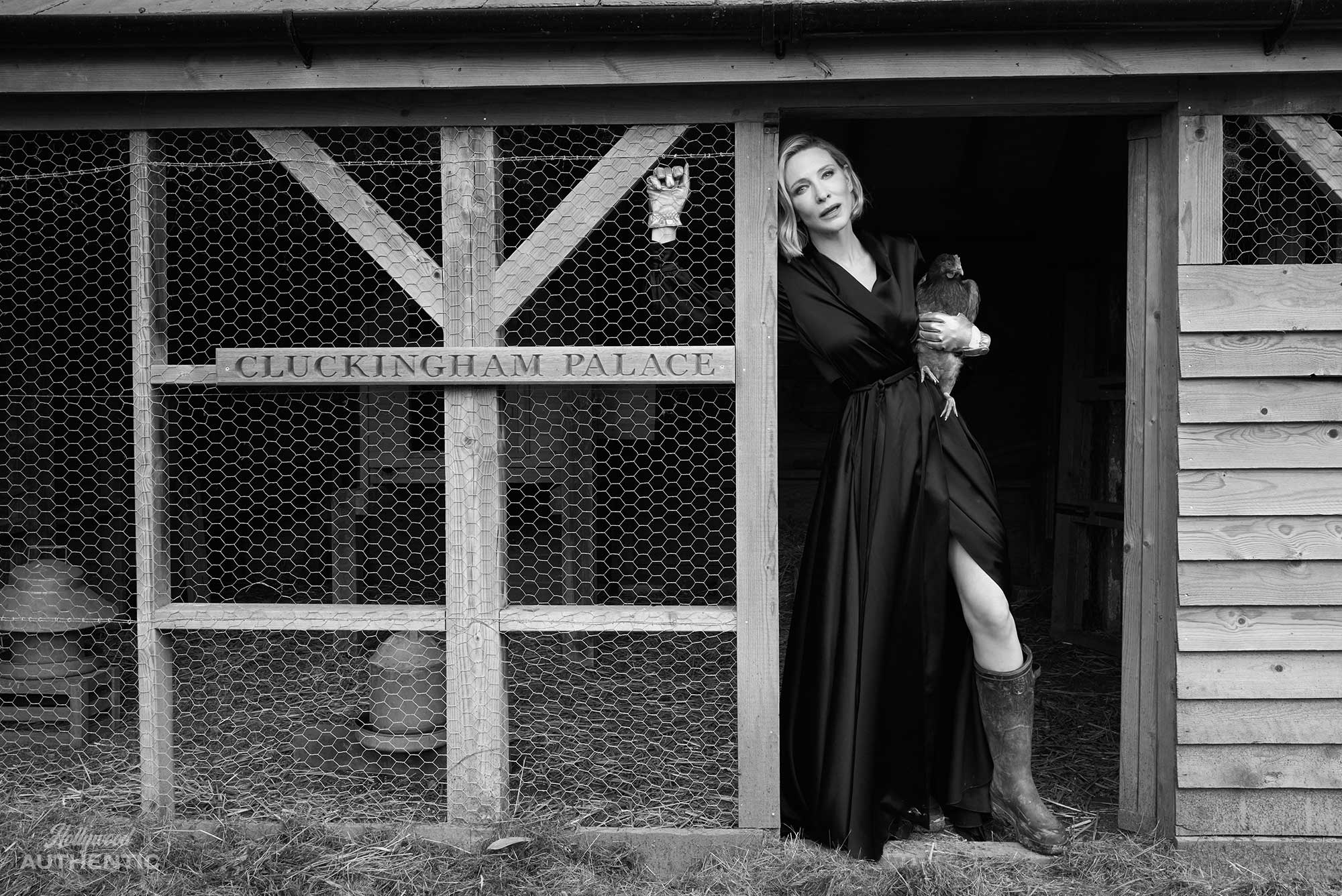
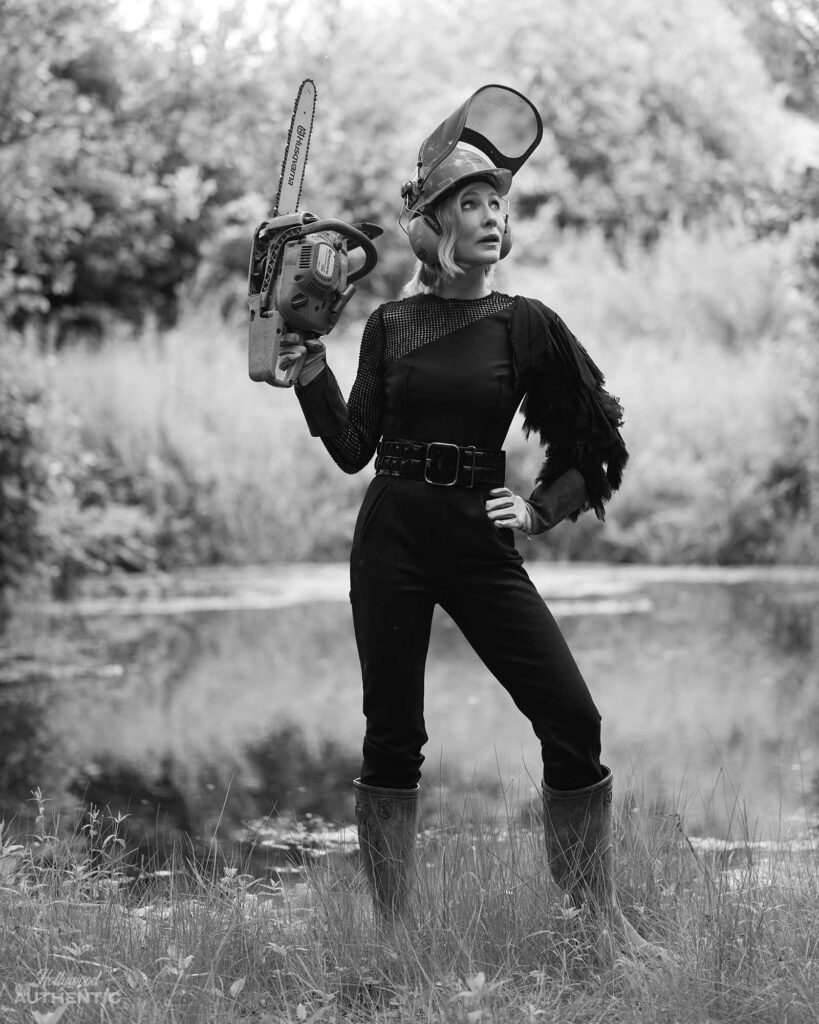
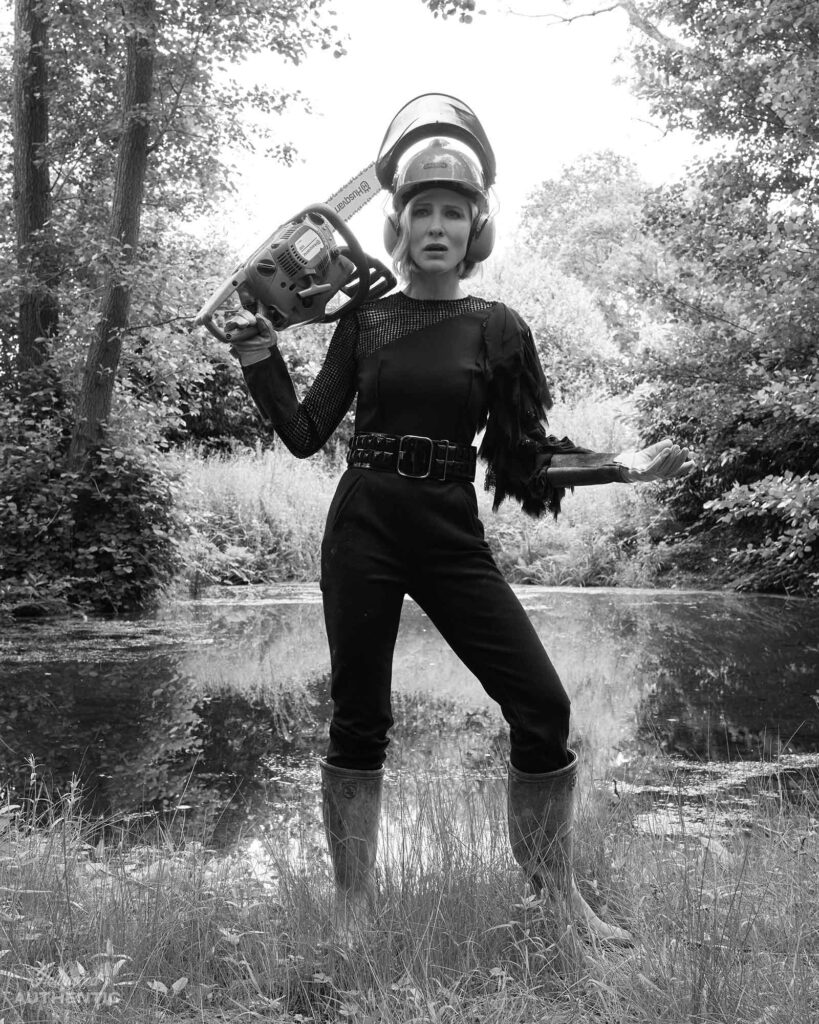
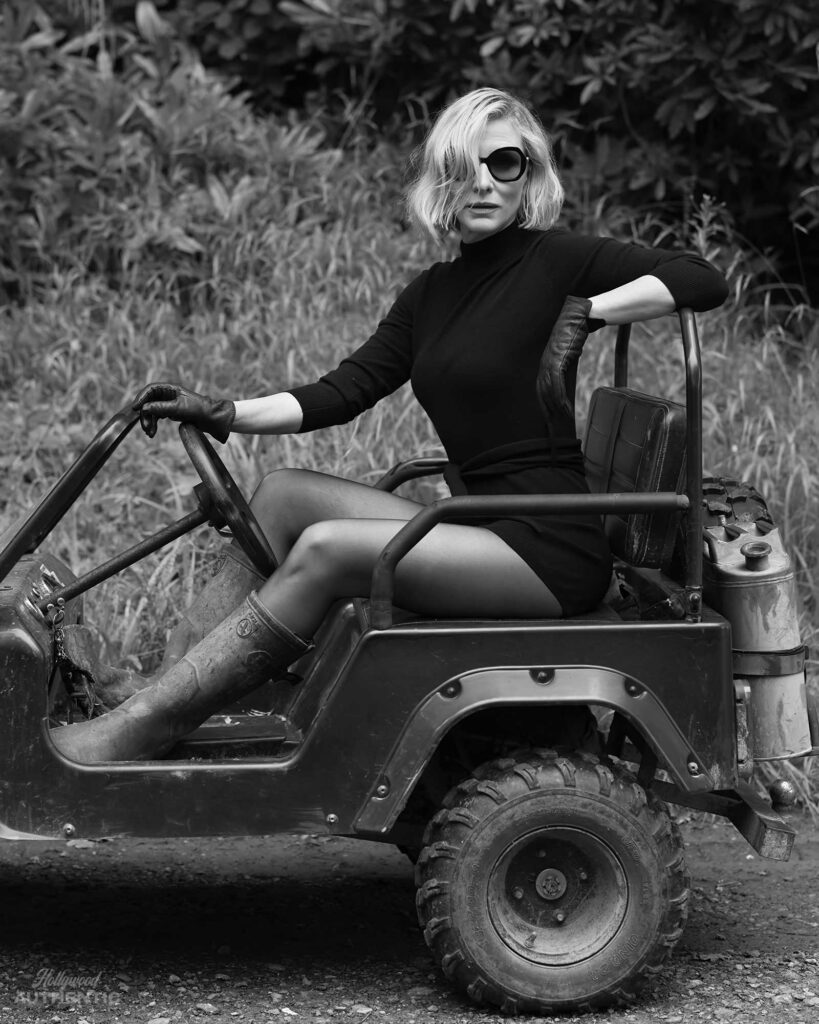
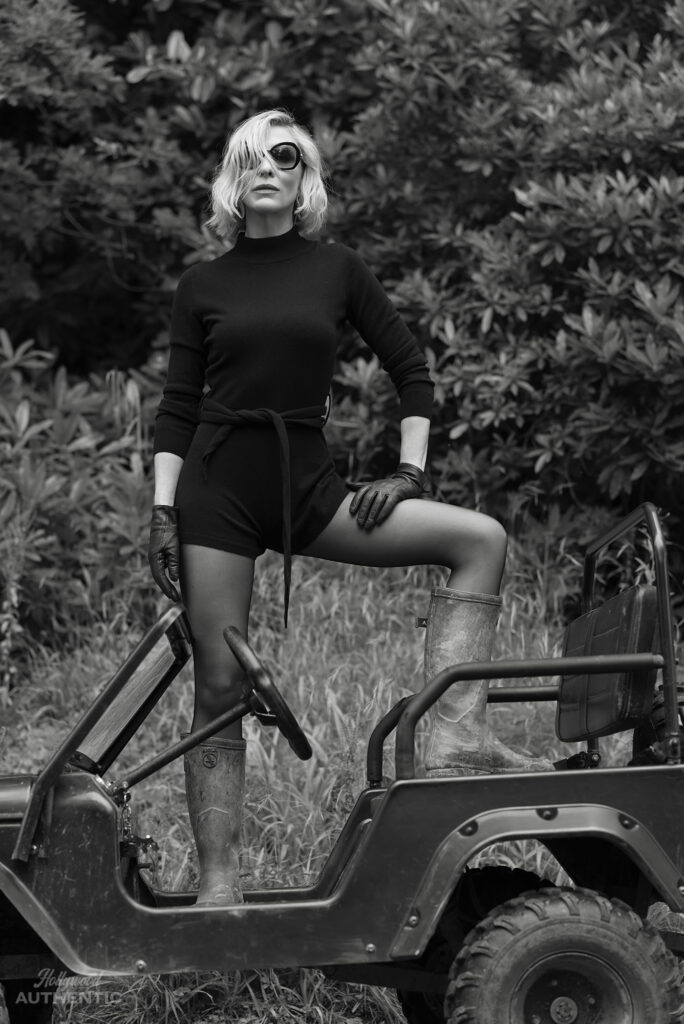
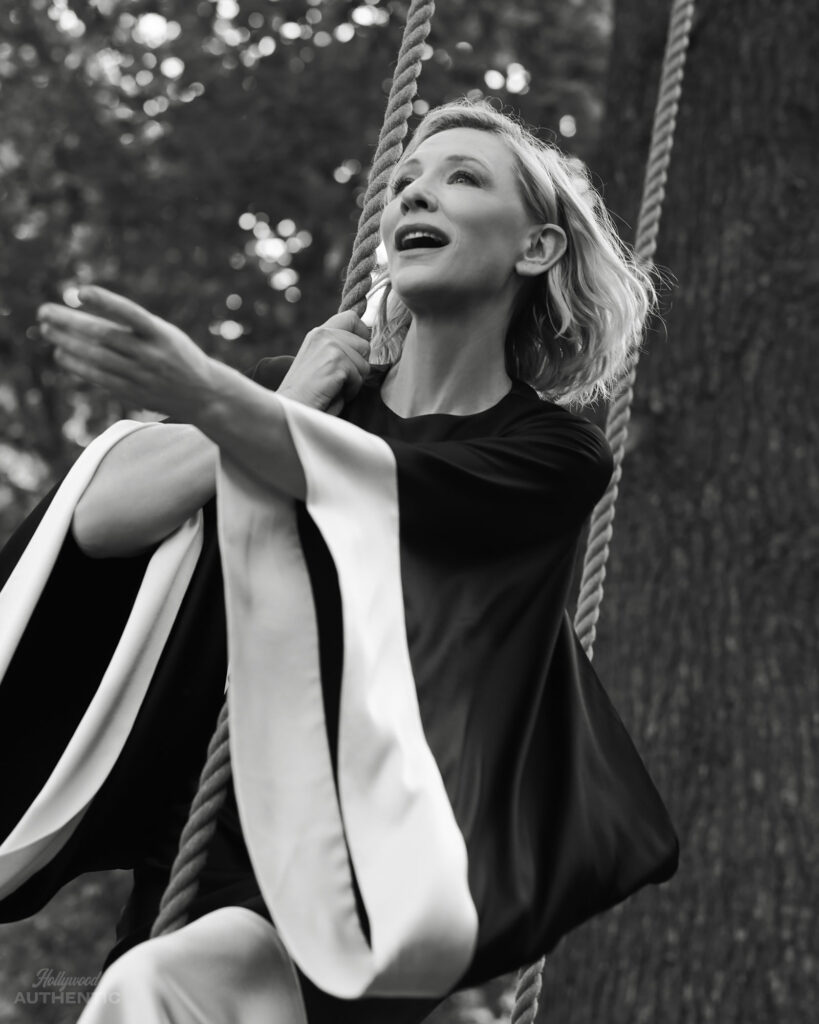
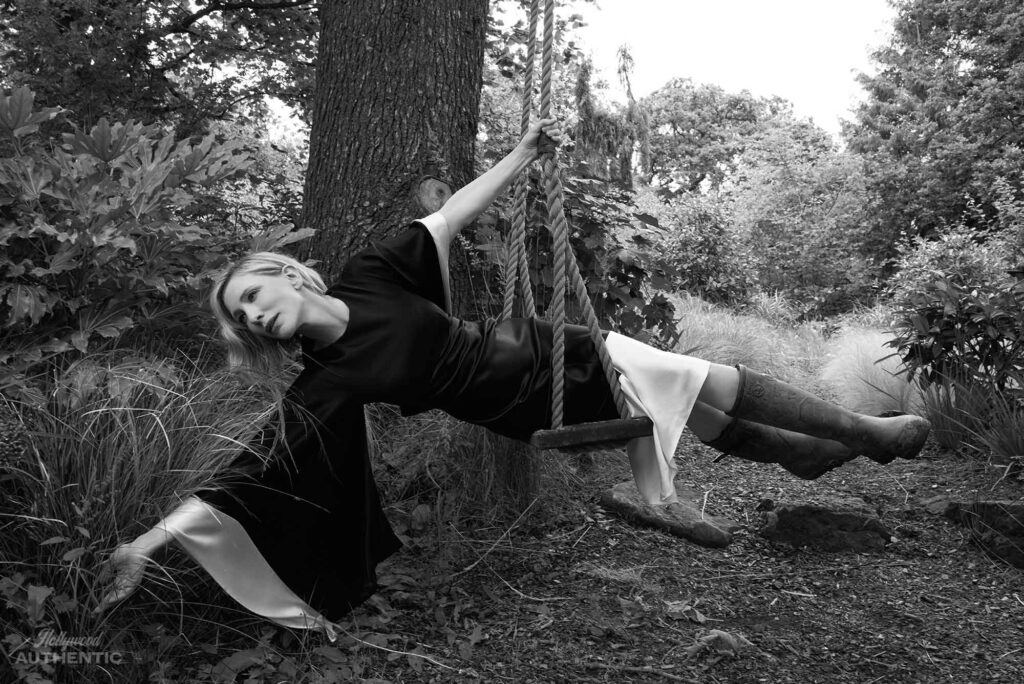
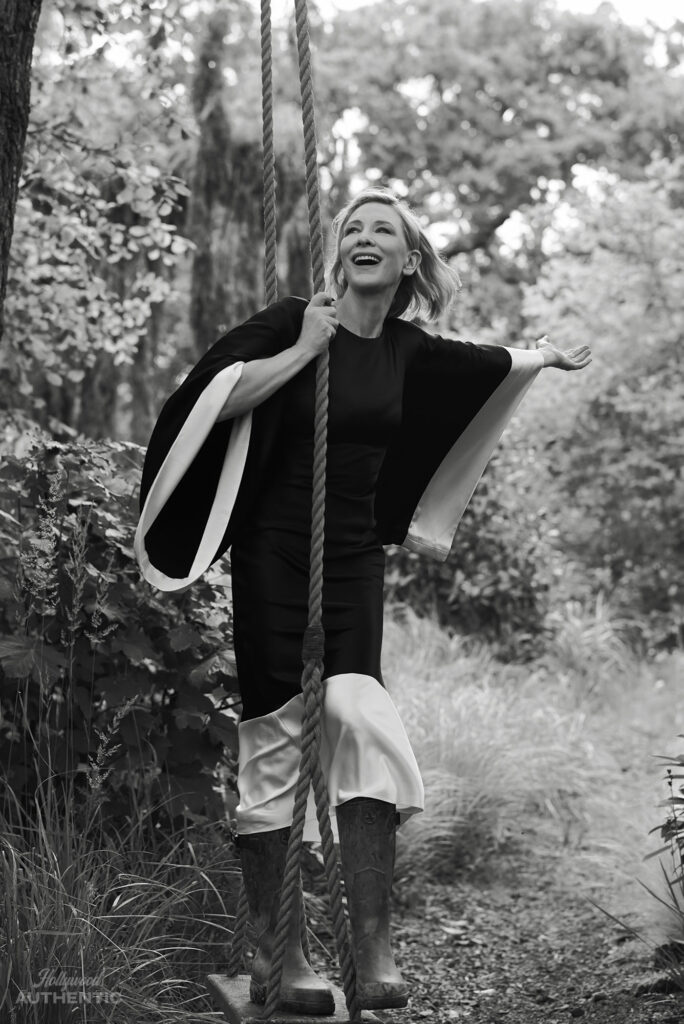
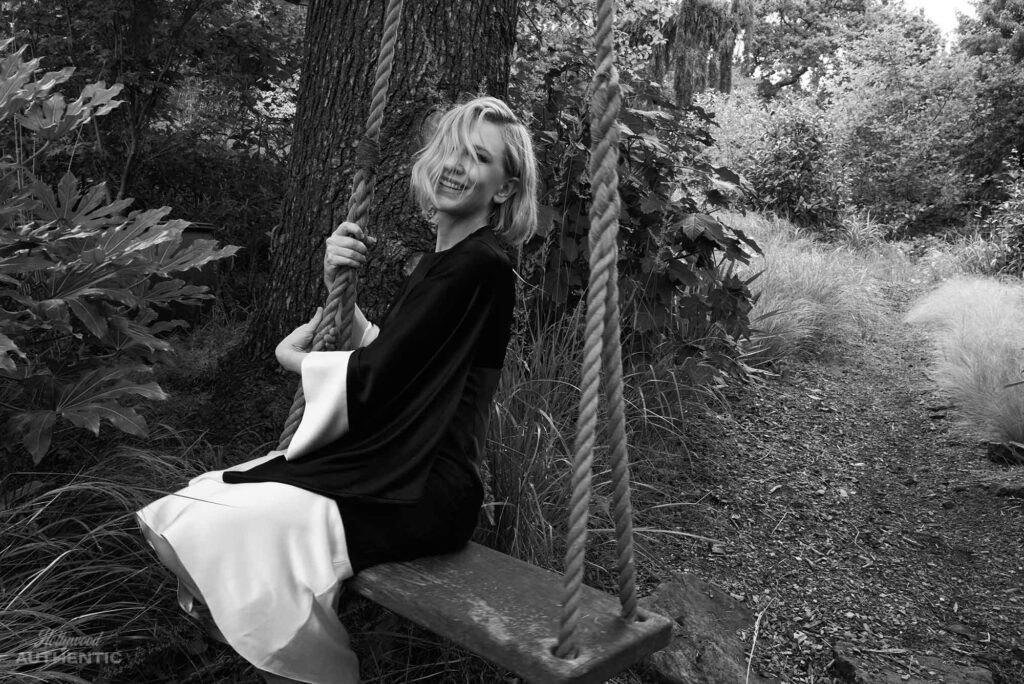
In 2020, Cate Blanchett and I sat in the back of a car at a locked-down Venice Film Festival – where she was president of the jury – and discussed the idea I had for a magazine. She suggested a shoot with her chickens and I imagined what that would look like on the cover of Hollywood Authentic.
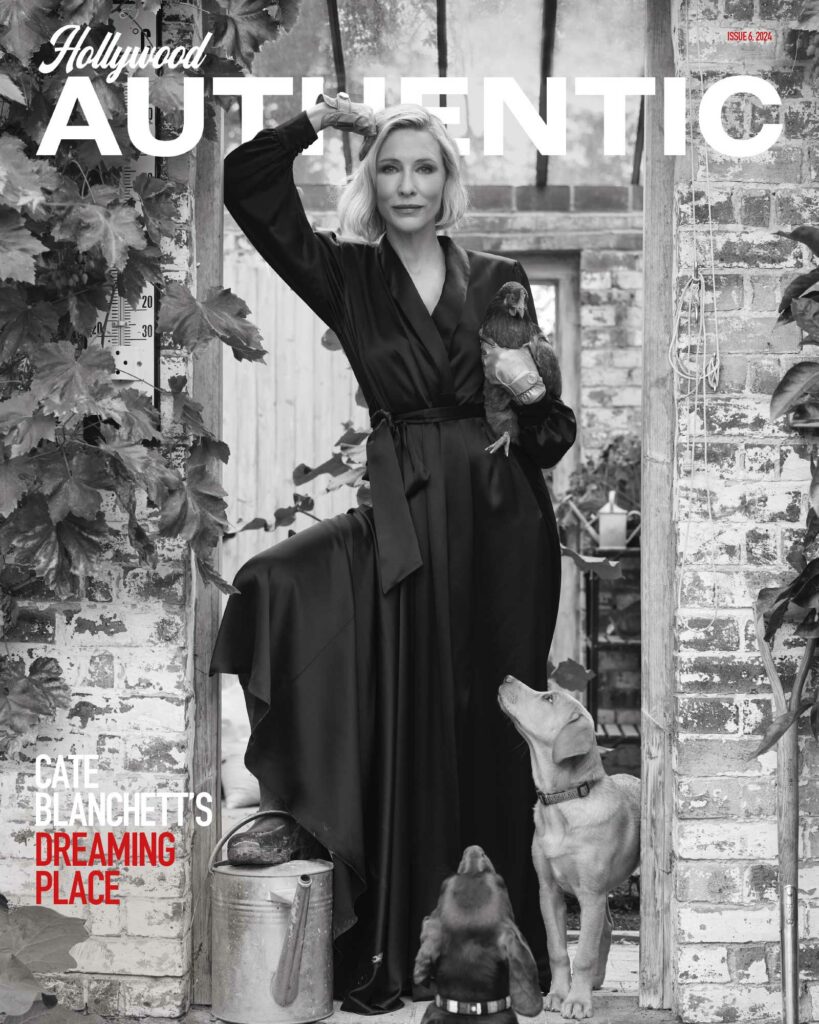
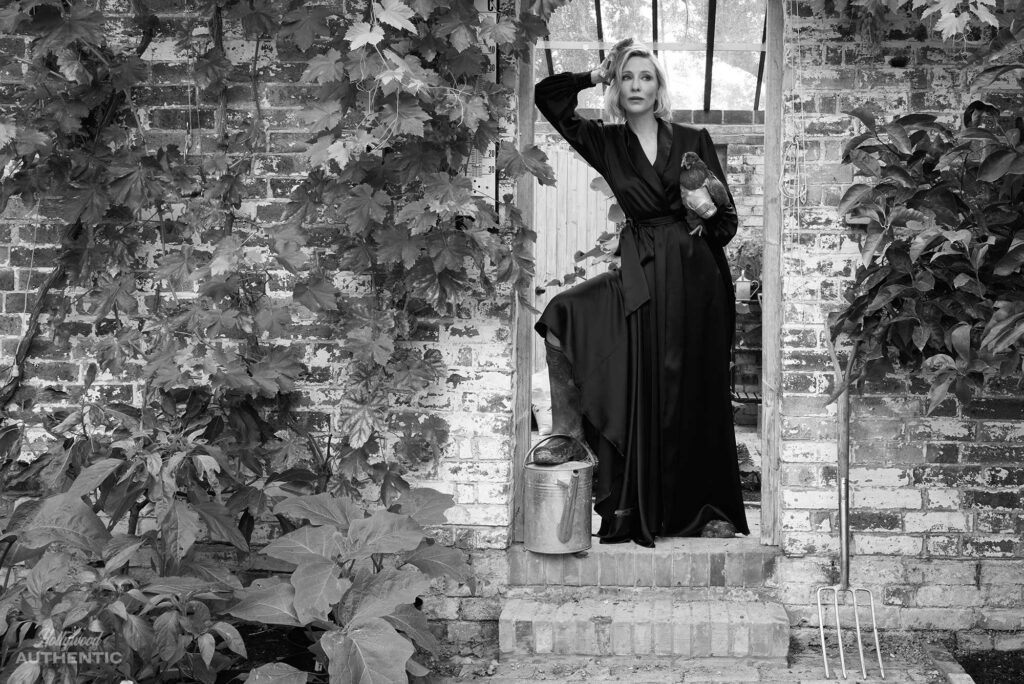
It was 2022 when we published our first issue; Sean Penn kindly agreed to be on our cover. Since then, I’ve continued to imagine that shoot with Cate and her chickens. Six months ago, my wife Daisy designed a gown inspired by Lauren Bacall in The Big Sleep for our fledgling Hollywood Authentic clothing range. We knew who we wanted to see in it and announced to the team that our dream was that Cate would wear it in a pair of muddy wellies holding a chicken in her potting shed. We got on with manifesting it. Fast forward to a serendipitous encounter at Glastonbury and hey presto…
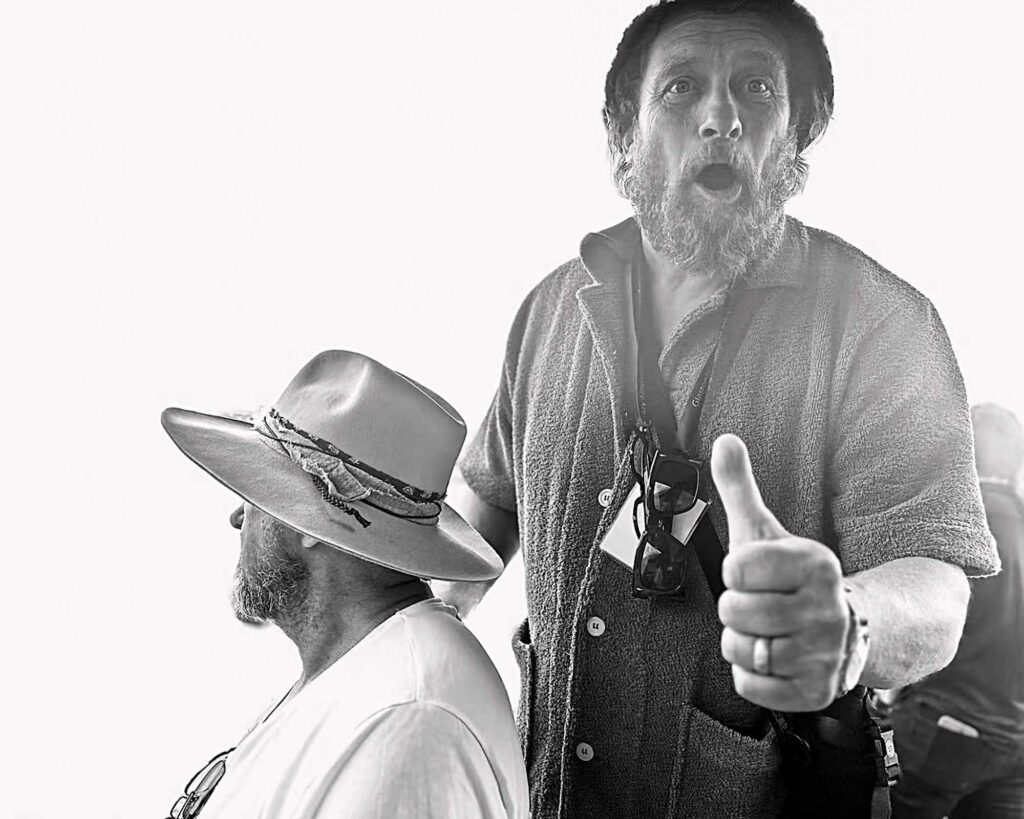
Greg Williams and Andrew Upton by Cate Blanchett
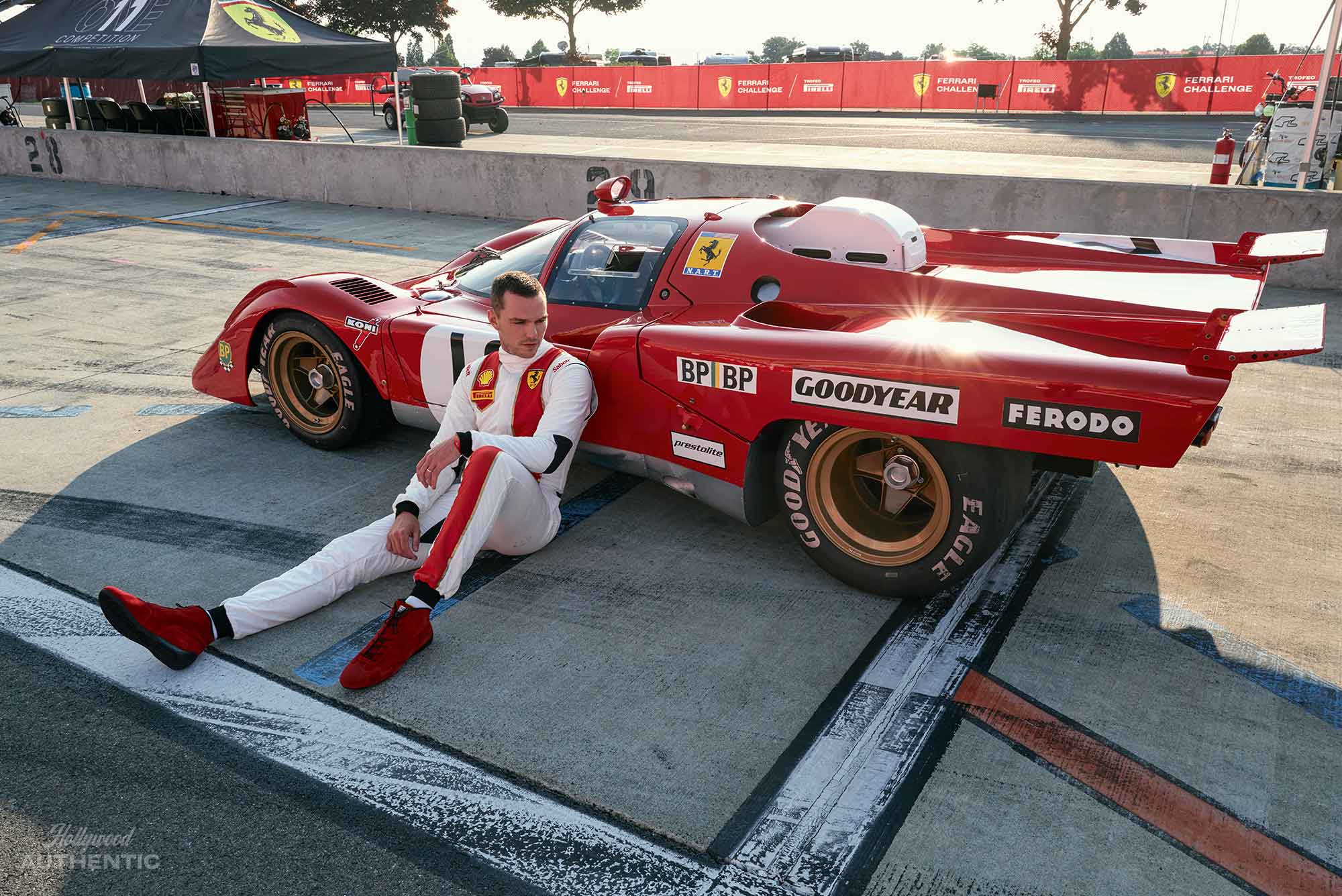
This issue represents another example of artists showing their generosity in inviting me into their lives to show an unseen side of themselves. Generosity and motion is what links all our subjects in this issue; they’re driving kid’s electric jeeps (Cate), vintage tractors (Josh Hartnett) and Ferrari race cars (Nicholas Hoult) while talking about what propels their passions and careers.
For this issue we also invited more collaborators into the Hollywood Authentic family. I met portrait photographer Charlie Clift at BAFTA a couple of years back and was immediately impressed by his work – he captures Lennie James for “a little nonsense”. We’re also thrilled to have Stephen Merchant guest-write his love letter to a Hollywood classic, Double Indemnity. Our now regular contributors are back: Gary Oldman and Gisele Schmidt write about the work of legendary Hollywood photographer Sam Shaw, Abbie Cornish gives us a review of Toronto Mexican restaurant Quetzal and Arianne Philips interviews veteran costume designer Albert Wolsky. Mark Read is also back turning his masterful lens to the Marin County Civic Center.
We’ve come full circle from that chat in Venice 2020 as we bring this issue to Venice 2024. I can’t wait to see what we take to the floating city in years to come…
Photographs and interview by GREG WILLIAMS As told to JANE CROWTHER
Cate Blanchett loves her chickens. Today, she is gently hypnotising one in her potting shed. She’s never done it before but is following instruction on the art by director and friend John Hillcoat. Cate is stroking her feathered friend and gently guiding its vision from its beak to her gloved finger as she sits on a doorstep dressed in muddy wellies, a black silk gown and leather gloves. The chicken relaxes as she soothes and is soon so chilled that she can carefully place the bird on its side, where it lays motionless. ‘I’ve fucking done it!’ Cate whispers in astonishment.
It’s hardly surprising that Cate can achieve such a feat. She has been an incredible artist since I first met her on Elizabeth when we were both at the relative start of our careers in film. Since then, she has taken on historical royalty, real-life war reporters, narcissistic conductors, intergalactic baddies, Middle-earth elves, Old Hollywood stars and iconic folk musicians in her three-decade career, during which we’ve collaborated many times. A performer open to experience and hungry to explore, Cate is always creative – whether that’s being playful in Piazza Navona on set of The Talented Mr Ripley, jumping in a bath in LA to pretend to use the showerhead as a telephone, donning her face mask to execute a perfect silhouette (and make a statement) in Covid-times Venice, or agreeing to stand on a Roosevelt Hotel fire escape just before the Oscars where she was nominated for Tár to capture the best light – and losing an unimaginably expensive borrowed diamond earring in the process, which was recovered five flights down. My heart was in my mouth for the minutes it took to find it! Twenty-seven years on, we bumped into each other at Glastonbury, where Cate generously invited me to her chicken shed to shoot our cover.
After finishing shooting Black Bag with Steven Soderbergh, she is about to set sail to promote her latest role as a space renegade in game-turned-movie actioner Borderlands, as well as her autumn Apple+ TV series, Disclaimer. Directed by Alfonso Cuarón, it features her as a documentarian who finds the tables turned on her and will premiere at the Venice Film Festival. Then there’s Rumours, in which she plays a fictional German chancellor at a G7 meeting that goes weirdly awry in the woods. It’s a typically varied slate that shows Cate’s appetite for exploration, but right now she has found time to play in the vegetable garden. She leads me into the rambling back yard – the chicken has shaken itself off and pottered away back home to the chicken coop labelled ‘Cluckingham Palace’ that it shares with six other chickens. Cate is hoping for baby chicks soon from two broody birds snuggled in their nests.
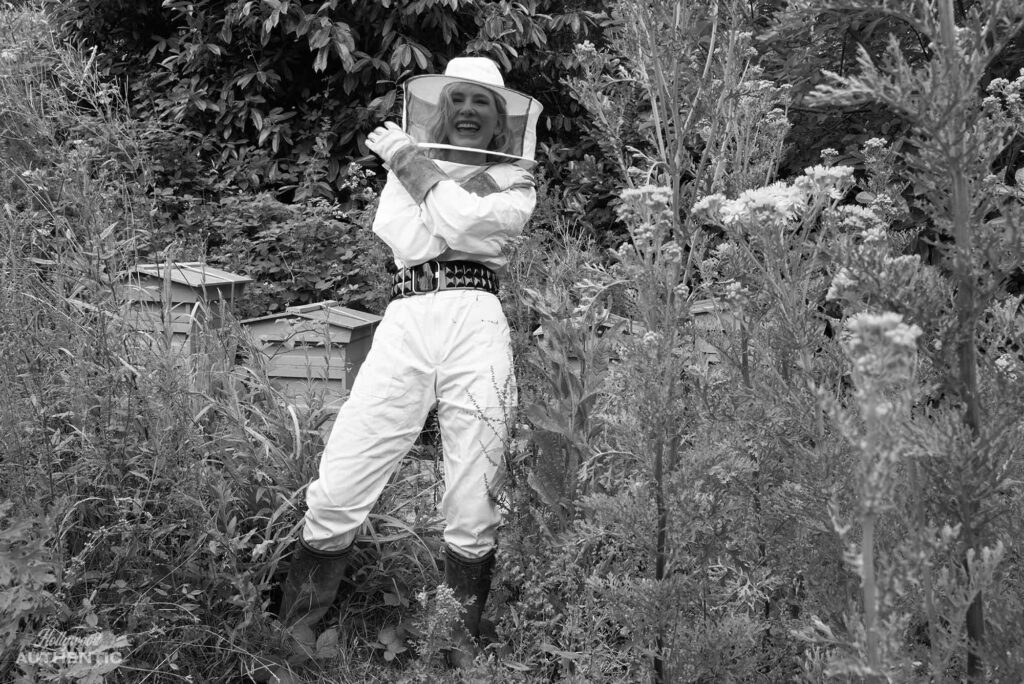
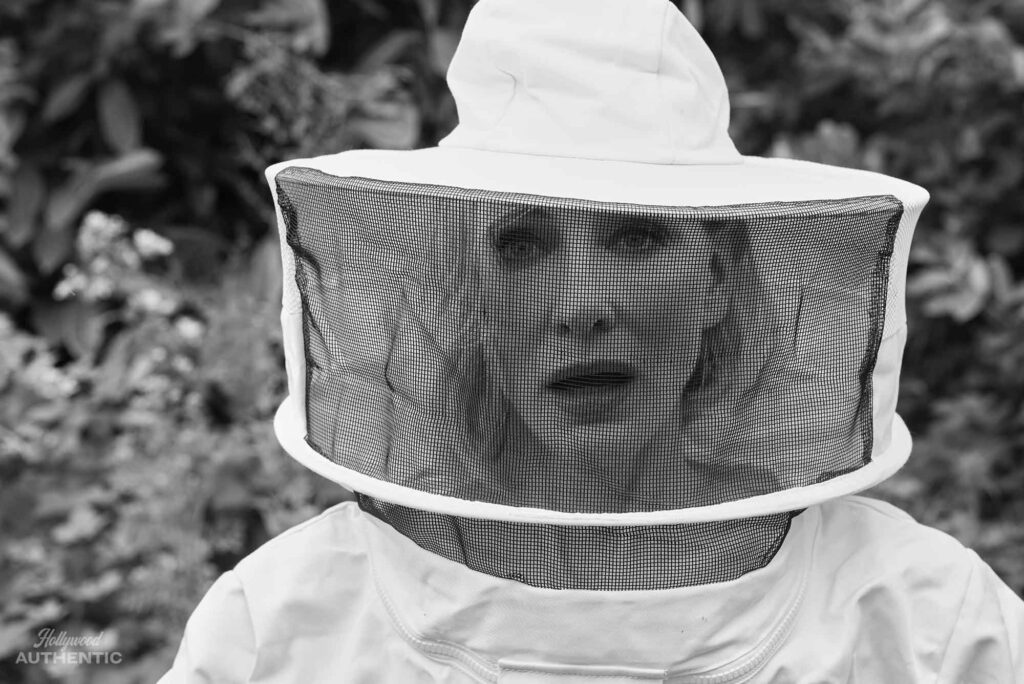
Deep in the garden, in a tangle of trees and verdant plants, are a set of active hives that provide lavender-flavoured honey. ‘We’ve always wanted to have bees,’ Cate says as she swaps her silks for protective wear to inspect the apoid workers. ‘We’ve had bee bricks in the city, for orphan bees or solo bees. But the idea of having hives… I’ve become obsessed because about 20 years ago on the cover of Time magazine, there was genuine full-on panic about how pesticides were killing off the bee population, and the enormous knock-on effect of that. It was an exploration of how fragile bees are as an insect species, and as the major pollinators they are, how deeply we rely on them. It really activated me, environmentally – and engendered big-sky thinking. The change in the taste of the honey reflects the change of their environments. It’s fascinating.’
As she carefully peers inside the hive, she tells me how she lost a colony to hornets last year, so had to invest in paper imitation wasp nests to hang in the trees. I ask her if it’s hard to leave the garden when she has to go away to work for months at a time. ‘Don’t you think, when you’re away, it helps to have a “dreaming” place?’ she asks. ‘A point of physical connection?’ She considers the question as someone who travels extensively for work. ‘Is it hard to leave the weeds?’ she jokes. ‘Actually, can I say: weeding is deeply therapeutic. My grandmother, who lived with us, and helped raise us after my father died, was an avid gardener but hated weeding. So she hired a gardener. His name was Mr Crutchett and he used to sing these beautiful songs, and just sit on his rear end, all day, pulling weeds in our garden. I think he was serenading my gran who he had a crush on. And he was the happiest man I’ve ever met. You don’t have to make headway in the garden – I humble myself and say, you know, “One weed at a time”.’
The fact that I even got the chance to make a film was extraordinary to me. I never expected to leave the shores of home to play the Queen of England
We leave the woody dell and Cate is driving a tractor as we discuss our first meeting, on set of Elizabeth, a star-making role that gave her her first Oscar nomination. ‘If I knew it was going to be a big moment, I would have collapsed under the weight of the pressure,’ she recalls. ‘I kept saying Judi Dench, Flora Robson, Glenda Jackson – I mean, what can I possibly add to the conversation? And the fact it was Shekhar Kapur – a director from Bollywood, and I was from the Antipodes; from the colonies – only exacerbated my hubris. These two outliers were looking at Elizabethan history, which is a period where so much of the English dream time comes from. Who did I think I was? The chutzpah. I think the only way I coped was the fact that I thought: “This is both the beginning and the end of my career.” I honestly thought, “This is it, so I may as well enjoy it.” I think that was the moment where I learned to flip terror and anxiety to excitement. They’re very similar energetic forces. People often ask “What would be the advice you’d give to your younger self?” I’m always really reticent to give people advice because mistakes are so important, and I’ve certainly made a lot of them.’ She pauses for a moment. ‘But honestly, as one gets older, the advice is think quicker. Do it quicker.’ Quicker? I ask. I imagined she’d say slower. ‘No,’ she says. ‘Live more slowly, think more quickly. Don’t overthink.’
I’m always really reticent to give people advice because mistakes are so important, you know? And I made a lot of them
Who did she look up to as inspirations back then as she tried to build her career in what she describes as a sort of ‘survival mode’? ‘I grew up in this incredible golden age of Australian cinema. We had Jack Thompson, Judy Davis, Mel Gibson, Bruce Beresford, Peter Weir, Gillian Armstrong and then Nicole Kidman went and forged a career, which was extraordinary, in America. But I was never that girl. So the fact that I even got the chance to make a film was miraculous. I never expected to leave the shores of home to play the Queen of England.’ It wasn’t the end of her career, obviously.
As she amassed more work in the likes of The Talented Mr Ripley, The Lord of the Rings trilogy, Veronica Guerin and The Aviator, Cate admits : ‘You hone your instincts, and you learn to trust them. There are times when one doesn’t trust – I mean, the times when things have gone a bit cattywampus are the times when I’ve not trusted my instincts.’ Cattywampus? Does she really use that word? ‘You don’t use that word? Everything’s akimbo. All screwed up. Back to front. I am sure it’s in the dictionary.’ She laughs. ‘Surely Hollywood Authentic is cattywampus?!’
We walk to a nearby swing hanging from a tree and as she twists the rope and allows it to unfurl, she spins as we discuss inspiration. I have a preoccupation with ideas and the notion of where they come from, and I naturally want to hear Cate’s take on it. ‘It’s elusive and it never comes from the same source. If it came from the same place, creative flow would be easy, wouldn’t it?’ she says. ‘Inspiration, for me, arises from unexpected places. Sometimes it’s a snippet of conversation, a snatch of someone else’s conversation that you overhear, or sitting in cold water, or actually tuning in to the sounds immediately around you or the music of others… And I think probably a lot of the time it comes in that – and I hate this word because it’s so overused – liminal space between wakefulness and sleep. You know, that glorious moment just as you’re waking, and coming into consciousness. Hopefully it’s not in a gutter, it’s in your own bed!’
Inspiration also comes from being open to receiving, she says. ‘I’ve had experiences on stage where there’s energy coming from the audience, and from the other actors, and from the text – there’s something that just erupts out of this intersection, that none of you can name, and you don’t quite know how it came or what it means and it’s absolutely thrilling. I think it’s probably the feeling that people get when they bungee jump. You intellectually know the sequence of events, but, once you’re in the middle of it, it’s happening to you, and through you, and you just have to flow with it. I’m deeply uncool. I can’t surf, and I can’t play pool. But I imagine if you hit the ball in that spot, or you catch the wave, it’s similar to being on stage. You can rehearse and prepare for this but if you take flight it’s a collective experience that is about connecting to the present moment with radical openness. It’s not something you can ever plan your way into.’
The hoping for such lightning to strike must be something of a rollercoaster. Cate nods. ‘I think it’s why a lot of people who live creative lives develop a superstitious relationship to the work: “Well, this time, the muse won’t visit me. It won’t happen unless I do x, y and z to control the conditions.” For me, personally, it’s important to have a life in parallel that’s as rich as the work, and totally antithetical to the work. I’m not living my life to work. I try not to think about where ideas come from. You only think about where they come from when they’re not coming. And that’s why it’s always better to work with people who are far more interesting than you are, and more skilled than you are.’
I’ve had experiences on stage where there’s energy coming from the audience, and from the other actors, and from the text – there’s something that just erupts out of this intersection, that none of you can name, and you don’t quite know how it came or what it means, and it’s absolutely thrilling
Cate has collaborated with numerous skilled artists during her career – from Martin Scorsese, Anthony Minghella, Jim Jarmusch and Peter Jackson to Sally Potter, Gillian Armstrong, Wes Anderson and Todd Haynes. Does she ever look back at her work? ‘I think it’s challenging working in a very concrete medium where the object remains – fixed, static, finite. If you’re a plastic artist, or you work in film, there’s an object; a product that can be held, and it’s finite. But the experience is not finite. It slips through your fingers, and you have to let it go. So I don’t revisit those objects because it’s not useful. It’s like the memory of a moment or the memory of a song over time. The memory of anything can become more powerful than the thing itself.’
Those sorts of memories are produced nightly in the theatre, she says. ‘The audience warms this circle with you, and they produce, for that moment, this miniature zeitgeist – and then it’s gone. Increasingly I am drawn to those more ephemeral artforms that don’t leave a “product”, but they leave some sort of ephemeral residue between people.’
The characters and projects she inhabits leave their mark on her too – she admits that she doesn’t feel she ever leaves a character fully behind. ‘It’s like those conversations that are late-night, and protracted, and somewhere they lodge deep within you, in a way that you can’t necessarily consciously recall them. It’s like all the relationships or friendships or encounters, positive or negative, that you’ve had – they will come back to you in some way. They will keep returning to you. You view the world through the prism of the conversation – the creative conversation that you’re engaged with. So you’ll hear words. You’ll hear phrases. You’ll see gestures. You’ll hear music that all connects to the project. That leaves you. That obsessive thing leaves you. But the residue – the glorious unfolding residue – of it, never leaves you. I am eternally grateful for that.
‘It’s like reading a really, really terrific book,’ she explains. ‘You’re inside. You’re with the novelist. The author locking arms with you, going on a long walk. I don’t know about you, but when I get to the end of such a book, and I realise there’s only three pages to go, I have a bittersweet melancholy as every word, every phrase – you are inching closer to the end of something. But that story doesn’t ever leave you. But you try and recall the book – in all of its particulars, in all the order it happens… for me, it becomes a jumble. What seems so linear and clear when you’re in the middle of it creatively – you can put all the pieces together – it shatters and fragments. And if you try and put it back together, and replicate it, you know, to do the metaphorical sequel – it’s a disaster.’ She smiles. ‘You’ve got to say, “This is fragmentary, and I’ll remember it as I do, or not. Maybe I’ll forget…”’
Borderlands is in cinemas now.Disclaimer premieres at the Venice Film Festival and hits Apple TV+ in the autumn. Rumours is in cinemas later this year. Black Bag follows in early 2025
Lorem ipsum dolor sit amet, consectetur adipiscing elit. Ut elit tellus, luctus nec ullamcorper mattis, pulvinar dapibus leo.Lorem ipsum dolor sit amet consectetur adipiscing elit dolor
Photographs, interview and video by GREG WILLIAMS As told to JANE CROWTHER
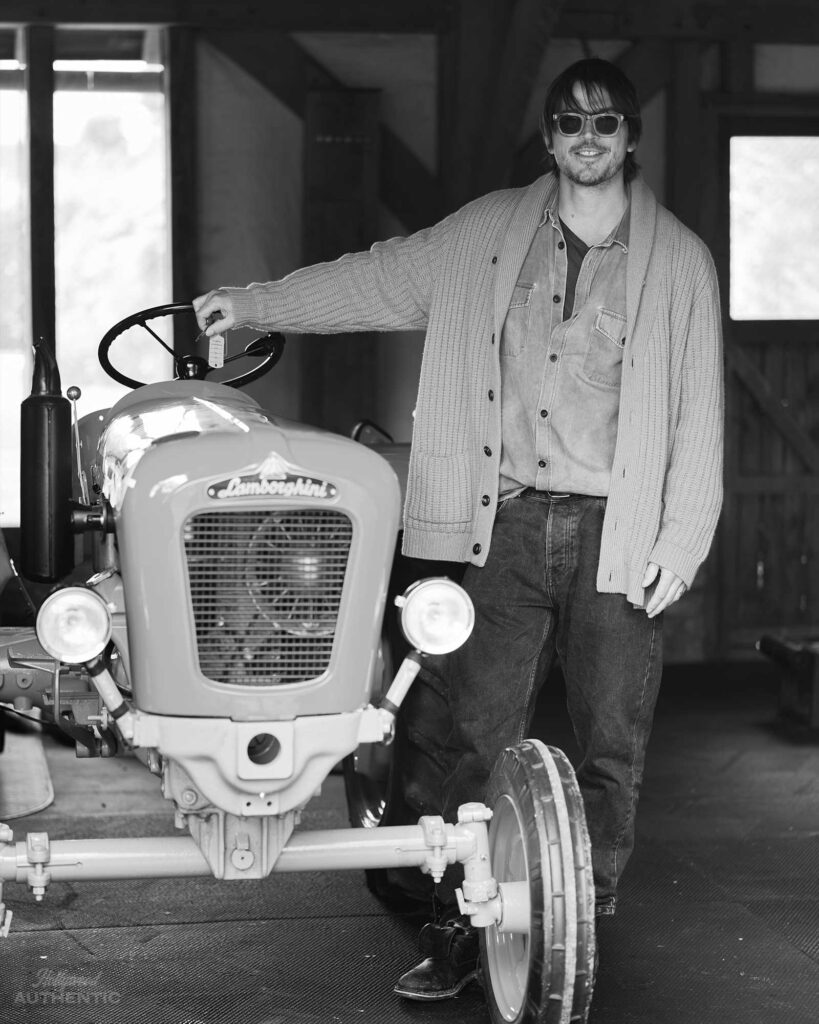
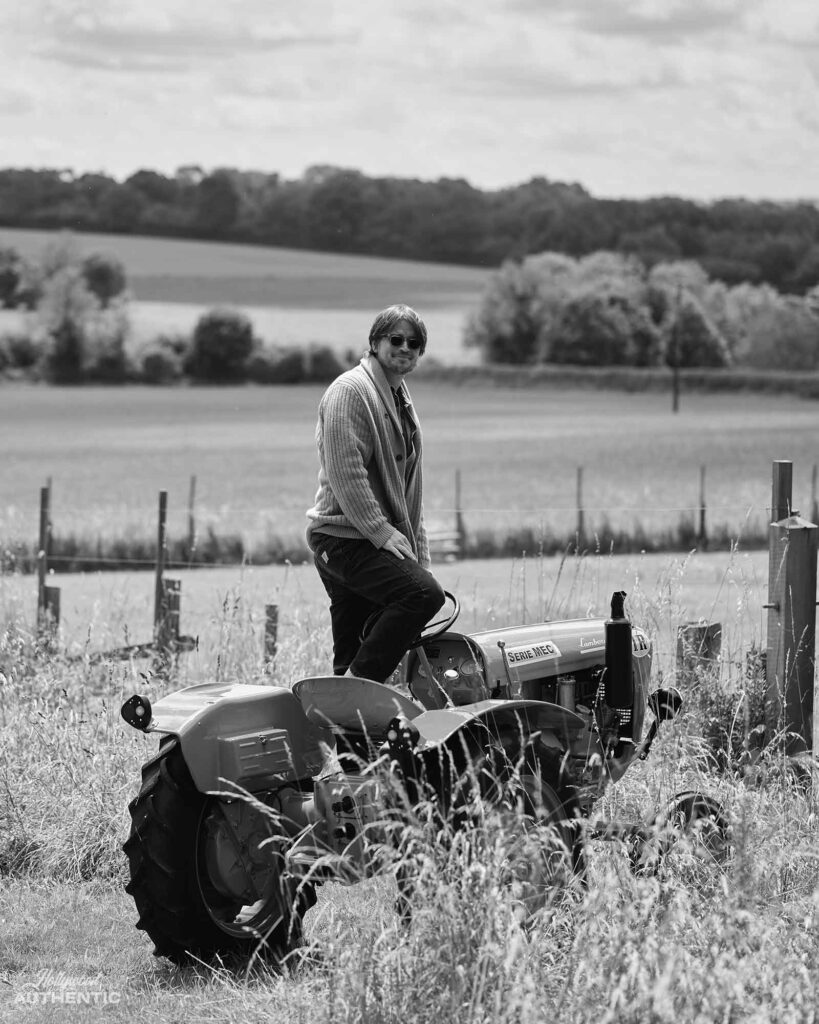
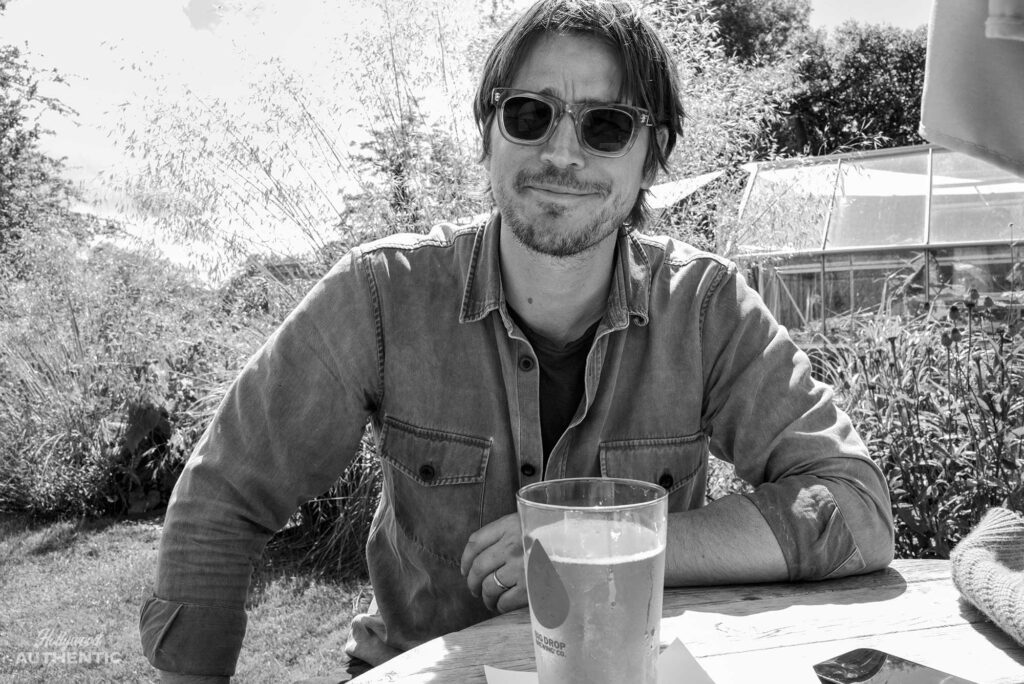
Josh Hartnett may reject the idea of being a ‘movie star’ but he does have a Lamborghini stashed away in the barn of his English country home. A vintage model that he’d dreamed of owning and managed to snag at auction, she’s a 1965 blue-and-orange machine that he calls ‘The Beast’. And she does a top speed of just 5mph. ‘I feel like a very budget Steve McQueen,’ he laughs as he unveils his restored Lamborghini tractor and strokes the polished metalwork. ‘He would be leaning on his Ferrari, and I’m leaning on my tractor…’
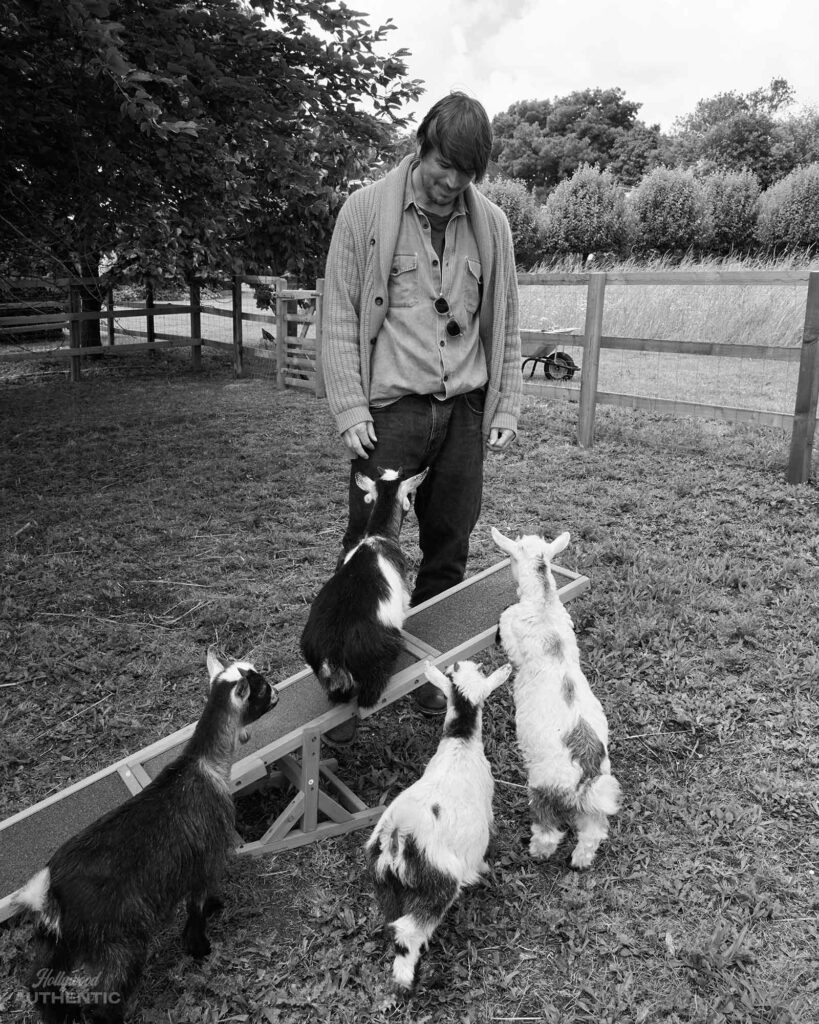
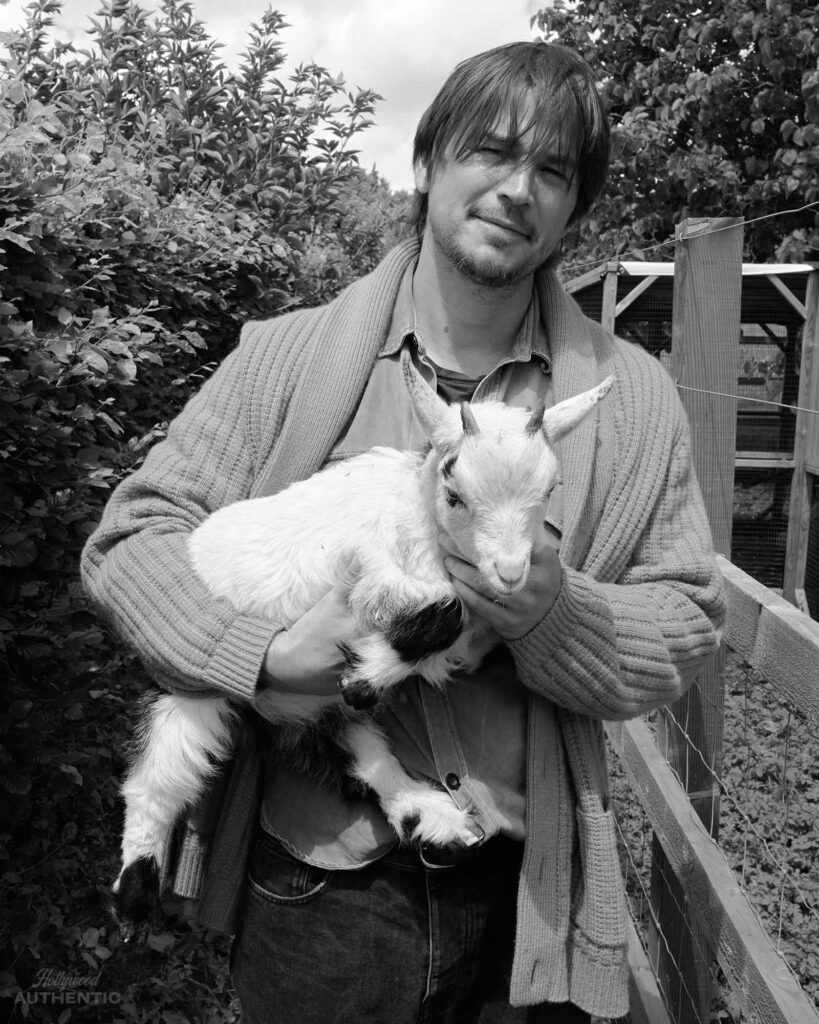
Though born and bred in Saint Paul, Minnesota and having worked all over the world during his 27-year acting career, Hartnett has found a contentment in the English countryside an hour’s train ride out of London, living with his wife, actor Tamsin Egerton, and four young children. The family share their home with four pygmy goats, six Silky bantam chickens, guinea pigs, a bulldog called Bear and a backyard big enough for Josh to learn about the land from the neighbouring farmers and warrant a gleaming orange tractor. His life, he jokes, is ‘fairly analogue’. He chugs out of the barn and down the field on a blustery July day. That sense of fulfilment is also mirrored in his work, having recently been a part of box-office and awards phenomenon, Oppenheimer, and now opening the new M Night Shyamalan water-cooler thriller, Trap – playing a serial killer trying to escape police at a pop concert.
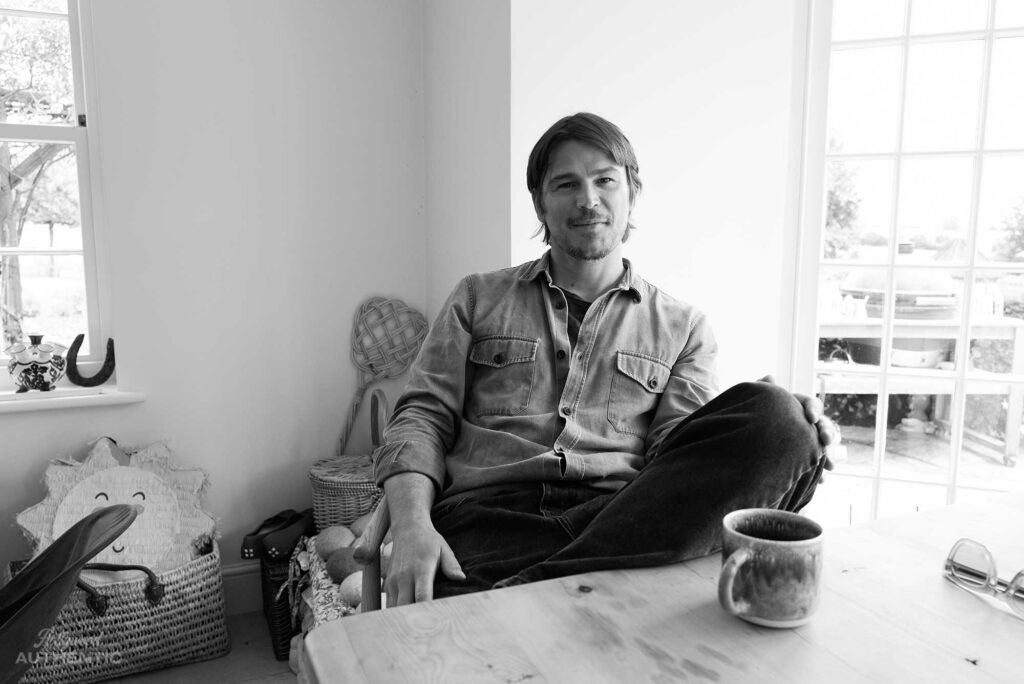
‘I’ve always been attracted to directors who are working in their own realm – some of them outside of the system, some of them within the system, but always doing something that feels very authentically them,’ Josh says of his career over coffee in his cosy kitchen, which shows his very real off-screen life via the baby cot and the dog crate taking up space in the room. ‘I’ve recently been lucky enough to work with those directors but on a bigger scale, and lots of people are interested in seeing them. And that’s the best of all worlds.’
Trying to find the sweet spot in work and the fame that comes with it is something Josh has been juggling since his first role in 1997 on TV show Cracker (a US adaptation of the UK Robbie Coltrane hit). Having moved to New York after art school to pursue acting as a teen, a trip to LA nabbed him the role that would propel him into the Hollywood system and a period of time when he was being marketed as a ‘heartthrob’. Roles in Halloween: H20, The Virgin Suicides, The Faculty, Black Hawk Down and Pearl Harbor followed, but his public persona chafed with his ambition and own sense of self.
I know it’s an odd thing to say as an actor, but I really wanted to do specific types of films, and I felt like I had the ability to do it because I got really lucky at a young age. So I used what little clout I had to create these films
‘Fame is not the endgame for me in any way shape or form. Money is good and great – you need it. You need to be able to make enough money to be able to survive. But if it becomes your be all and end all, I think that’s a trap,’ he says. ‘I’m not particularly interested in falling into those traps if possible. I’m very happy with my family and my life. I’ve got a lot of good friends. I try to keep it all in perspective.’
That resistance to the narrative crafted for him and belief in pursuing his own interests rather than following a rote route led to the now 45-year-old famously passing on an opportunity to play Batman in Christopher Nolan’s The Dark Knight in 2008, when the actor and director met for a preliminary chat. Their conversation led to an interest in working together but not to Josh donning the famous cape. ‘I had an initial conversation with Josh but he had read my brother’s script for The Prestige at the time and was more interested in getting involved with that,’ Nolan recalled last year. ‘So it never went further than that.’
‘I didn’t do any of the superhero movies back when it was the inception of the modern superhero,’ says Josh. ‘Around the time Downey did Iron Man, there were a lot of new things happening but it was not really the route that I felt like I needed to go on. Personally, I didn’t want someone else dictating how I was portrayed in the media, and how I was portrayed on screen so much. I know it’s an odd thing to say as an actor, but I really wanted to do specific types of films, and I felt like I had the ability to do it because I got really lucky at a young age. So I used what little clout I had to create these films. Some of them were more successful than others. I heard a great quote from another actor. I had a film that wasn’t super-successful come out, and he said, “Look, you’re never as bad as they say you are, but you’re also never as good as they say you are. This is a business of extremes. People want to tell a story. It’s all narrative. Take it with a pinch of salt. Enjoy it when it’s working, but don’t take it too seriously when it’s not, and don’t ever get too excited about yourself.” So, all that said, I didn’t really want to be defined by other people. I wanted to do my own thing. That’s why I’ve created the career I’ve created.’
Part of the pulling away from the prescriptive ‘movie star’ persona was self-preservation. ‘It just felt like there was a lot of intrusion into my life at that point because I was a young actor, and people were interested in my life, and I didn’t know how to protect myself exactly at that point because I was young. And, also, I was still defining myself, in the way that we all do in our late teens or early twenties. So to have all these other opinions of who I was constantly swirling around in the miasma that is my brain while I’m trying to decide what it is that I want to be – it didn’t feel entirely healthy. So I just sort of took a step back, and tried to re-evaluate. The big machine wants you to do something very tried and true – something that they believe that they can reproduce or control. I wanted to try to do something that felt more authentic to me. I think, looking back on it, it was self-protective, but it was also much more positive than that. They wanted star-making. There were specific things that everybody in the industry wanted me to do, and I felt like I hadn’t signed up for that entirely. I just kind of felt like I wanted to be more myself than that.’
Though he didn’t take an official sabbatical or stop working, Josh moved physically and mentally away from Hollywood. ‘I’ve never really considered Hollywood to be the centre of my adult life. Even though I’ve been working in Hollywood my whole adult life, I’ve always thought of myself as being more spiritually a New Yorker.’ He laughs at himself. ‘“Spiritually” sounds so dorky and over the top. But I feel like I want to be around people from all sorts of walks of life. Especially when I’m not working, it feels unnatural to be constantly talking about work, or constantly talking about my own career. It feels too isolating, and it’s self-indulgent. In New York, most of my friends weren’t in the business, and still, to this day, my close friends aren’t in the business.
‘I love my job. I love acting, and I love making films – I guess I just never thought of our business as a fully catch-all lifestyle. It’s work, and I really enjoy the work, and I like to escape it and see friends and family in different places, and live in a different place. And all the travel, when you’re acting, has kind of lent itself to feeling like I could exist anywhere. So coming to the UK didn’t feel unnatural. Living here full-time doesn’t feel unnatural, as it wouldn’t feel unnatural to move to Morocco, where I was working for a long time, or Hong Kong, where I was working for a long time. It just always feels like, “Oh, this is the next step.” It doesn’t feel like it has to define you in any specific way.’
Honestly, I’ve become really fond of being here: the quiet, the still; all of it. It’s being much more aware of yourself and your surroundings. I’ve become enormously impressed by farm work, and how much people put into it, and how difficult it is
In 2011, Josh met Tamsin on the set of The Lovers and England became a place he visited more often, before moving between the States and the UK as they grew a family together. Then Covid hit and the couple made a decision to put down roots in the British countryside. They’ve been in a small village with an excellent local pub for two years now. ‘We’re sort of transplants from the city,’ Josh admits as we take a walk through the garden to the goat enclosure and the chicken coop, which borders the working farm next door. ‘We’re trying to get to know what it’s like to live in the countryside. And, honestly, I’ve become really fond of being here: the quiet, the still; all of it. It’s being much more aware of yourself and your surroundings. I’ve become enormously impressed by farm work, and how much people put into it, and how difficult it is. I grew up in cities – so all this is brand new to me. It comes with that sort of feeling of: “Is this my real life, you know?” Because it doesn’t feel like the rest of my life has felt up til now, so it’s all just fresh.’
As he introduces his goats (Olive, Lavender, Poppy and Grape) and the chickens that provide daily eggs, Josh considers his most recent projects and how he’s come full circle to actually engaging with the work that he always wanted to. He recently appeared in Black Mirror, just guest starred in Season 3 of The Bear (as Tiffany’s Taylor Swift-adoring fiancé) and was part of last year’s ‘Barbenheimer’ box-office phenomenon when he and Nolan finally worked together on Oppenheimer. Playing nuclear physicist Ernest Lawrence, Josh’s was one of the roles that spanned the decades throughout the film, which meant he worked opposite most of the cast and was on-set for most shooting days. ‘Chris is a singular filmmaker on every level – nobody tells him how to make his film. He’s a great example of someone who’s been able to create a sort of independent style of film with a massive budget, in the midst of a massive industry, and still have tons of people who want to see it. It’s a remarkable achievement. I could probably count on two hands the directors who could do that. I think [Trap writer/director] Night [Shyamalan] is another one. A director who’s been able to find a way to relate to the audience, and do it his way, now for 25 years. I feel incredibly lucky to be able to keep working with these guys.’
Josh doesn’t do social media and wants his kids to enjoy their tangible country existence over a virtual life lived through a screen. ‘You just have to be careful about how you introduce your kids to it, get a sense of where the information is coming from, and who they’re interacting with. And you have to be really clear about that. Otherwise, it’s the Wild West. It’s dangerous.’ He’s also aware that careers ebb and flow – that for every awards-magnet Oppenheimer, there’s a critically mauled Pearl Harbor – but equally that all films find an audience eventually. ‘Most of [my films] went unseen until many years later on Netflix. People tend to like them, and come up to me now, and say they really enjoyed the film. But our careers in this business – there’s so much luck involved. It’s so streaky. So when people start to find you interesting again, suddenly you’re being offered a lot of stuff that people are going to see. And when people are less interested, suddenly you’re offered nothing.’
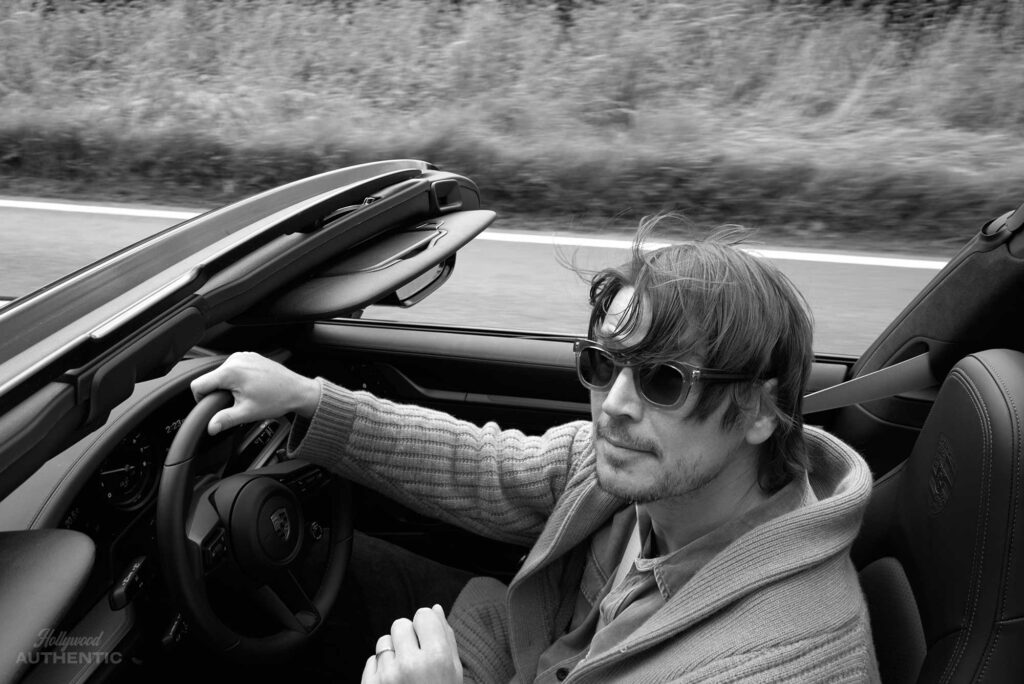
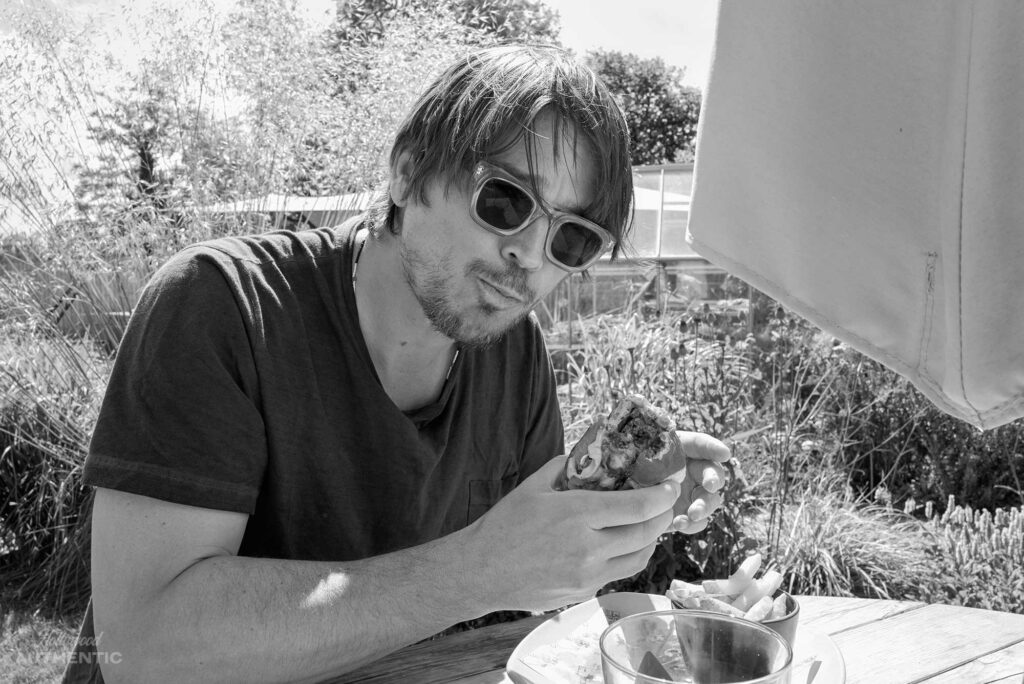
As we head out to the local pub for a burger and a pint, Josh spots my Porsche in his drive and asks to take it for a spin. As he negotiates twisting country roads with the wind in his hair, he recalls a high-speed former life before he settled down to fatherhood and the country. ‘I used to track-race Porsche cars all the time. I completely gutted 911s with the biggest engine you could get, completely light. A lot of fun. I took a Bugatti out on an F1 track in Kuala Lumpur. The straight is pretty full on. I don’t know exactly how fast I was going, but it was faster than I’d ever gone before…’ Quite the difference from the Lamborghini tractor that the actor has to switch off before putting in reverse in order to park it back up in the barn. ‘It can’t change gears while it’s driving,’ he explains fondly. The same certainly cannot be said for its owner, who changed his direction of travel mid-journey and arrived at a happier destination.
Josh Hartnett stars in Trap, directed by M Night Shyamalan, in cinemas now. Grooming by Charley McEwen. Josh wears own clothes and cardigan by Hollywood Authentic × N.Peal
How important is a little bit of nonsense now and then to you? I like nonsense. One of my favourite sounds is laughter. I can corpse [laugh during a scene] very, very easily. I’ve worked with a few actors who are very good at setting other people off, and then not doing it themselves. I find that very cheeky.
What, if anything, makes you believe in magic? I don’t believe in magic. One guy I know used to work out tricks for a very successful magician. So I’ve kind of seen behind the curtain. But I do believe that things are magical. Aretha Franklin or Otis Redding’s voice. The way Lionel Messi or Pelé played football. A work of art…
What was your last act of true cowardice? I was sat on a table next to [Everton football manager] Sean Dyche the other day. I really wanted to talk to him but I didn’t. Afterwards, I was gutted about it.
What single thing do you miss most when you’re away from home? My bed, because I’ve worked hard to get that bed to fit me. I spend quite a lot of time – because of the job I do – sleeping in beds that aren’t my own.
Do you have any odd habits or rituals? I have to play two different forms of Patience – Simple Solitaire, and then Diplomat – until I win before I can start writing.
What is your party trick? I can do the Rubik’s Cube in under two minutes. It used to be under a minute.
What is your mantra? Do unto others as you would have them do unto you.
What is your favourite smell? The top of a baby’s head.
What do you always carry with you? Cash in my pocket. Just a little mad money.
What is your guilty pleasure? I don’t particularly think that any pleasure is guilty but I take a great amount of pleasure in a well-made Old Fashioned.
Who is the silliest person you know? My mate Mark, who I go to the football with along with my brother-in-law. He’s just one of those guys on the terrace who always says the funniest thing at the absolute right time.
What would be your least favourite way to die? I’d quite like one where people go ‘He had a good innings, and went surrounded by the people he loved.’ I don’t want one where they go ‘…and it took them ages to get him out of the tree’.
Lennie James graduated from the Guildhall School of Music and Drama and went on to work on stage and screen in TV favourites such as Spooks, Line of Duty, The Walking Dead and Fear of the Walking Dead. He has also appeared in numerous zeitgeist movies including 24 Hour Party People, Snatch, Les Miserables and Blade Runner 2049. ‘I like characters who are having interesting conversations with themselves,’ he says of what draws him to a role. As a writer, the Nottingham-born actor has penned semi-autobiographical film Storm Damage and Royal Court play The Sons of Charlie Paora. Next up he’ll take the lead in an eight-part TV adaptation of Bernardine Evaristo’s novel, Mr Loverman, playing a man coming to terms with ‘his 60-year love affair with his best friend, Morris, and how they’ve kept it a secret through each of their marriages’. In December, he will also appear in Lion King prequel, Mufasa, and has just finished work on Joshua Oppenheimer’s post-apocalyptic musical, The End.
Mr Loverman is available from 14 October on BBC1 and iplayer. Mufasa: The Lion King is released in cinemas 20 December
Photographs by CHARLIE CLIFT
*Arguably one of the most memorable (and quotable) scenes in 1971’s Willy Wonka & the Chocolate Factory is when Mr Salt mumbles, ‘It’s a lot of nonsense,’ to which Wonka replies, in a sing-song voice, ‘A little nonsense now and then is relished by the wisest men.’
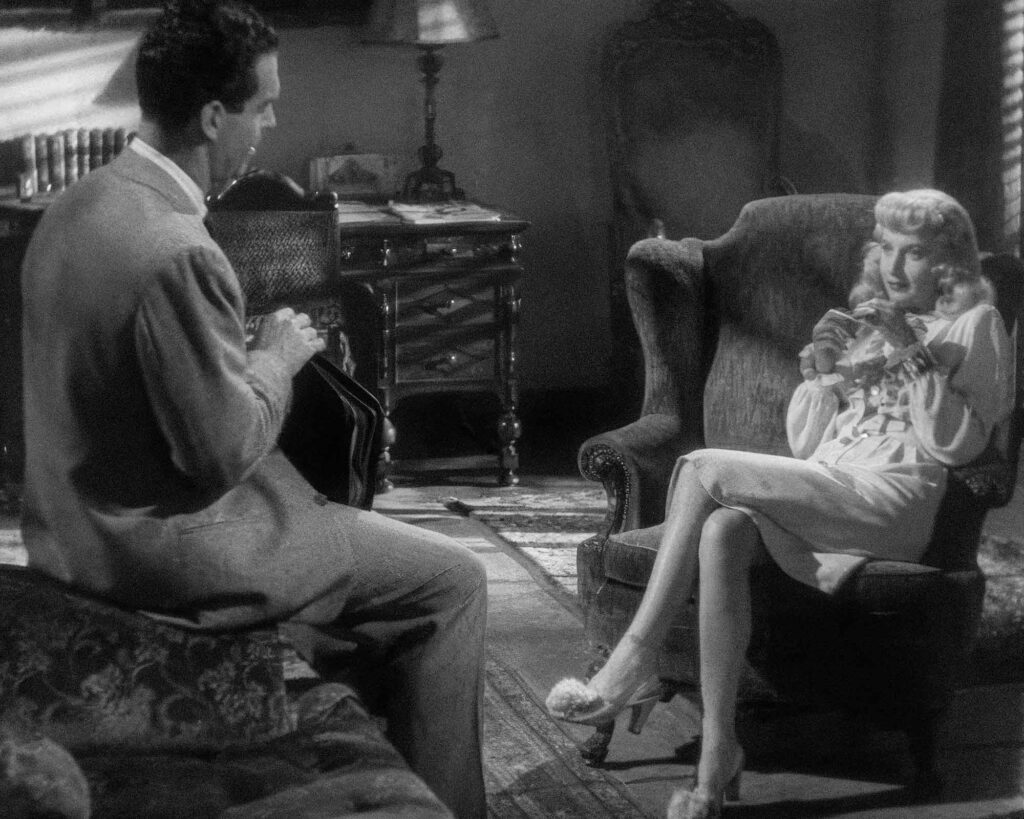
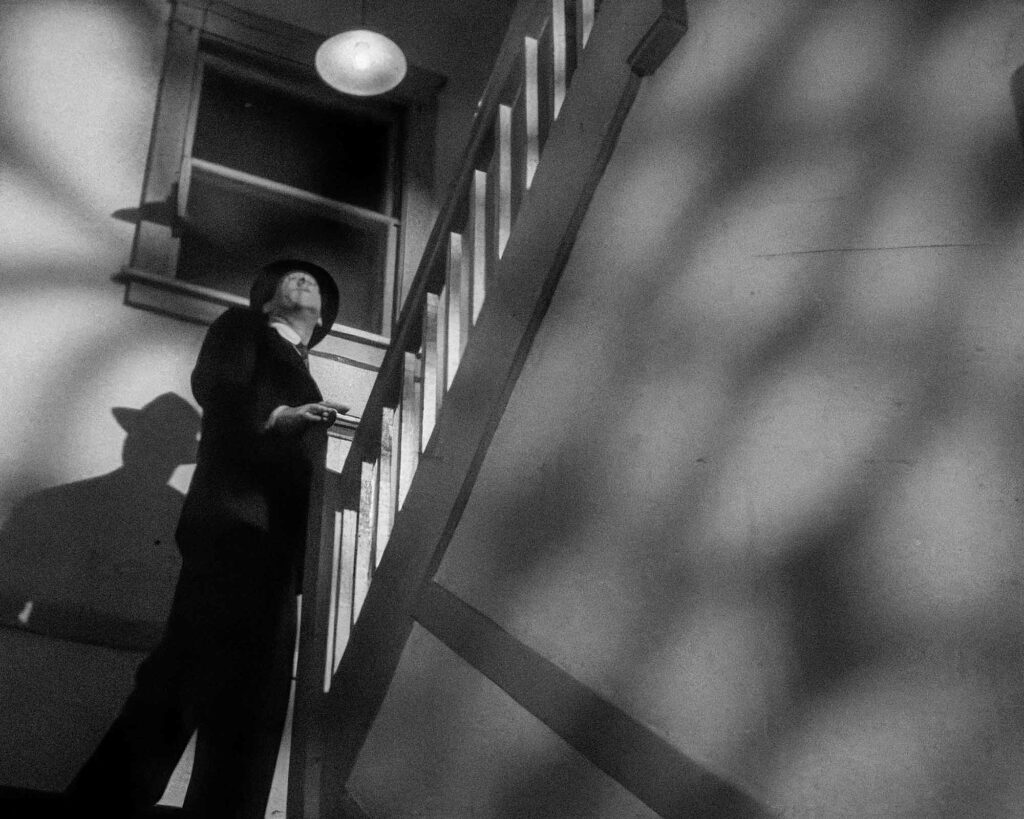
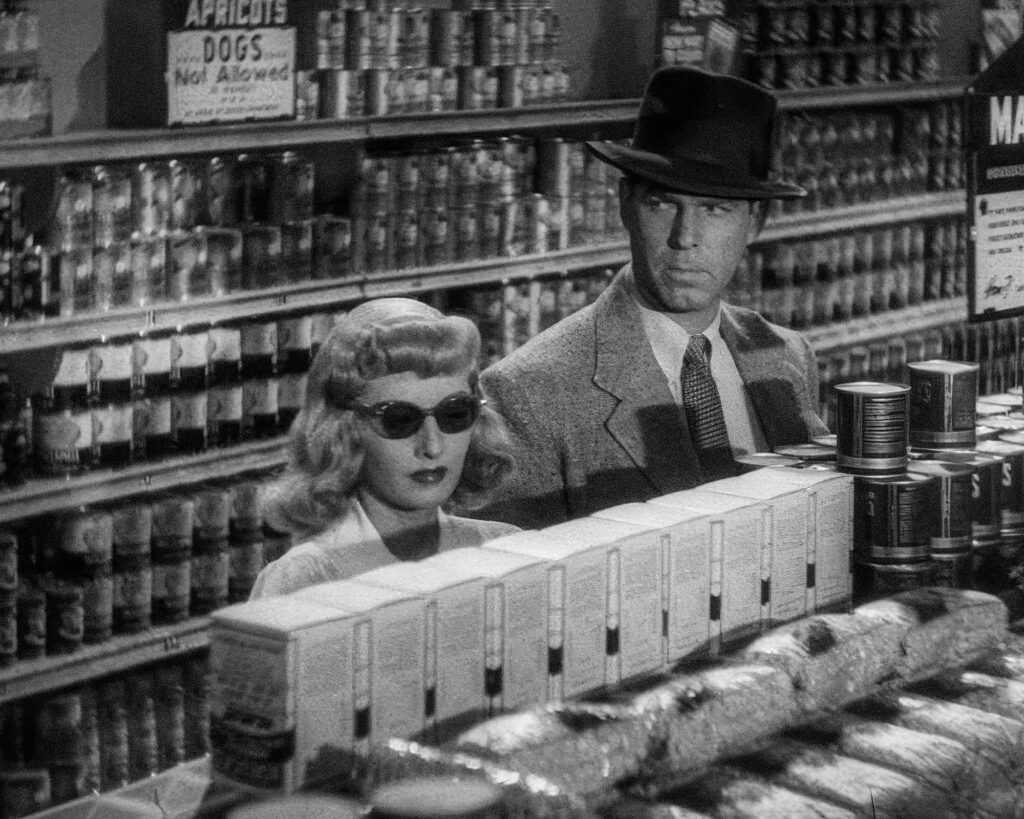
In 1944, director Billy Wilder released the quintessential film noir before the term even existed. Double Indemnity bears all the hallmarks of the genre: wiseass repartee; crisp black-and-white cinematography; a manipulative femme fatale twisting a lust-fuelled sap around her finger; shards of light pouring through venetian blinds casting prison-bar shadows across the faces of our amoral protagonists as they hurtle towards a doomed comeuppance.
This is no spoiler. The movie opens at night (it’s noir, of course it’s night) with a wounded man driving his coupe through downtown LA, staggering to his office, and dictating a confession to his colleague: ‘Hold tight to that cheap cigar of yours, Keyes. I killed Dietrichson. Me, Walter Neff, insurance agent, 35 years old, unmarried, no visible scars… until a little while ago, that is. Yes, I killed him. I killed him for money – and a woman – and I didn’t get the money and I didn’t get the woman.’
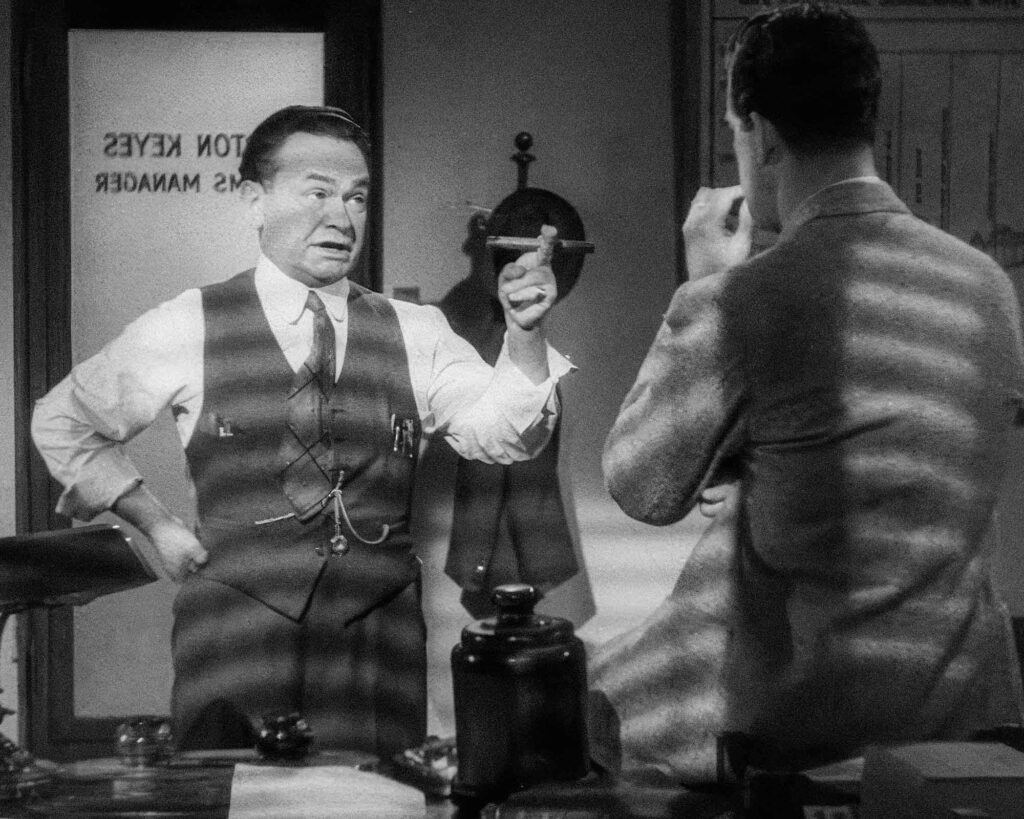
From here, flashbacks show Neff (Fred MacMurray) falling for the glamorous but unhappily married Phyllis Dietrichson (Barbara Stanwyck). Together they concoct a devilishly clever plan to bump off Phyllis’ husband for his accident insurance money, only to come under the suspicious gaze of Neff’s friend and colleague, insurance investigator Barton Keyes (Edward G. Robinson).
Double Indemnity is an early example of a ‘whydunnit’, telling us the killer’s identity upfront (a narrative technique popularised 30 years later by TV’s Columbo), but is it the first thriller to make us root for a bad guy driven by greed and sex? Unclear, but certainly that opening narration sets the blackly comic tone that pervades the film, in which brief early scenes of sunny LA give way to ever more darkening shadows as our conniving pair descend into murder and betrayal.
The movie was based on a novella by hardboiled crime writer James M. Cain, who as a journalist had attended the trial of a woman and her lover convicted of a similar murder in the 1920s.
Wilder’s regular screenwriting collaborator Charles Brackett declined to adapt the book, regarding it as too scandalous and immoral, so Wilder famously hired master crime author Raymond Chandler, creator of the archetypal gumshoe Philip Marlowe. Chandler assumed that writing a film would be quick and easy, taking maybe three weeks. When he was told his weekly rate was $750, he thought he could stretch it out to four. As described by Maurice Zolotow in his biography Billy Wilder in Hollywood: ‘[Chandler] schlepped it in five weeks later. Billy read it at once while Chandler watched. Then he threw it – yes, hurled it – right at Chandler. It hit him in the chest and fell on his lap. “This is shit, Mr. Chandler,” he said amiably. He suggested that Chandler use it as a doorstop.’
Their relationship went downhill from there, with Chandler battling alcoholism and Wilder every step of the way. Nevertheless, their Oscar- nominated screenplay is a triumph, cleverly refining and reworking the novella while injecting Chandler’s trademark wit and smart-alec crosstalk. Take Phyllis and Walter’s flirty first encounter, fizzing with innuendo to dodge the censor’s red pencil:
PHYLLIS: There’s a speed limit in this state, Mr. Neff. Forty-five miles an hour.
NEFF: How fast was I going, officer?
PHYLLIS: I’d say about ninety.
NEFF: Suppose you get down off your motorcycle and give me a ticket. PHYLLIS: Suppose I let you off with a warning this time.
NEFF: Suppose it doesn’t take. PHYLLIS: Suppose I have to whack you over the knuckles.
NEFF: Suppose I bust out crying and put my head on your shoulder. PHYLLIS: Suppose you try putting it on my husband’s shoulder.
As a film and TV writer, I know full well that good dialogue is only as good as the actors delivering it, and Stanwyck and MacMurray are faultless, loading every line with just the right amount of sexy snark, Fred grinning an insouciant smirk, Barbara fighting the urge to do the same.
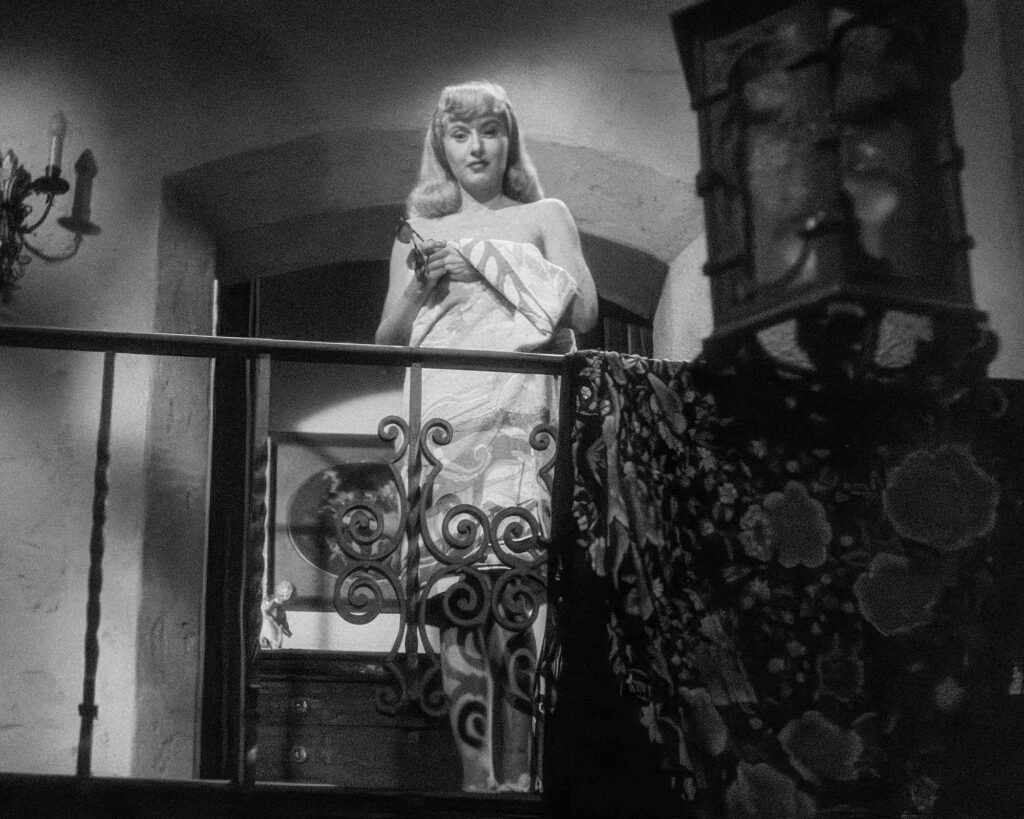
Years later, movies like Basic Instinct would make these seduction scenes explicit, but in 1940s Hollywood every erotic beat had to be carefully calibrated to sneak past America’s moral guardians. It was racy enough that Stanwyck first appears at the top of a staircase in a towel; moments later, Wilder’s camera fixates on her anklet as she descends in what were scripted as ‘pom-pom slippers’ – signifiers that despite her nice suburban home, Phyllis (in Wilder’s words) is showy and trashy. It’s the reason the director made Stanwyck wear a cheap blonde wig, which is constantly distracting once you realise it’s a piece. As one studio executive who hated the wig apparently stated: “We hire Barbara Stanwyck and we get George Washington.’
For a city that seems to have little reverence for its historical buildings, I take great pleasure in discovering (via Google maps) that the exterior of the Dietrichson residence, a Spanish Colonial Revival-style house in the Hollywood hills, has changed very little since it starred in the movie almost 80 years ago. If Double Indemnity is a thoroughbred film noir, it’s also a Los Angeles movie to its core, partly thanks to its locations – including the Hollywood & Western Building and the Hollywood Bowl – but also because every frame seems soaked in the sweat and humidity, cynicism and paranoia, of the big city.
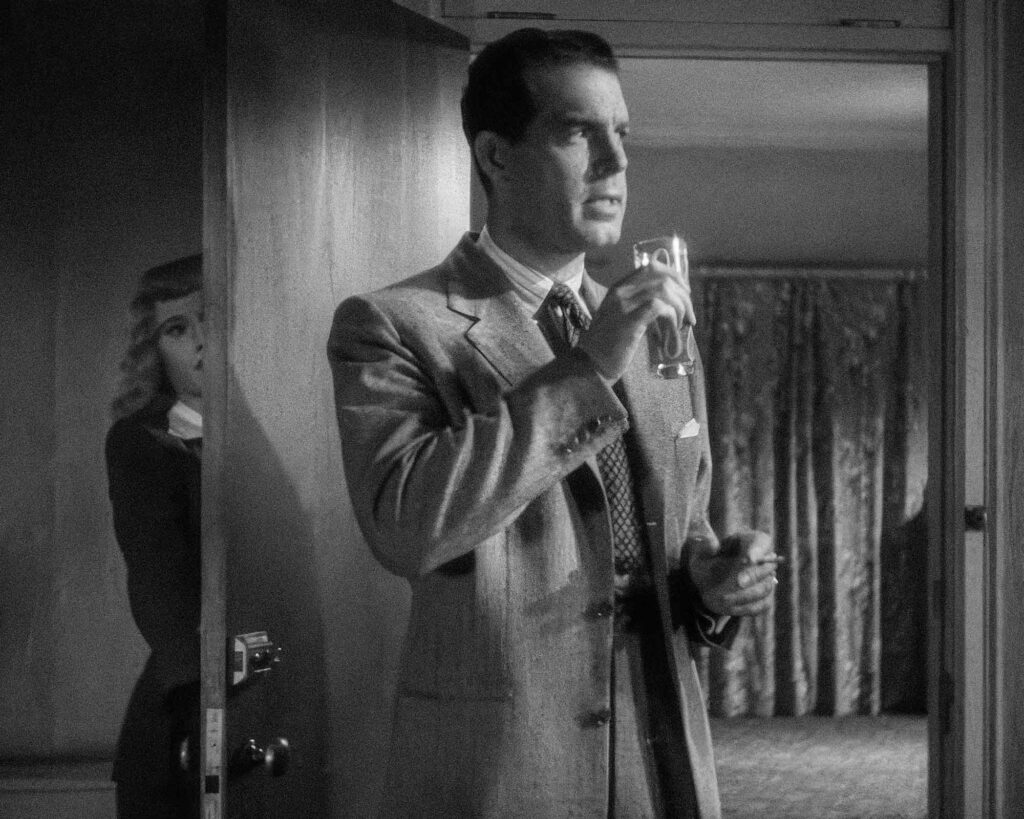
Neff’s North Kingsley Drive apartment block is still standing too, the setting for one of the finest suspense scenes in any movie. Neff receives a late-night visit from Keyes, whose ‘little man’ in his stomach keeps telling him something is amiss with the Dietrichson insurance claim. Oblivious, Phyllis is on her way up to the apartment, but if she encounters Keyes, the murder conspiracy will be blown wide open. She is about to enter Neff’s apartment as Keyes is leaving, but at the last moment ducks behind Neff’s apartment door, which inexplicably opens outwards into the corridor. No apartment door has ever done this in the history of construction, but it’s testament to the movie’s immersive, slow-burning suspense that you don’t even register it on first, second or fiftieth watch.
At the 17th Academy Awards, Double Indemnity was rightly nominated for seven Oscars but wrongly won none. Wilder was apparently so furious about losing Best Director to Leo McCarey for the mawkish Going My Way that as McCarey walked to the stage, Wilder tripped him up. It’s the perfect coda for a movie that not only trips up but snaps the neck of the polite mores and suburban civilities that America was trying to sell itself in the 1940s; a movie that only an émigré like Wilder, having escaped the horrors of the Nazis, could so gleefully use to expose the dark, irredeemable recesses of human behaviour; a movie that in 2024, an election year in which politicians would have us believe there was once a golden age in which America was happy and bright, reminds us the country has always been merrily, deliciously dark.
Photographs by SAM SHAW Words by GISELE SCHMIDT & GARY OLDMAN
The love of Sam Shaw’s photographs begins with Gary’s admiration for the films of John Cassavetes, the grandfather of independent American cinéma vérité. Gary is a self-described Cassavetes junkie. Having had little exposure to Cassavetes’ work prior to the start of our relationship, Gary immediately introduced me to several of his films. But what was it about Cassavetes that Gary found so undeniably fascinating? His style. Cassavetes dared to capture what other filmmakers would overlook: raw humanity and the chaotic nature of life. Cassavetes broke the rules of traditional filmmaking and his unconventional storytelling refused to tie up loose ends for the sake of providing the audience with a happy ending. Cassavetes took one look at Hollywood’s formula and threw it all away! Cassavetes’ influence is abundantly evident when one views Gary’s masterpiece, Nil by Mouth. Much like Cassavetes, Gary wrote, directed, financed and produced his film to depict a messy but emotionally honest story, not compromising his artistic vision for commercial appeal. But how does all of this bring us back to Sam Shaw?
Well, Cassavetes and Sam were best friends, colleagues, and collaborators. Shaw was an advisor on Cassavetes’ first film, Shadows (1959), and later went on to produce many of Cassavetes’ films including Husbands (1970), A Woman Under the Influence (1974), The Killing of a Chinese Bookie (1976), Opening Night (1977) and Gloria (1980). A producer, sometimes production designer, publicity and advertising campaign contributor, and later a filmmaker in his own right, Sam never gave up his first love of photography and remained the specials photographer on set.
Gary’s favourite Cassavetes film is Husbands, so naturally, the second photograph he had me track down for his collection was of Peter Falk, Ben Gazzara and John Cassavetes during its filming. We are so grateful to the Shaw Family Archives, who so graciously opened their vault of Sam’s personal prints and allowed Gary to acquire a sequence of five photographs, culminating in the image at the top of this page, which was used for publicity on the release of the film.
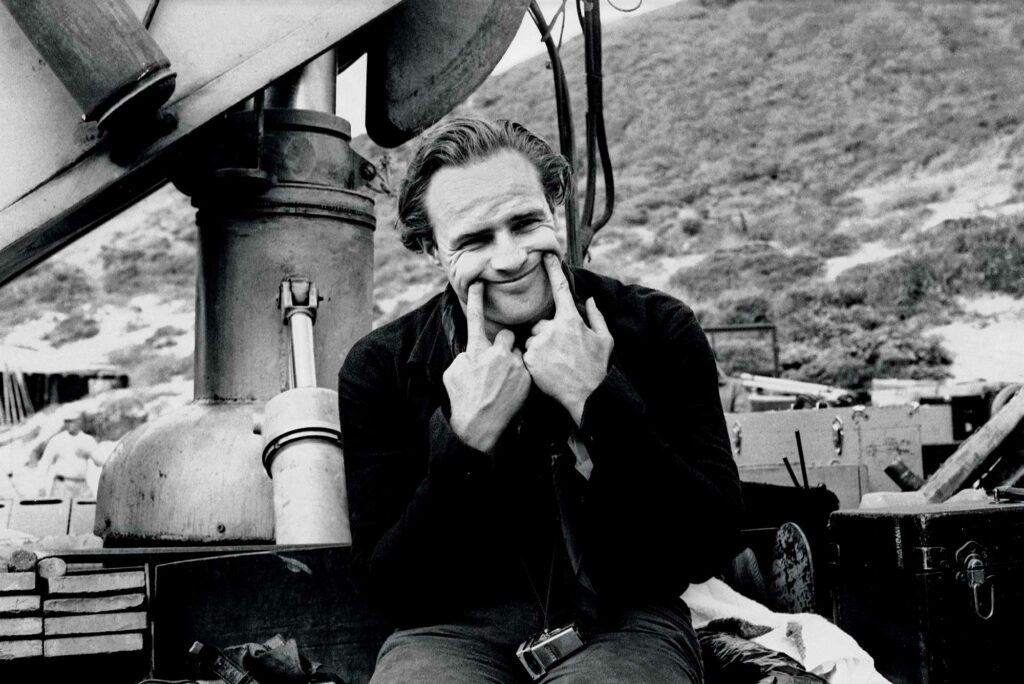
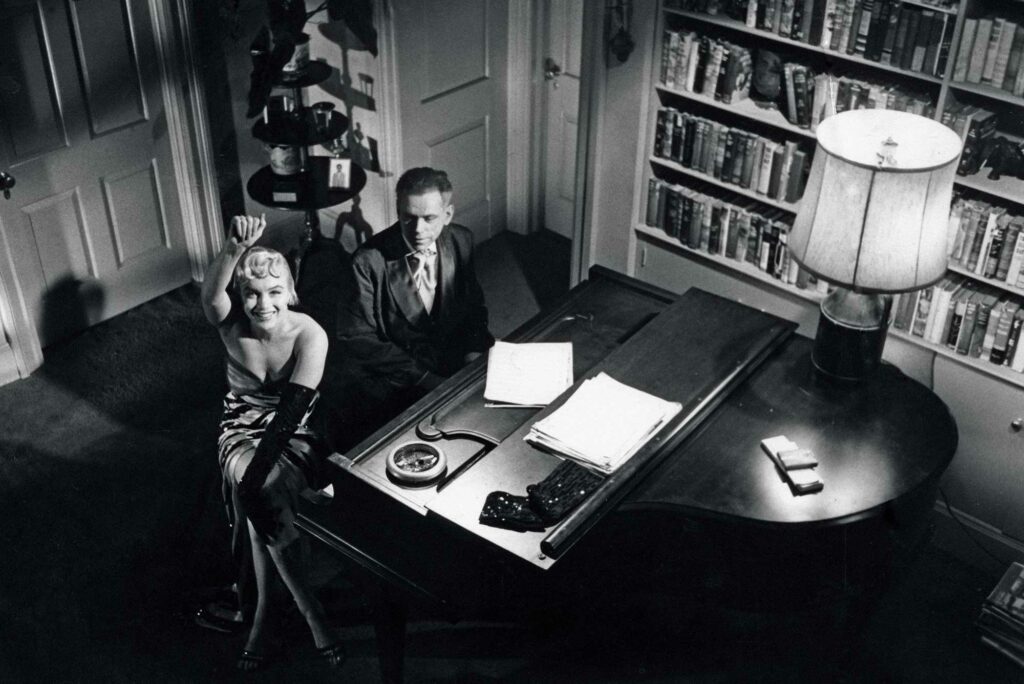
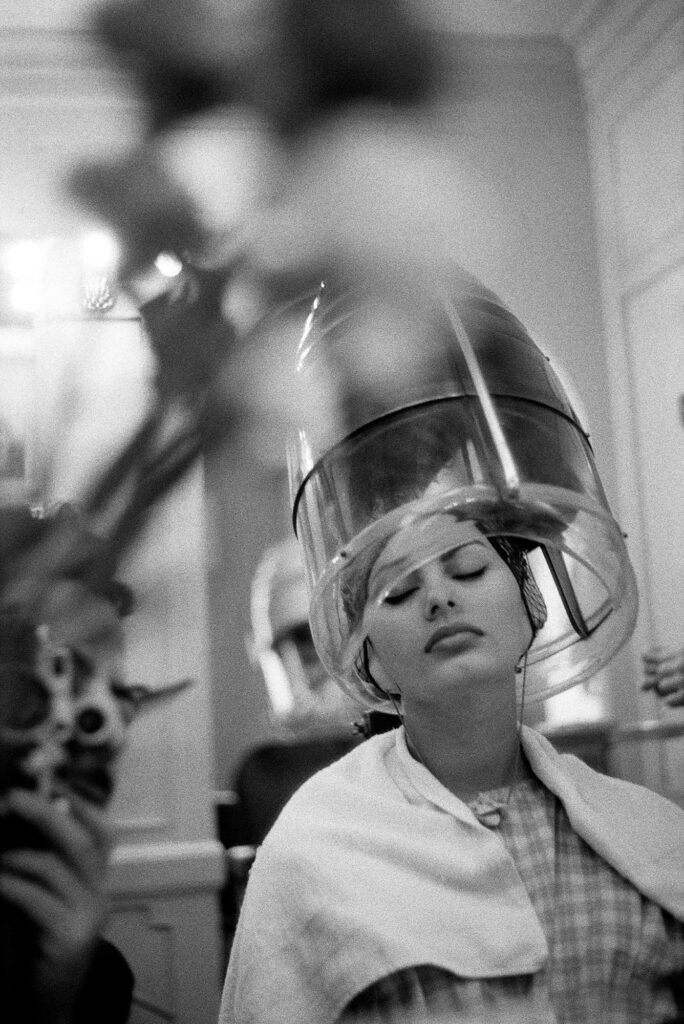
Sam’s photographs embrace independence and encourage spontaneity. Shaw wasn’t looking for the traditional ‘perfect’ shot. Shaw’s images can be raw, have blurred focus, with skewed perspectives, but they are undoubtedly beautiful, innovative and real. They capture the perfect but fleeting moment that only a click of the shutter can provide. How can one not laugh at Brando pulling a face? Or be charmed by Marilyn waving hello? Or be transfixed by the angle of the shot of Loren snoozing under the hair dryer with Shaw’s self-portrait reflected in a mirror in the bottom corner? With his artistic composition and his journalistic instinct, Shaw’s images are uncharacteristically Hollywood; what Cassavetes did for film is what Shaw did for stills photography. What a legacy!
Shaw’s career spanned six decades and there was never a day that his two beaten-up Nikon cameras weren’t at the ready dangling from his neck. His photographs graced the covers of LIFE, Look, Paris Match, the Daily Mail, Der Stern, Harper’s Bazaar and countless other publications. He captured images of everyone from those mentioned above to Elizabeth Taylor, Audrey Hepburn, Charlie Chaplin, Frank Sinatra… The list goes on and on and on. His photographic archive covers a variety of his interests: cinema, music, theatre, literature and the arts, as well as social and political activism, and it is preserved and promoted today by his children and grandchildren through the Shaw Family Archives.
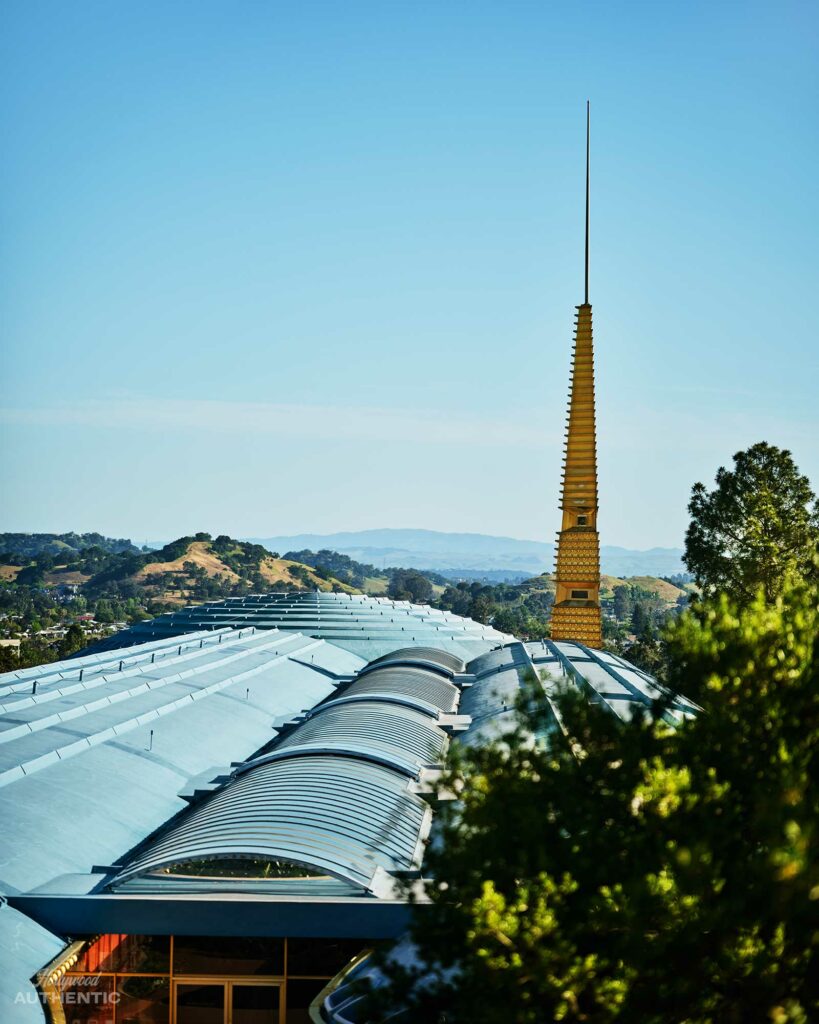
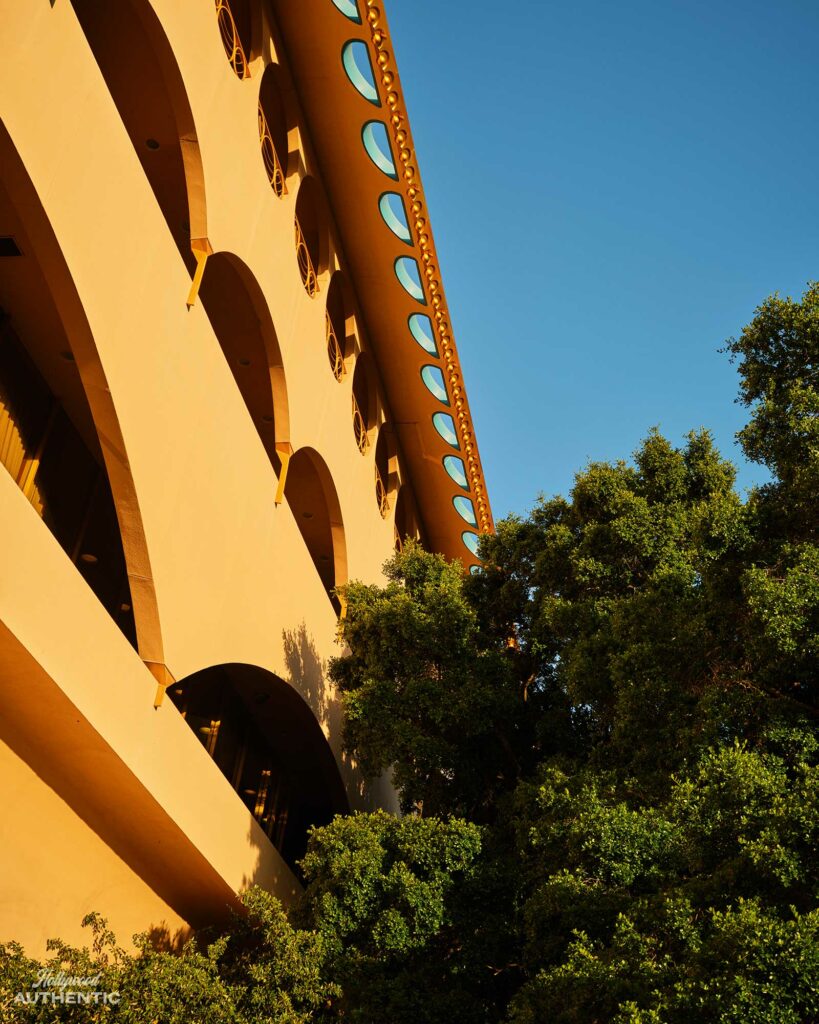
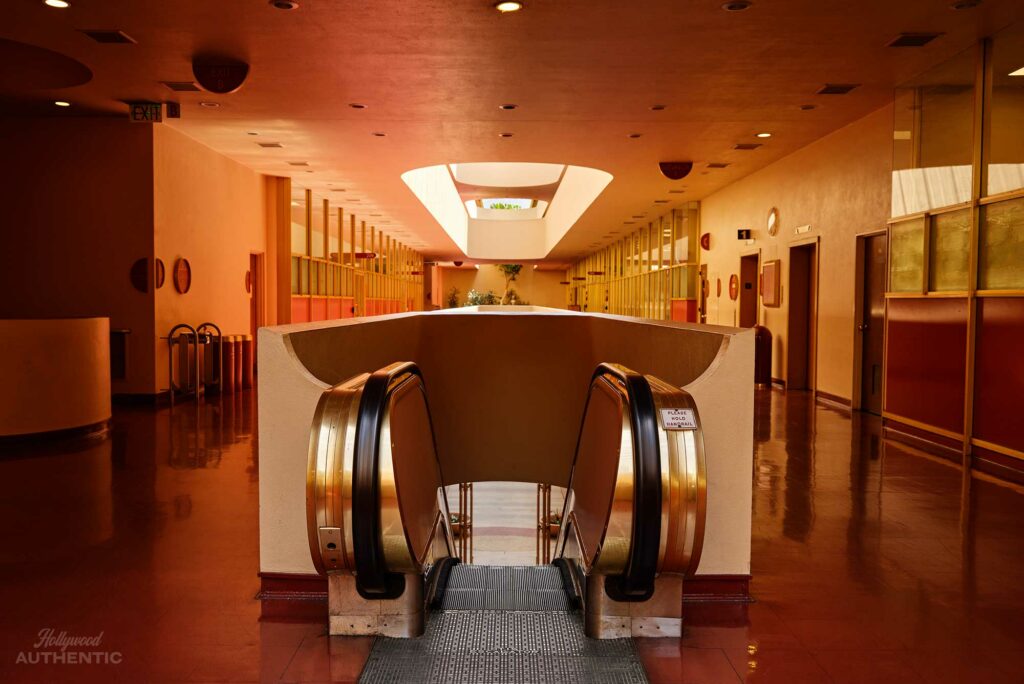
If you drive north from San Francisco on the 101, the impressive engineering feat of the Golden Gate Bridge is a postcard view that wows. But further north, nestling among the rolling countryside and a carpet of trees, lies another architectural feast for the eyes – one that seems plucked straight from a sci-fi movie. With its cerulean domes, scalloped roof, textured spire and clean lines, Marin County Civic Center in San Raphael recalls the architecture of Jabba’s Palace in Star Wars: Return Of The Jedi and the roofline of Naboo in The Phantom Menace. As large as any palace and situated in the dip between golden hills, you could almost believe that this mid-century complex housing the county’s hall of justice, library, post office and administration buildings might be expecting a visit from C-3PO and R2-D2, or hosting a celebration parade presided over by Padmé Amidala.
Marin County Civic Center in San Raphael recalls the architecture of Jabba’s Palace in Star Wars: Return of the Jedi and the roofline of Naboo in The Phantom Menace
That’s no coincidence – long-time Marin resident George Lucas conceived and filmed his Star Wars films in the surrounding area (the Ewoks made their home in the redwood forest north of the site), and his creative hub, Skywalker Ranch, sprawls nearby. But his first brush with the centre came in 1970, when the fledgling filmmaker created a future dystopia in THX-1138 and used the municipal buildings as interior and exterior locations for his debut feature film. Self-described as a ‘frustrated architect’, Lucas may not have been good enough at maths to create bricks-and-mortar designs, but as a celluloid world-builder his vision shaped cinema and popular culture. Perhaps his shoot in Frank Lloyd Wright’s truly visionary space was more influential than merely kicking off an interstellar career.
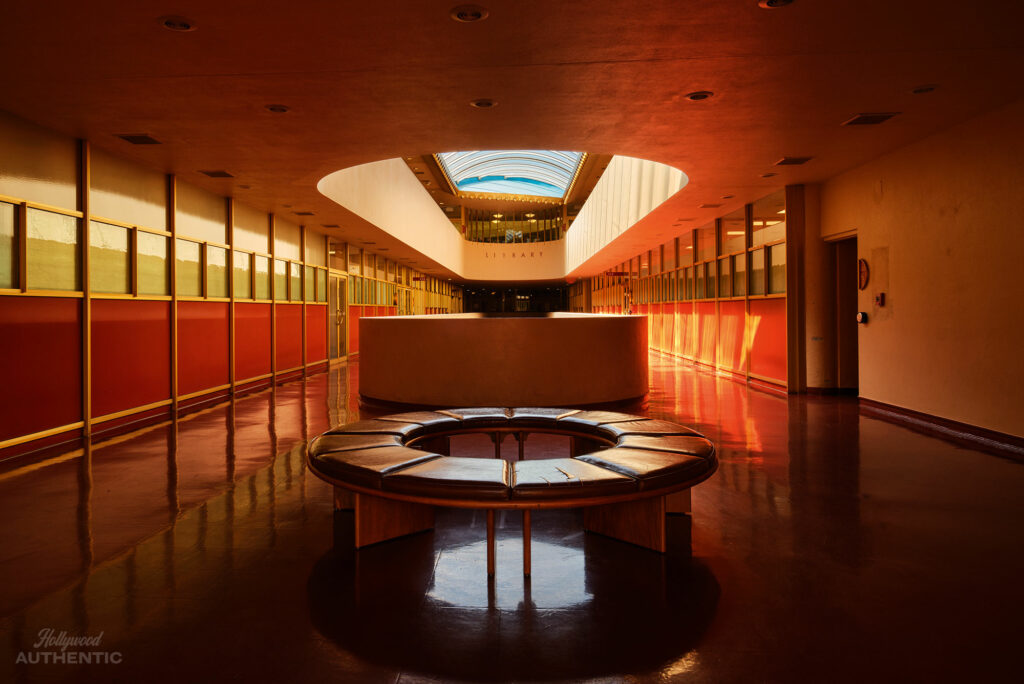
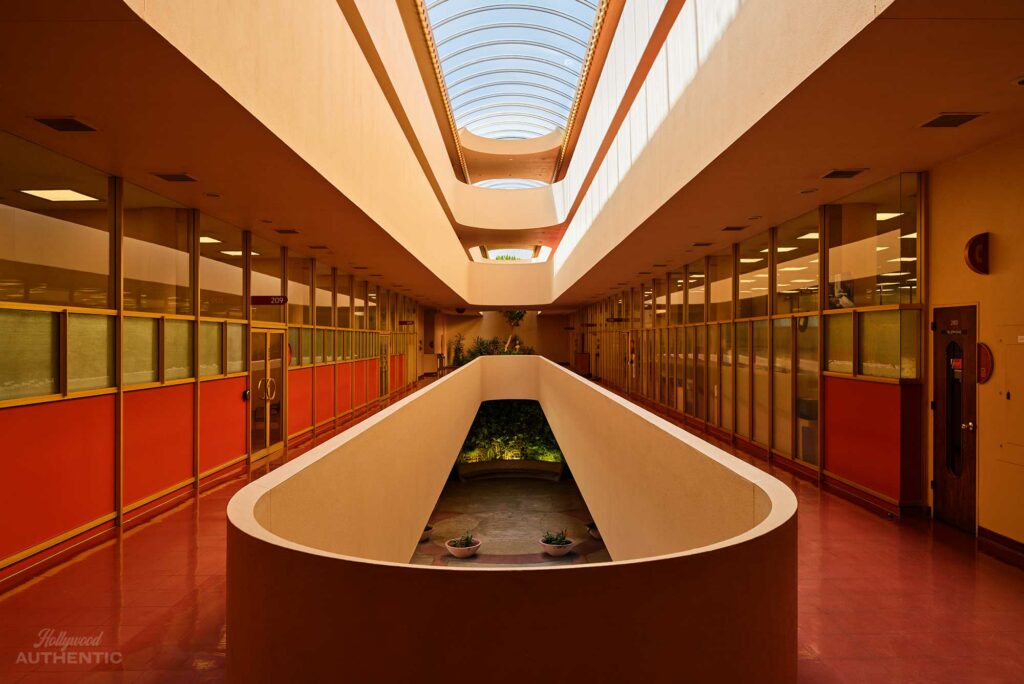
Lucas isn’t the only filmmaker to be struck by the futuristic splendour of the building. When scouting for a place to represent the near-future headquarters of Gattaca for the 1997 film of the same name, director Andrew Niccol chose the roof and the library of the centre to convey the sense of order, precision and sterility of eugenics. Many visitors now recreate the arrival to work for Ethan Hawke and Uma Thurman as they enter the hushed building and take the escalator up through the oval rotunda. And perhaps one of sci-fi’s leading lights, Philip K Dick, was inspired by the symmetry and style of the place – he visited the police department in 1971 to report a robbery at his house, fearing the CIA had ransacked his safe. The Marin County Civic Center would not be out of place in one of his bestselling books.
It would have likely pleased Wright to know his work caught the imagination of those looking to the stars – he conceived his building to withstand the test of time but also mature into the environment, planning trees that would not reach their full potential until long after he was gone, and designing structures that would require materials not yet available to him while he sketched. In this way, Wright was something of a time traveller himself – projecting into the future as he conceived the structure in 1958.
Despite his fame and reputation, Wright had not been the first choice to create the campus in San Raphael when the original courthouse burned down and needed replacing. Land was bought in 1956 and a selection committee looked at the submitted work of 26 architects (Wright refused to compete). Wright had featured on the 1957 New Year’s Day cover of House Beautiful magazine and committee member Vera Schultz and planning department head Mary Summers campaigned to offer the job to him without a submitted plan. In March 1957, he was lecturing at nearby Berkeley and was convinced to visit the proposed site. Gazing across the view from a jeep parked on the highest hill, he apparently could envisage a design immediately and took the commission. He was 90 years old and still inspired. ‘In Marin County you have one of the most beautiful landscapes I have seen,’ he said. ‘Here is a crucial opportunity to open the eyes not of Marin County alone, but of the entire country, to what officials gathering together might themselves do to broaden and beautify human lives.’
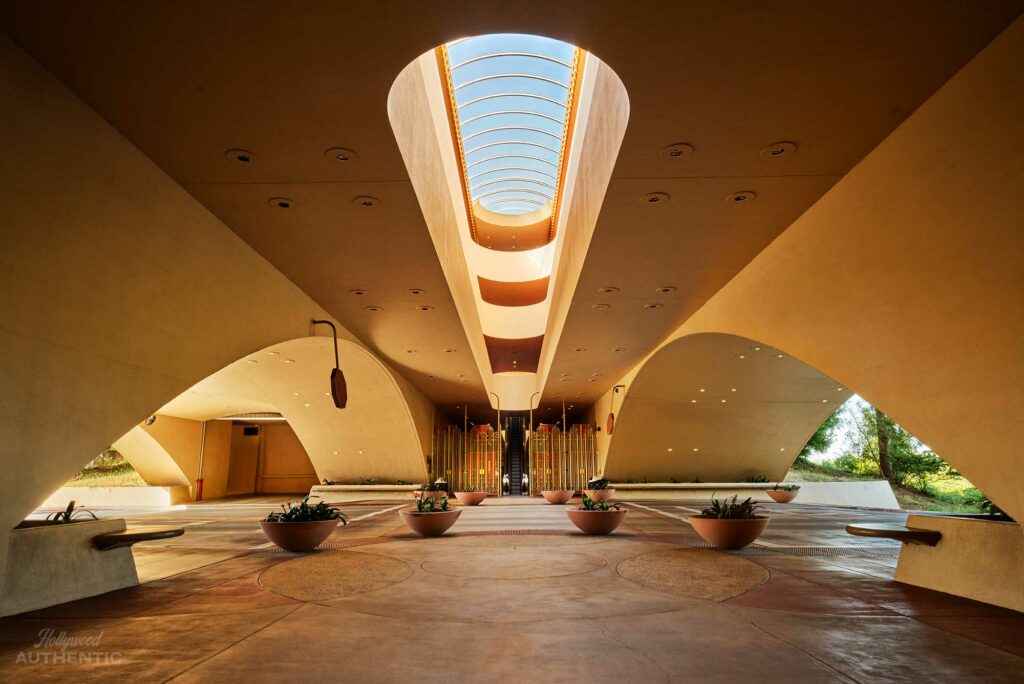
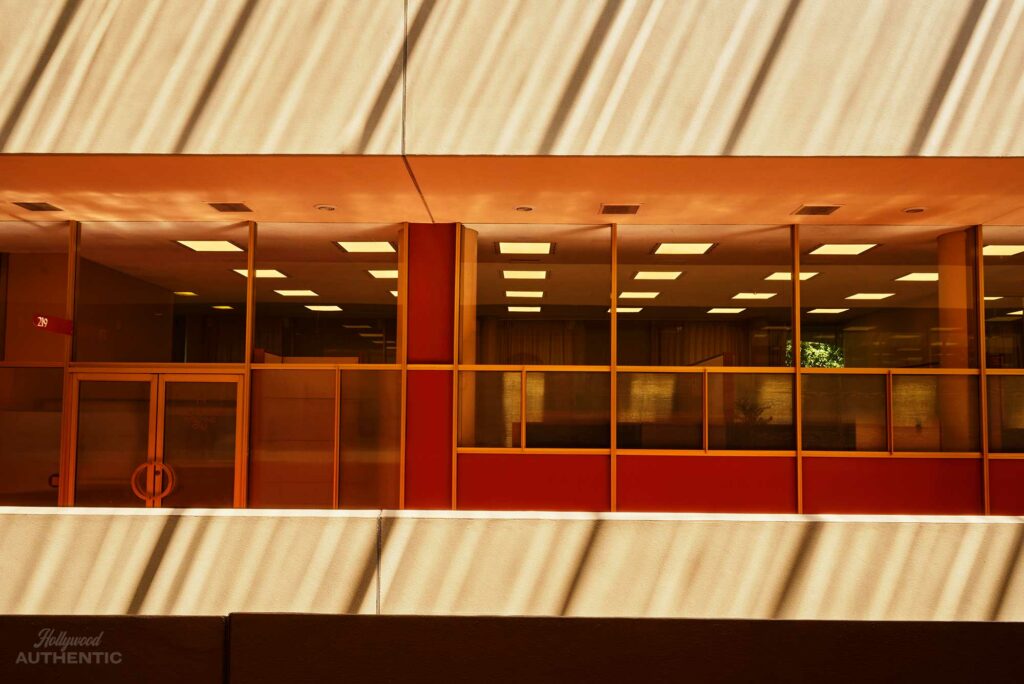
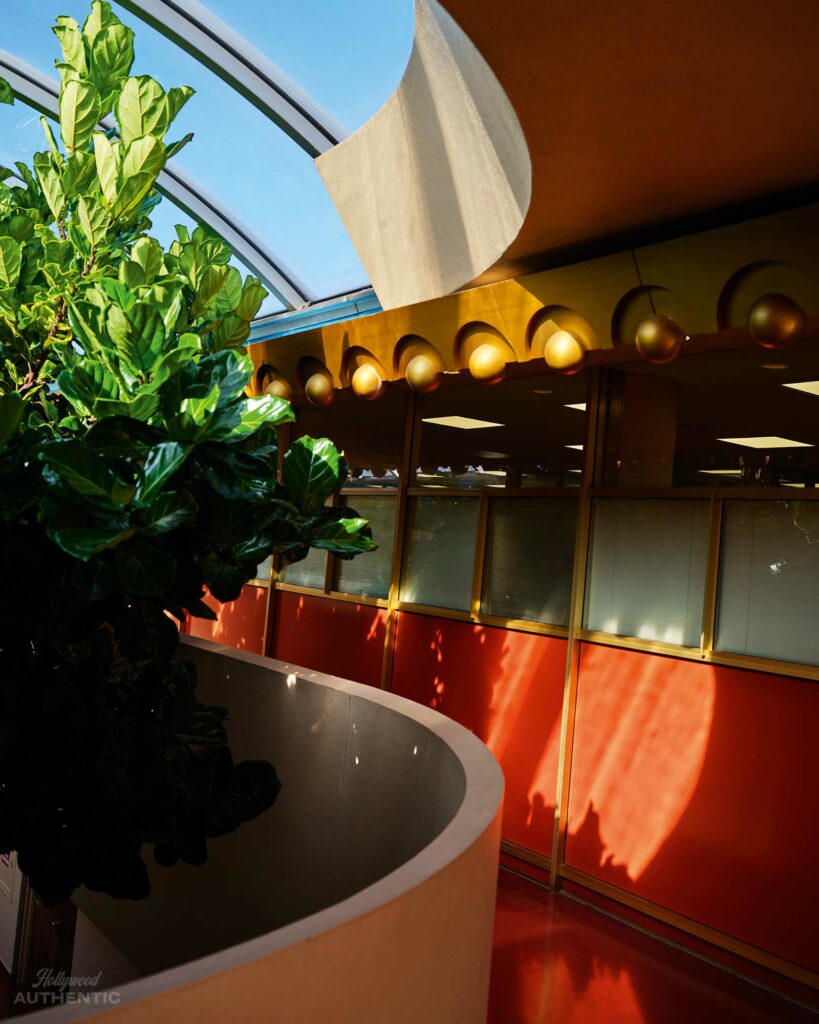
He certainly brought beauty to the valley – designing a 580 ft-long administrative building connected to an 880 ft-long Hall Of Justice and lozenge-shaped library, juxtaposed in classic Wright vernacular by a 172 ft-tall spire (that he erroneously told officials was a vital radio mast in order to get around height laws). His domes were intended to be gold to reflect the surrounding grassland; his interiors boasted his trademark ‘Cherokee red’ in lacquered doors and walls lining circular atriums; his floors custom tiles and terrazzo. His designs were organic rather than stoic and he incorporated literal organic architecture, planning a line of pine trees surrounding the site that would naturally die off to reveal slower growing native oaks over decades. And he predicted our reliance on the car, conceiving three arches in the building so that citizens could drive through the heart of county matters.
Wright died in 1959 before ground was broken in 1960, but his vision was brought to life in his absence and in accordance with his dream of a community environment that reflected the natural world around it. Interior woodwork and furniture designed by Wright and Aaron Green was fabricated locally at the San Quentin and Soledad Penitentiary wood shops. The gold dome was given a sustainable life with a switch to a material that would not tarnish, the blue of it (chosen by Wright’s widow, Olgivanna) reflecting the skies above. Future additions (such as the jail completed in 1994 from Wright’s designs) also reflect his theme of circular spaces, orbs, spheres, arcs and arches. All very celestial, contributing to the sense of entering a beautiful spaceship or intergalactic palace when crossing the threshold.
The civic buildings are always open to the public and would-be Naboo and Gungans wanting to admire the calming campus can do so on a weekly guided tour (Fridays at 10.30am) or self tour via the campus’ app. Perhaps the next-generation’s sci-fi disruptor will be inspired to dream of new worlds gazing through its domed skylights or ascending the escalator through the rich, red concentric circles of the atrium.
Photographs and video by MARK READ Marin County Civic Center. 3501 Civic Center Drive, San Rafael, CA 94903, United States.www.marincounty.org
Words by ARIANNE PHILLIPS As told to JEREMY LANGMEAD
Esteemed costume designer and Hollywood Authentic correspondent Arianne Phillips sits down with a man she describes as ‘the costume designers’ costume designer’, Albert Wolsky, to discuss swapping travel agenting for tailoring, working with legendary directors, dressing Diane Keaton and the beautiful mistakes of the classic musical Grease.
Albert Wolsky, 93, is a great artist with a prolific and profound career that has continued to influence and inform culture across multiple generations. His work spans every genre of filmmaking: drama, comedy, science fiction, period, contemporary, musicals, thrillers. From Grease to Galaxy Quest, All That Jazz to The Jazz Singer, Down and Out in Beverly Hills to Star 80, Manhattan to Sophie’s Choice, Across the Universe to The Manchurian Candidate, Revolutionary Road to Road to Perdition, and Birdman to Bugsy, Wolsky has worked with the most influential directors of the last century and this. He has close to 100 films to his credit.
I have a deep respect, reverence and admiration for Mr Wolsky. I’m in awe of his artistry, his vision, his subtle and bold choices, the worlds he creates, and his layered storytelling. He is truly an icon for me and many of our colleagues.
Albert is also incredibly humble, kind, funny, warm and generous. Preparing for our conversation was nerve-wracking, to say the least – where would I begin? How would I be able to do justice to his more than 50-year career? In the end, our hours-long conversation flew by. Albert shared many wonderful stories and memories. I am thrilled to be able to share a part of that conversation with you here.
AP: Thank you so much for giving us your time.
AW: Not at all. You’ve made me reflect, and think back, which I don’t often do, so it’s been very interesting.
AP: And Albert, as you know, we all like to discuss how we can promote or elevate, even celebrate, the art of costume design and stories such as this help us to do that.
AW: Absolutely. It’s very important. Because otherwise you get totally ignored. Even today it’s always a fight to get your name out there otherwise you get swept under the carpet.
AP: I’m so grateful that I got to talk to you today. You are a costume designer’s costume designer: humble, approachable, warm – and the benchmark that we all aspire to. When I was revisiting your resume I was intimidated because the films you have designed have been probably the most influential ones for me, personally. From Where’s Poppa (Carl Reiner, 1970), Lenny (Bob Fosse, 1974) and Harry And Tonto (Paul Mazurksy, 1974)… all these films my parents dragged me to as a kid. And I was especially inspired by your collaborations with Mazurksy. You made 11 movies together…
AW: Well that was a gift. He is the only director I’ve worked with for that long – between 15 to 20 years. I’ve had influential directors – Bob Fosse, of course, and others – but for me Paul Mazurksy was the benchmark. [During his career, Mazursky, who died in 2014, received five Academy Award nominations and two Golden Globe nominations.]
AP: So Albert, how did you get into a career as a costume designer. You came into it quite late I think?
AW: Yeah, I was 30. I never knew what I wanted to do. And I kept sort of wandering along and got through college and then I was drafted, so I went in the army for two years. When I came out I joined my father who was a travel agent. We worked together in New York City for around five years. We got along really well, but I came to realise that he was doing exactly what he wanted to do. He loved it. And I wasn’t. I was getting more and more miserable to the point where I dreaded weekends because I had to come back to work on Monday. So I thought, well, I’ll have to go in and say, ‘I have to leave,’ and he’s going to say, ‘For what?’ And I would need to say something. And because I liked fashion and loved theatre, I thought why not combine the two? I’ll try to become a costume designer for the theatre. Movies hadn’t crossed my mind at that point.
My father was actually very supportive and so I started asking around to see if anyone would let me study under them. I was persistent and eventually someone suggested I should talk to the renowned Broadway costume designer Helene Pons. She was a designer, but she also ran a costume house, and had executed Cecil Beaton’s costume sketches for My Fair Lady in 1956. [Pons worked with everyone from Tallulah Bankhead to John Gielgud; and as well as My Fair Lady worked on original stage productions such as 1949’s Kiss Me Kate and 1955’s The Diary of Anne Frank.]
We met, I did her a favour with some flights she needed for a trip, and she offered me a job straight away. So I left the travel business on a Friday, and I started on a Monday with Helen Pons working on Camelot starring Richard Burton and Julie Andrews. And that was my beginning. For $100 a week, I helped run her studio and learned on the job. And subsequently got to work for and alongside some of Broadway’s most talented designers, directors and actors.
AP: What was the first production you did on your own?
AW: It was a play called Generation in 1965. It was the first time I got sole credit for costume design. And Henry Fonda was the star. And then sometime later I got a call from the costume designer Theoni V Aldredge [whose work included 1974’s The Great Gatsby, Ghostbusters and Addams Family Values] offering me a film. Assisting on a movie is probably a good idea, I thought, so I said, ‘When do you need me?’ She said, ‘Right away. And I don’t want you to assist. I want you to do it yourself as I can’t.’
It was the film version of one of my favourite books, The Heart Is A Lonely Hunter by Carson McCullers. The cast included Alan Arkin, Sondra Locke and Chuck McCann. Alan was a spiritual man; very nice, and he requested me for the next movie that he did. And so we’re off.
AP: How did you find the difference between theatre and movie costume design?
AW: I first noticed it with the fittings. You could always tell in those days whether an actor came from television or from the theatre by the way he looked in the mirror. A theatre actor would immediately start looking for the character. A movie actor would just pick clothes off the rack. The clothes weren’t him, they were just another costume. I try to avoid working that way. And I very rarely had to deal with that in my career.
One of my favourite people to work with in recent years was Jude Law when we were working on Sam Mendes’ film Road To Perdition in 2002. He really invested in time with the costume, hair and make-up teams. We experimented in many different ways for his character to dress and appear. And what we ended up with had nothing to do with what the person he was playing looked like originally. He was so involved with that. It doesn’t happen very often.
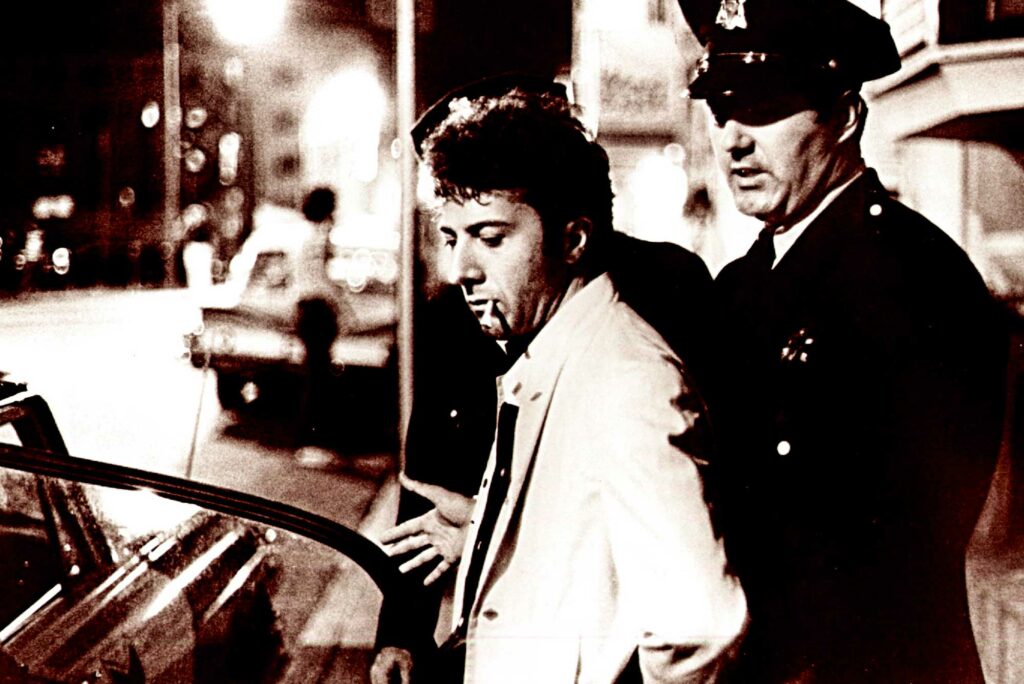
AP: So tell me about working on Lenny, the biographical film about the comedian Lenny Bruce, starring Dustin Hoffman and directed by the legendary Bob Fosse.
AW: Fosse had done two movies, Sweet Charity, in Hollywood, and Cabaret, which he made in Europe. Fosse was not what you would call buddy buddy, he was serious. You never laughed a lot on set with Fosse, but he worked hard. He’d be the first one on set, moving things around, setting up all the camera shots. And he remembered everything. He had that kind of mind. But as far as influence with costumes, it was very free.
We decided we wouldn’t dress Hoffman like Lenny Bruce and after that he didn’t get too involved. I would present my ideas to him and he would say, well, maybe this, or he would say no. It went very smoothly. But he was a true perfectionist. I stepped up a level working for Fosse on Lenny and on All That Jazz.
AP: What do you think made you have such a successful career?
AW: You know, I was starting to reflect a little bit and I thought, I don’t consider myself so brilliant. So how did I do that? I don’t know. When you start out, you’re just glad you’re working. You don’t spend too much time contemplating how or why. But I think I always looked out for a good script, as it gives you ideas, and who the director was. I’m very director oriented. And I’d always hope it was a period piece because I found contemporary very difficult to do.
AP: How come?
AW: Difficult because it then becomes a thing of taste. The other person’s taste, a producer’s taste. There’s so much interference. There’s much less interference in period because they don’t quite know as much. And you can really push harder.
AP: Tell me more about working with Mazurksy?
AW: Oh, we knew each other from New York. And we first worked together on Harry and Tonto in 1974. It starred Art Carney, who won an Academy award for best actor. We worked mostly in New York; Paul preferred it there. Obviously for films such as Down and Out in Beverly Hills (1986) we were based in California.
Paul was very collaborative and would get me involved very early in the process. By the time we started rehearsal, I had had weeks of preparation. And that was a gift. It makes you a better designer, and it makes you able to give more to help the project. Paul was very open to ideas. And smart. What he didn’t know, he picked up very quickly. Being open is so important.
AP: Which other directors have you found collaborative to work with regarding the costume design?
AW: The last great director I worked with in that way, I would say, was Sam Mendes. Road To Perdition, which I mentioned already, with Tom Hanks, Paul Newman and Daniel Craig, as well as Jude – about a mob enforcer in the Great Depression – was a very rewarding experience. Sam was great, a wonderful director.
On the first day of shooting Road to Perdition, there was a scene with 500 people coming out of a factory. And in the afternoon, a bread line of 300 people. That’s a lot of costumes. And as we were setting those scenes up, Sam’s assistant was watching and she came up to me and said: ‘Sam’s going to be so impressed.’ And I said, ‘Well if he doesn’t like them, fuck him.’ Later in the day I get a tug on the arm. It’s Sam. ‘It’s very nice,’ he says. ‘And I understand I have to like it.’
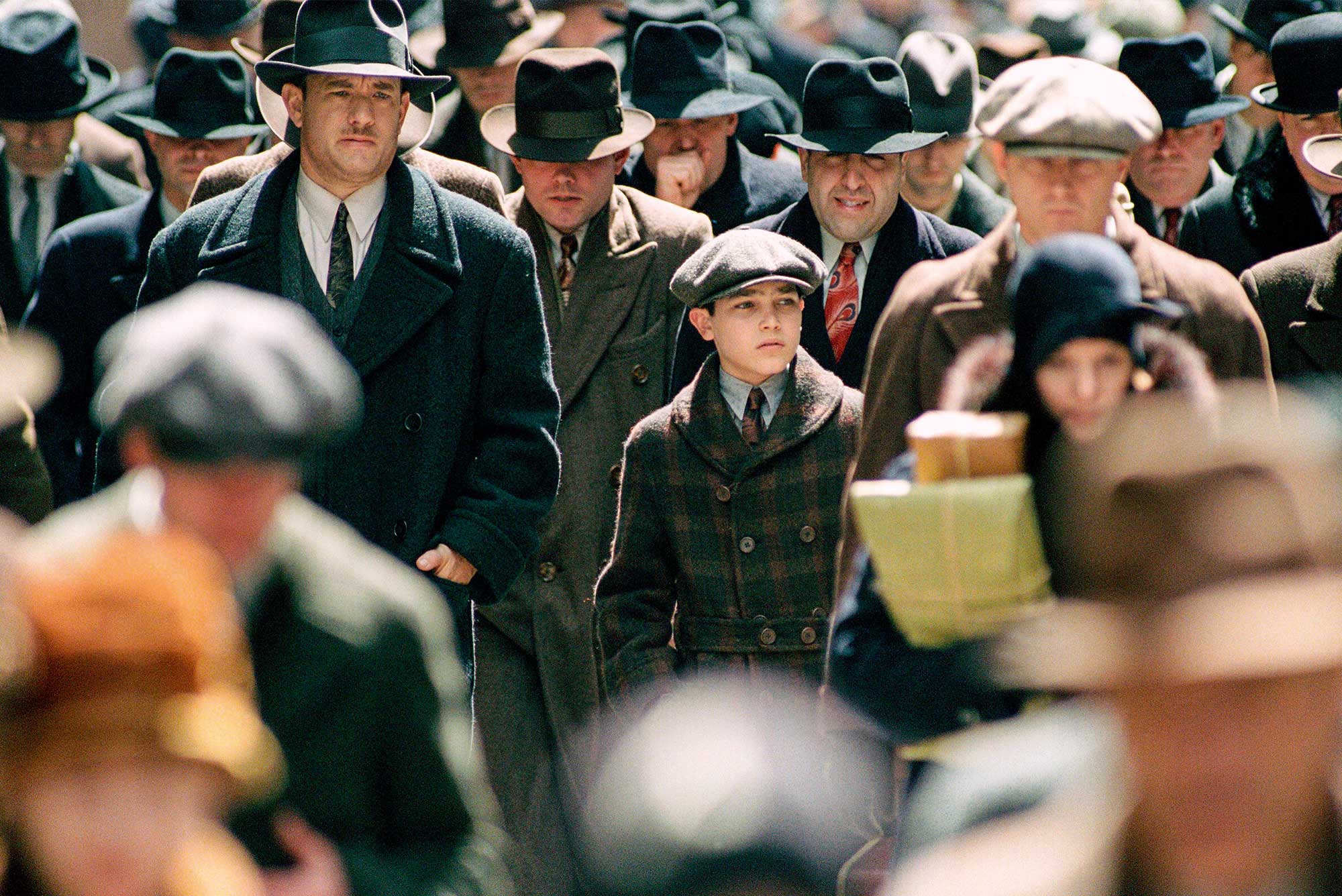
We worked together again on a big crowd costume scene in Revolutionary Road (2008) with Leonardo DiCaprio and Kate Winslet. When DiCaprio is heading to his office in Manhattan from the suburbs of New York in the early 1960s, we had dozens of commuters in similar grey or beige suits and fedoras. Really, that scene was all about the hats.
But you see, you can discover my secret of how I handle some period things. It’s not the exactness of the period, but it’s what people did that helps me. The fact that everybody wore hats. Not every person wore hats then, but for that scene to look right and to tell the story, and to capture the mood, we put everyone in hats.
AP: It’s the thinking like that about costume design that’s important to share. It’s important for people to know what a costume designer does and thinks. It is not just pretty clothes. It’s about storytelling, and it’s about helping the story and helping the director to visualise that story. And if you feel you can help that, it’s a gift for you personally.
AW: Oh, yeah. I think it should always be a collaboration. And it doesn’t matter who gets the credit. I’m not worried about the credit. I’m worried about what we have, what do we need, what do we see, how do we help? And it’s such a joy when it works like that.
AP: Hats have played an important role in a few of your movies. Didn’t you work with Warren Beatty on Bugsy (1991)?
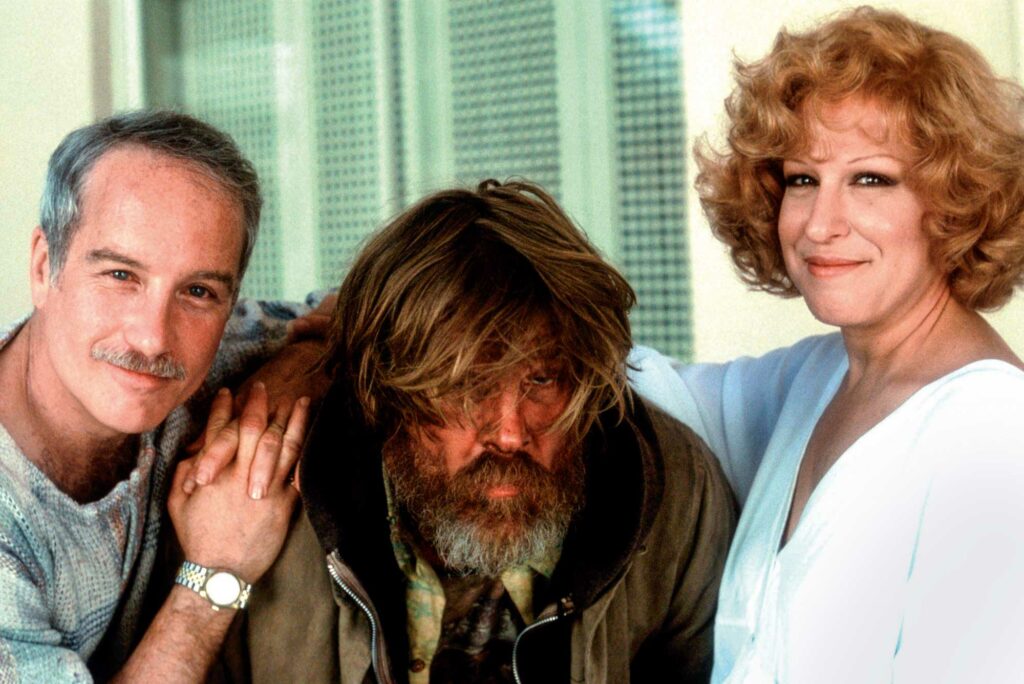
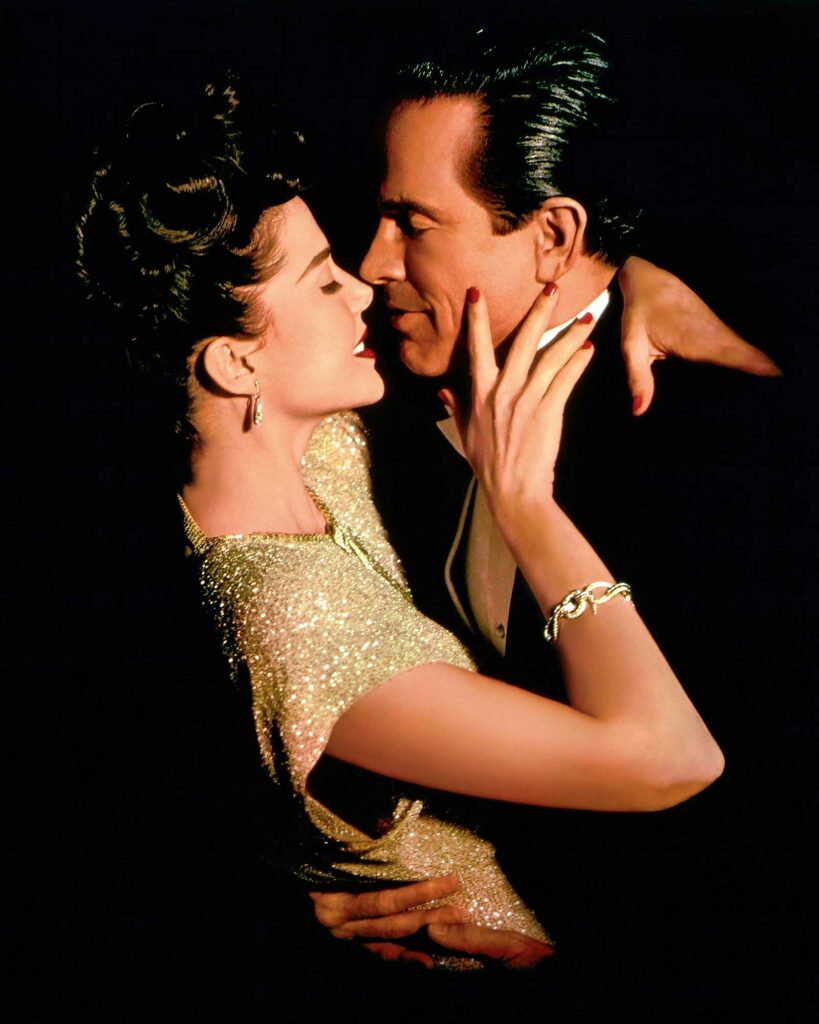
AW: Warren is a lovely man, very talented, but he’s not comfortable with anybody the first time. He has to work with them a lot before he trusts them. It was wonderful working with him and the director Barry Levinson. And then Annette Bening, who was just at the start of her career. She was very open and it was a joy to dress her. The only problem I ever had with Annette is that she never reacted when looking at herself in the costume in the mirror for the first time.
AP: Are you looking for some sort of reaction?
AW: She never said yes, or let’s just do it, or that’s okay. So I would think what’s missing; something’s missing. And then one day, while we were shooting, as she was walking towards the set and I was behind her, she stood straight and everything about her changed. She opened the door, was ready to act, and that changed the whole costume. It came alive. That was so moving to me, to watch. That’s what was missing at the fitting.
AP: It must have been interesting working with Diane Keaton, who has an amazing dress sense of her own?
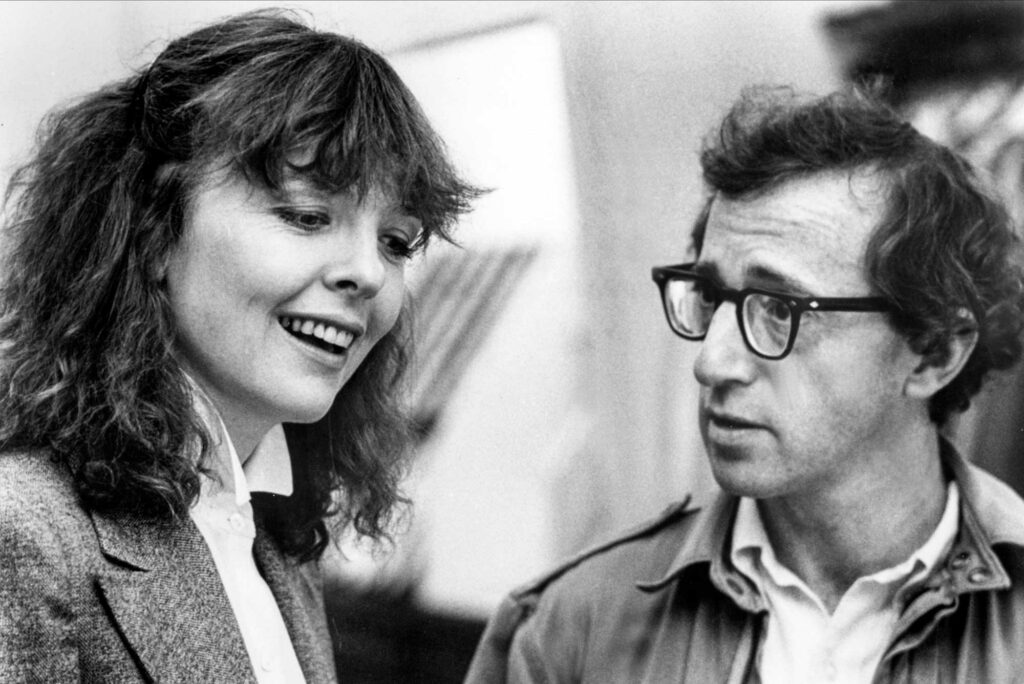
AW: I worked with Diane on Manhattan with Woody Allen in 1979 alongside Meryl Streep and Mariel Hemingway. Diane was very influential on how her character looked; especially after Annie Hall had come out. At that point she was Allen’s girlfriend. I learned that Allen was never going to say no to any actor about how they wanted to dress for the role. If an actor wanted to wear a pajama top, that’s what they wore. Which didn’t always make it easy for me.
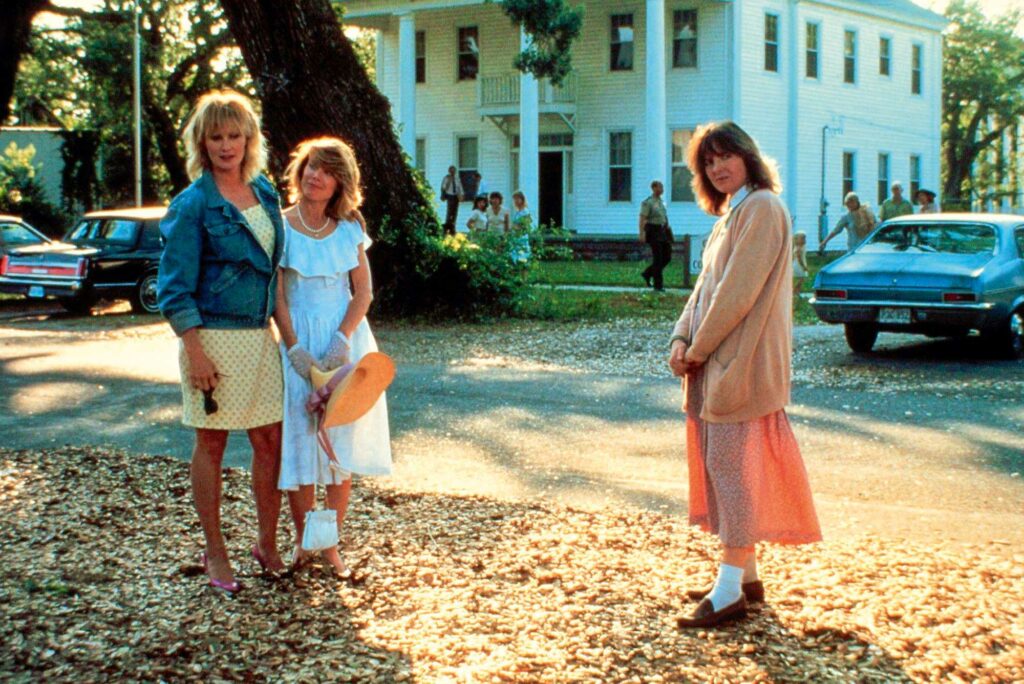
Diane always dresses as if she’s playing a role. Her whole personality is how she looks. When we filmed Crimes of the Heart together in 1986 (Bruce Beresford directed) alongside Jessica Lange and Sissy Spacek, we were all staying in a resort out of town. Off-set, everyone was dressed down in the mornings except for Diane who would appear at breakfast in a big cape, hat, big cross, looking like a character from a different movie. The other two were so in awe of her. I liked her a lot. She was always in costume.
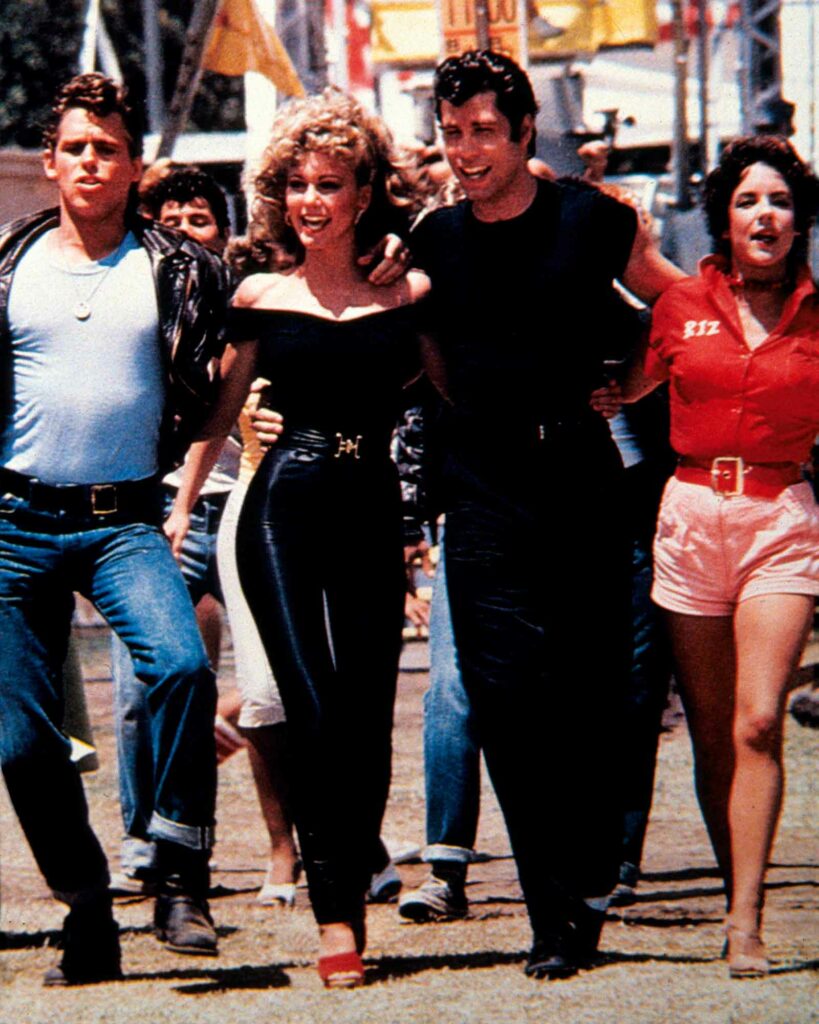
AP: And, of course, you did the costumes for Grease. Costumes that are still emulated and worn by generations who weren’t even born when the film was made in 1978.
AW: In the making of Grease (directed by Randal Kleiser), none of us who worked on it ever thought that it was going to become so iconic. We were just trying to do a good movie. As John Travolta said to me at one of these open-air screenings a few years ago, ‘Albert, do you realise we’re still talking about Grease?’ You know, its endurance and fashion influence is a total surprise; the fact that people now dress in character to go to watch the movie is amazing. It wasn’t what we imagined when making it. I don’t remember if I was trying to make a statement or what. I was just going by numbers. It wasn’t a big budget and the shooting was quite hectic. And everything, everything was off the cuff. The last number… well, we didn’t have a last number when we started the film. I think it was two weeks before they started rehearsing that we were given the script for that scene. But there it was and, all of a sudden, you had to get all the costumes done. In retrospect, the mistakes were better than the non-mistakes. The play was a mess on Broadway, and the movie is a slight mess, but it worked out really well. [It was the highest-grossing live-action musical movie until 2012’s Les Misérables.]
AP: There’s so much more we could talk about, Albert! We will have to continue in person over dinner.
AW: Thank you. You made me feel very good revisiting my work today.
AP: You’ve worked with the most incredible talent because you are an incredible talent. Your extraordinary career is a measure of who you are as a person.
AW: It’s been such a pleasure to be a part of so many stories. It always will be.
Few cities come wrapped in as fine a cloak of glamour as Italy’s lady of the lagoon. Venice is a place of remarkable beauty and splendour, alive with a history that is openly apparent in its canals and churches, museums and monuments. But for the best part of a fortnight at the end of every summer, this European aristocrat becomes even more chic – via the Venice Film Festival, which brings many of cinema’s biggest actors and filmmakers to its door. The fun and games take place all over the city and its islands – but, most notably, in the grand hotels where the A-list comes to stay and play…
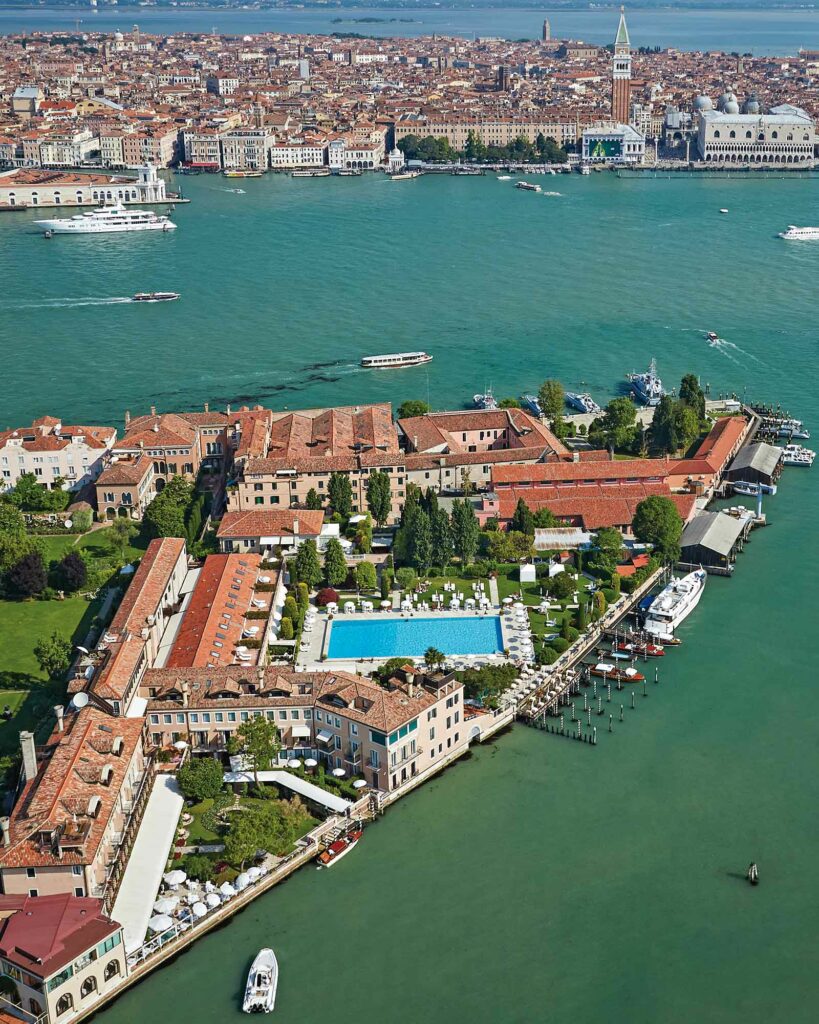
1. THE CIPRIANI If you are looking for a hotel that encapsulates the sophistication of Venice, you need only cast your eye across the water from central San Marco to the nearby island of Giudecca. There, it will alight on the Cipriani – the gorgeous daydream of a hideaway that may be the city’s most exclusive. It has always been a perfect creation – conceived in 1958 as an escape from it all by the chef and hotelier Giuseppe Cipriani. He knew what he was doing, crafting an accommodation masterpiece that was – and still is – an oasis removed from both the tourists who crowd into Venice, and the general commotion of the film festival. But it is not so far removed as to be aloof or impractical. There it rests, at the eastern corner of Giudecca, peering across the lagoon at the belltower of St Mark’s Basilica, just a five-minute ride away by water taxi.
It’s also exceedingly luxurious – both inside, where its chandeliers of Murano glass all but make for an art museum of themselves, and out. The Palladio Suite is the jewel of the 79 sumptuous rooms, a space with 180-degree views of the lagoon, a private dock entrance, a terrace with a plunge pool, and scurrying clouds painted across its ceiling. It is not the only grand space. Somehow, in a city so busy, Cipriani found room to install an Olympic-sized salt-water swimming pool and tennis court. Both have been enjoyed over the years by a cavalcade of talent: Sophia Loren, Yves Saint Laurent, Cary Grant, Burt Reynolds and Catherine Deneuve, to name just a few. Those premiering films on the Lido often make the ‘Cip’ their home, bobbing across the water in Venice’s trademark polished-wood water taxis, or eating shellfish at Il Porticciolo, an oyster bar at the water’s edge. The hotel’s Cip Club, a wooden terrace with breathtaking views of Saint Mark’s, is a delightful place to wind down and make deals. And there are opportunities for relaxation too, at the house spa, which sits within the Casanova Gardens – so-named because the great Venetian lover used to stroll and woo within them.
Cocktails are a firm tradition in the Cipriani’s world. Giuseppe was also the brains behind the famous Harry’s Bar (see opposite page), while George Clooney, a regular guest, helped to create the Buona Notte (a mix of vodka, lime, fresh ginger, cane sugar, bitters and cranberry juice) and the Nina’s Special (a combination of elderflower and passionfruit, named in honour of his mother) on prior stays. Hollywood Authentic’s founder also has a drink named after him; ‘The Greg’ is a bowl glass filled with ice and prosecco. Saluti!
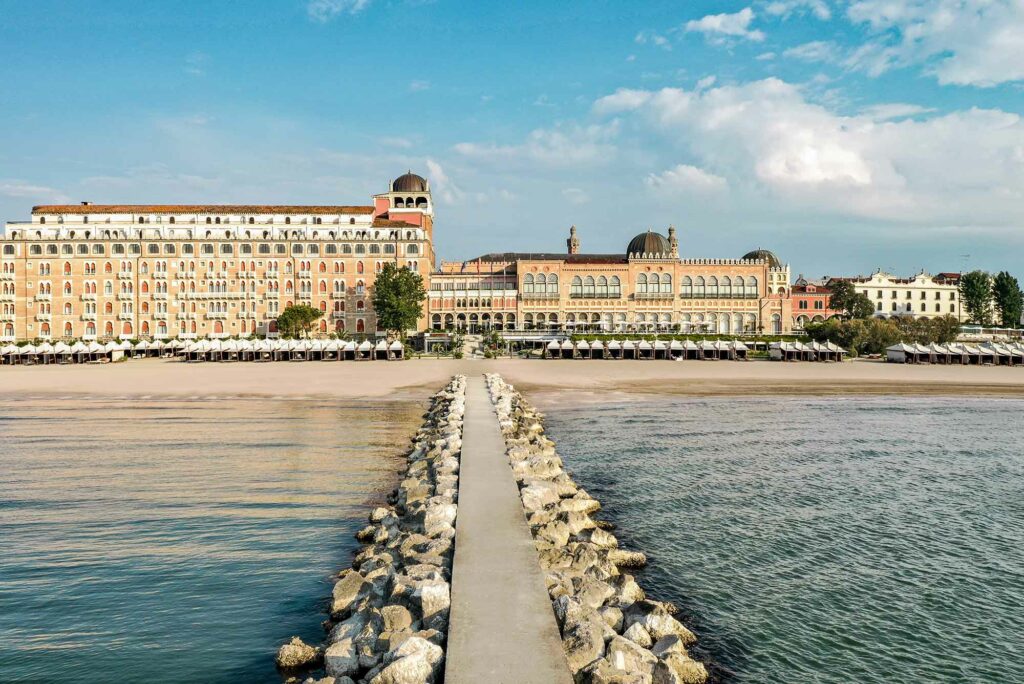
2. THE HOTEL EXCELSIOR One hotel has always stood at the epicentre of the Venice Film Festival – acting as its official venue since the inaugural event in 1932. But then, the Excelsior can trace its tale back even further than that. It formally opened its doors in 1908, amid the optimism of the Belle Époque – the period of good times that preceded the First World War.
It does not sit among the bridges and palaces of fabled San Marco – instead, it waits on that long barrier island, the Lido, facing the Adriatic. Its location has always served the festival well, softening the cut and thrust of the event with sea breezes, golden beachfront views and a landing jetty slap-bang next to the festival’s premiere cinema. This formula has worked since 6 August 1932, when the original festival began with a screening, out on the terrace, of the horror classic Dr. Jekyll and Mr. Hyde, with Fredric March in the dual title role. There have been plenty more star guests in the subsequent decades – such as Winston Churchill, and the Duke and Duchess of Windsor, who slumbered in its spacious rooms. Appropriately, there have been plenty of visits by Hollywood royalty as well – Ingrid Bergman, Marlene Dietrich, Greta Garbo, Clark Gable, James Cagney and Joan Crawford all enjoyed scarcely needed beauty sleep under the Excelsior’s cupola-dotted roof. Nowadays, many of the festival’s contemporary artists enjoy the Moorish-design balconies during stays and junkets.
The hotel is so embedded in movie culture that it has appeared on camera pretending to be somewhere else. When Robert De Niro’s New York hoodlum eats out at a Long Island seafood restaurant in Once Upon A Time In America, he is, in fact, enjoying the pleasures of the Sala Stucchi – one of the Excelsior’s most feted dining spaces.
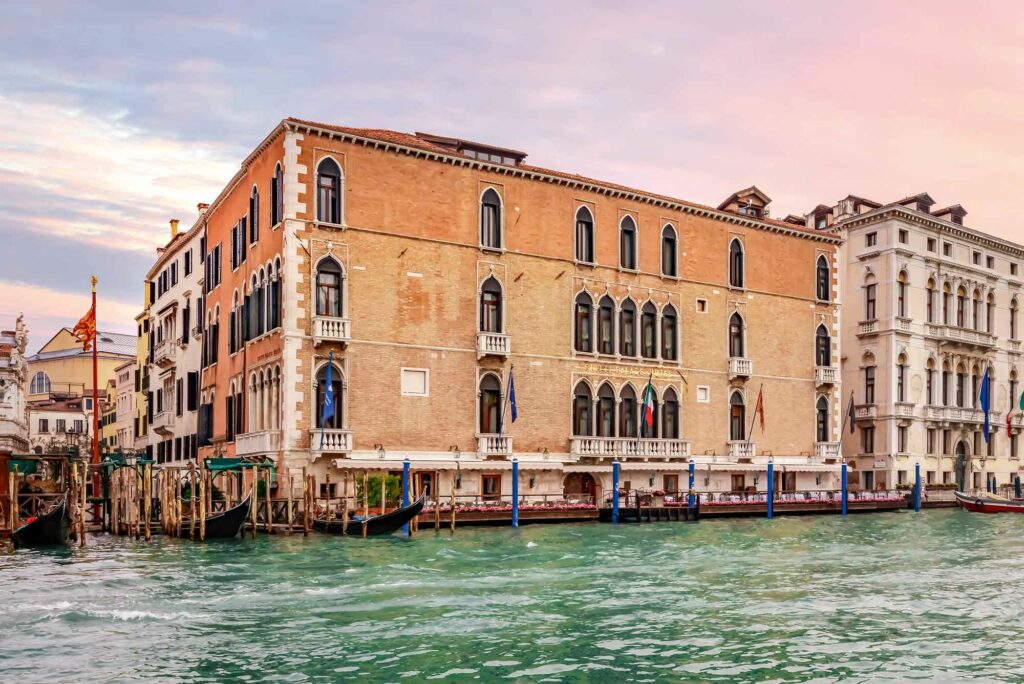
3. GRITTI PALACE Like the Cipriani and the Excelsior, the Gritti Palace’s location is both desirable and on the water – but, in this case, on the north edge of the Grand Canal, in the core of the medieval city. Formerly the Palazzo Pisani Gritti, a stately mansion originally constructed in the 14th century, it still bears the name of its most famous resident, Andrea Gritti, the nobleman who held court as the Doge (Prince) of Venice between 1523 and 1538. He is not the only power player to have slept here. In the near-130 years since the palazzo was converted into a hotel (in 1895), the likes of Grace Kelly, Humphrey Bogart and Charlie Chaplin have all checked into its ornately decorated rooms (82 in total, including 10 suites), as well as Ernest Hemingway – always a man with good taste in accommodation. And the hotel became a cinematic star in its own right in Woody Allen’s romantic caper Everyone Says I Love You – the actor-director’s typically anxious New Yorker attempting to woo Julia Roberts, who is staying in the Gritti’s Hemingway Suite.
More recently, the property became a safe haven for Tom Cruise, who was in Venice when the Covid pandemic struck in March 2020, while doing the groundwork for Mission: Impossible – Dead Reckoning Part One. He made the wholly understandable decision to lock down in the city at the Gritti Palace. Why wouldn’t he, when the Riva Lounge, a grand terrace with one of the best views of the Grand Canal, awaits?
As writer W Somerset Maugham observed: ‘There are few things in life more pleasant than to sit on the terrace of the Gritti when the sun, about to set, bathes in lovely colour the Salute.’ Its green marble and antique mirrored interior makes for one of the most beautiful bars in Italy. Order the dry martini (Hemingway’s favourite tipple while staying) from the bespoke martini cart, and relax.
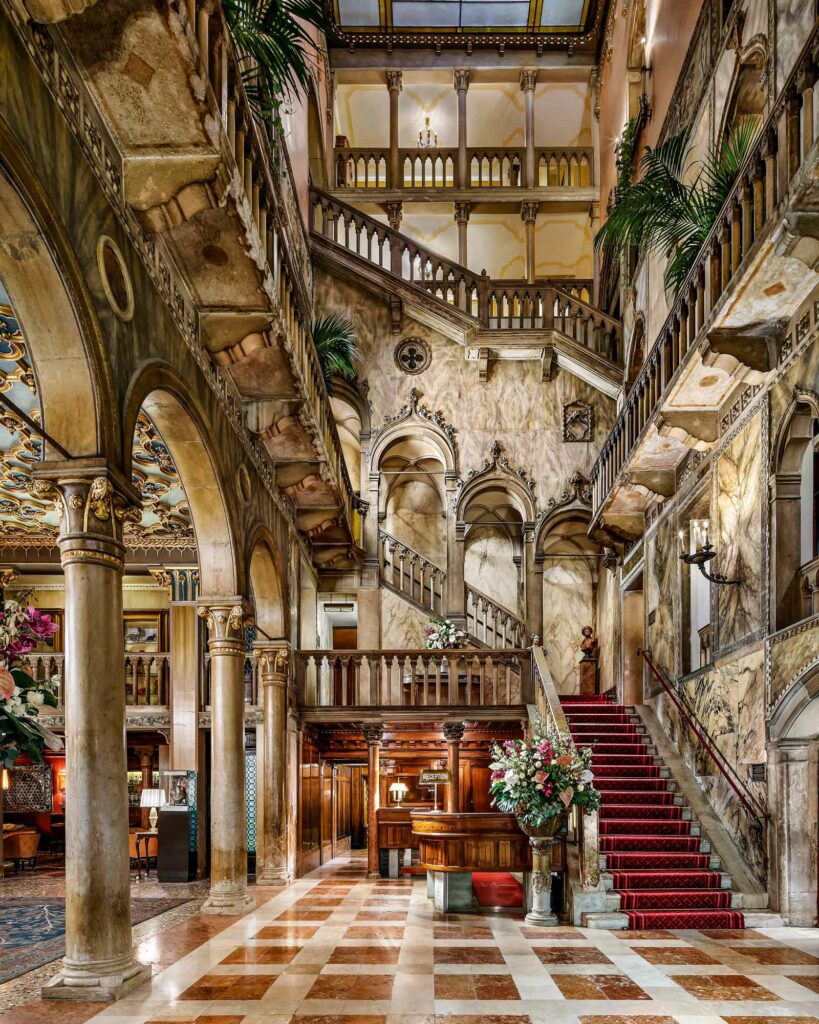
4. HOTEL DANIELI The regal Danieli has been a supremely distinguished spot on the Venetian map for more than 700 years. Set just around the corner from St Mark’s Square (with a rear facade that overlooks the quayside of Riva degli Schiavoni), its location is also superb. It encompasses another 14th-century mansion, the Palazzo Dandolo. And as with the Gritti, its name harks back to a genteel former resident – Giuseppe Dal Niel, a wealthy 19th-century local, who went by the nickname “Danieli”. It was he who purchased the property in 1824, restored it lavishly, and began its transformation into a hotel. It now houses the renowned Gritti Epicurean School and the Explorer’s Library, a sacred space for bookworms, with its collection of rare tomes.
Danieli would surely be thrilled that his passion project is still so revered exactly two centuries later. Charles Dickens, Peggy Guggenheim, Leonard Bernstein, Marcel Proust and Honoré de Balzac, as well as Steven Spielberg, have all crossed the threshold. It is a star location for The Tourist and the Venetian segment of Indiana Jones and the Last Crusade.
It is also one of the sites to have helped to cement the alliance between Venice and James Bond – a union that began with From Russia With Love in 1963, and continued with 2006’s Casino Royale. However, it was neither Sean Connery nor Daniel Craig who strolled through the Danieli on celluloid. Its Suite del Doge (royal suite) housed a spot of horseplay between Roger Moore and Lois Chiles in 1979’s Moonraker.
If you can tear your eyes away from the fondant of a balustraded internal staircase in the lobby, check out the photos of another noted guest – Elizabeth Taylor and her Pekingese pups arriving for one of her many stays.
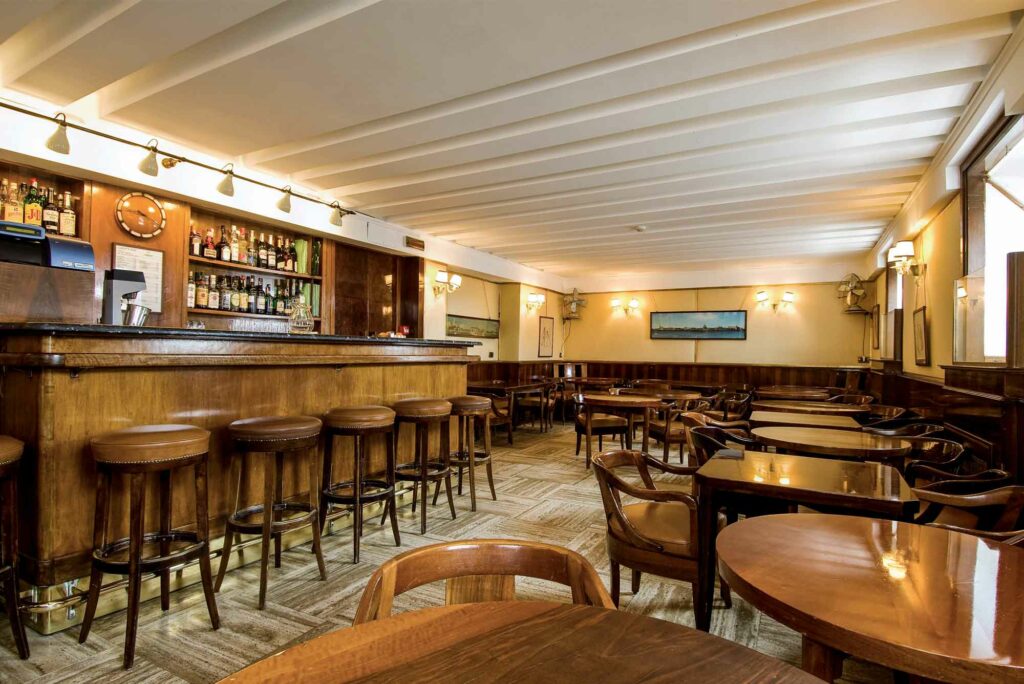
HARRY’S BAR A true Venetian icon, the bijou Harry’s Bar was opened in 1931 by Giuseppe Cipriani, 27 years before he dreamt up his hotel. He named it after an American tourist, Harry Pickering, to whom he lent money to while working as a bartender at the Hotel Europa. Pickering later returned to Venice with the repayment and more; enough cash for Cipriani to open his own establishment. It is a watering hole where two indulgent traditions were born. In 1934, Cipriani paired champagne and white peach juice to produce the Bellini, a refreshing delight of a drink that many festival-goers will be familiar with. And in 1963, Venetian countess Amalia Nani Mocenigo requested a light snack, adding that her doctors had instructed her not to eat processed meat. In a moment, Cipriani had invented beef carpaccio, complementing the thin slivers of pink flesh with lemon juice and salt.
To sip a Bellini, in trademark stemless glasses, at the wooden bar is to follow in the footsteps of Ernest Hemingway, Truman Capote and Maria Callas.
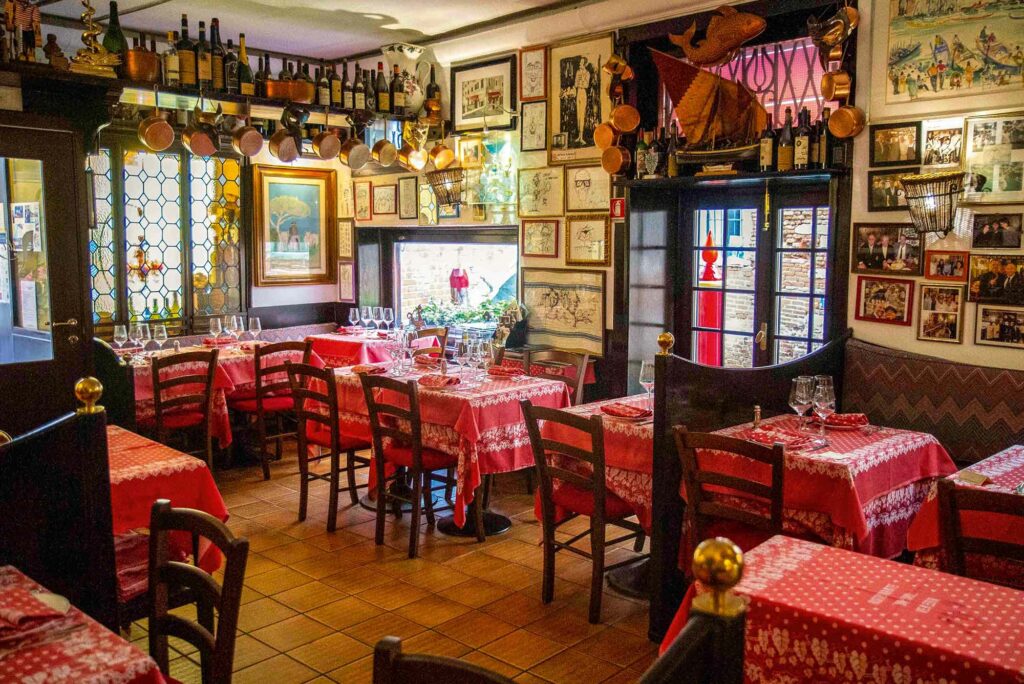
DA IVO RESTAURANT George Clooney held his stag do this at this cosy San Marco trattoria with cheery red tablecloths, specials chalked on a gilt-framed blackboard, and its own gondola stop. With good reason. The menu takes in oysters and delights such as duck pasta, octopus ragu, Granseola crab and the Venetian desert, Sgroppino – whipped lemon sorbet, prosecco and vodka with a dash of Calvados, designed to ‘untie a little knot’ after over-indulging. Which you surely will.