


Photographs MARIO DE LOPEZ
Words by MATT MAYTUM
A modern classic that has come to define 21st-century LA, this musical monument to one of Hollywood’s most ambitious producers is an audio and visual masterwork; a striking feat of design embraced by the music community and the movies.
Hollywood Authentic reflects on the genius that inspired the Walt Disney Concert Hall – ‘the light of the Hollywood dream’.
How long does it take for a building to become a landmark? The Walt Disney Concert Hall in Bunker Hill makes the case that it can happen instantaneously, even if the journey to the opening wasn’t always smooth. Standing as a monument to two giants in their respective fields – pioneering filmmaker Walt Disney and exuberantly ambitious architect Frank Gehry – the venue, which is home to the LA Philharmonic, was conceived as ‘a living room for the city’. That contradiction between welcoming accessibility and imposing achievement defines Disney and Gehry. Both made magic that sprung from pencil sketches.
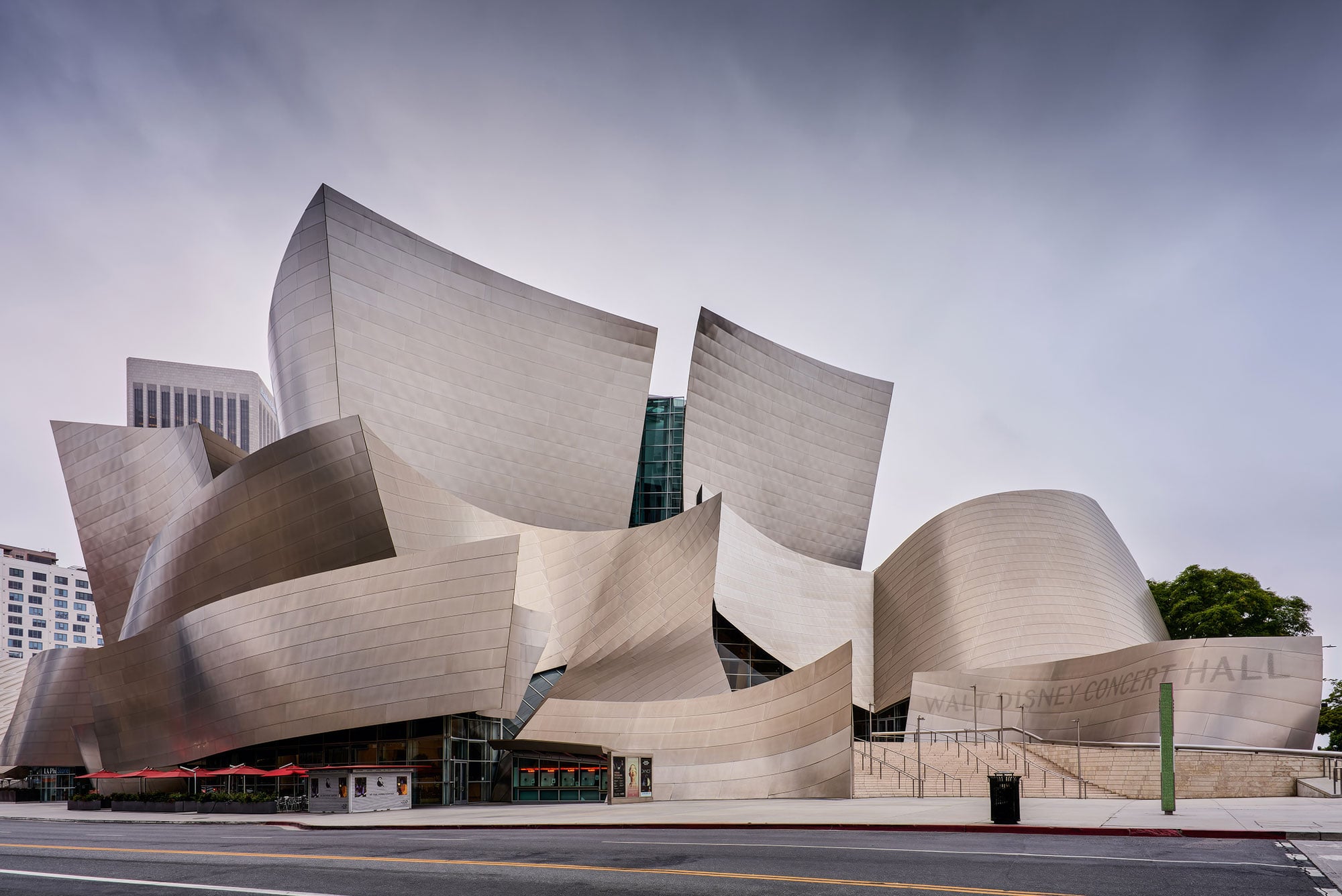
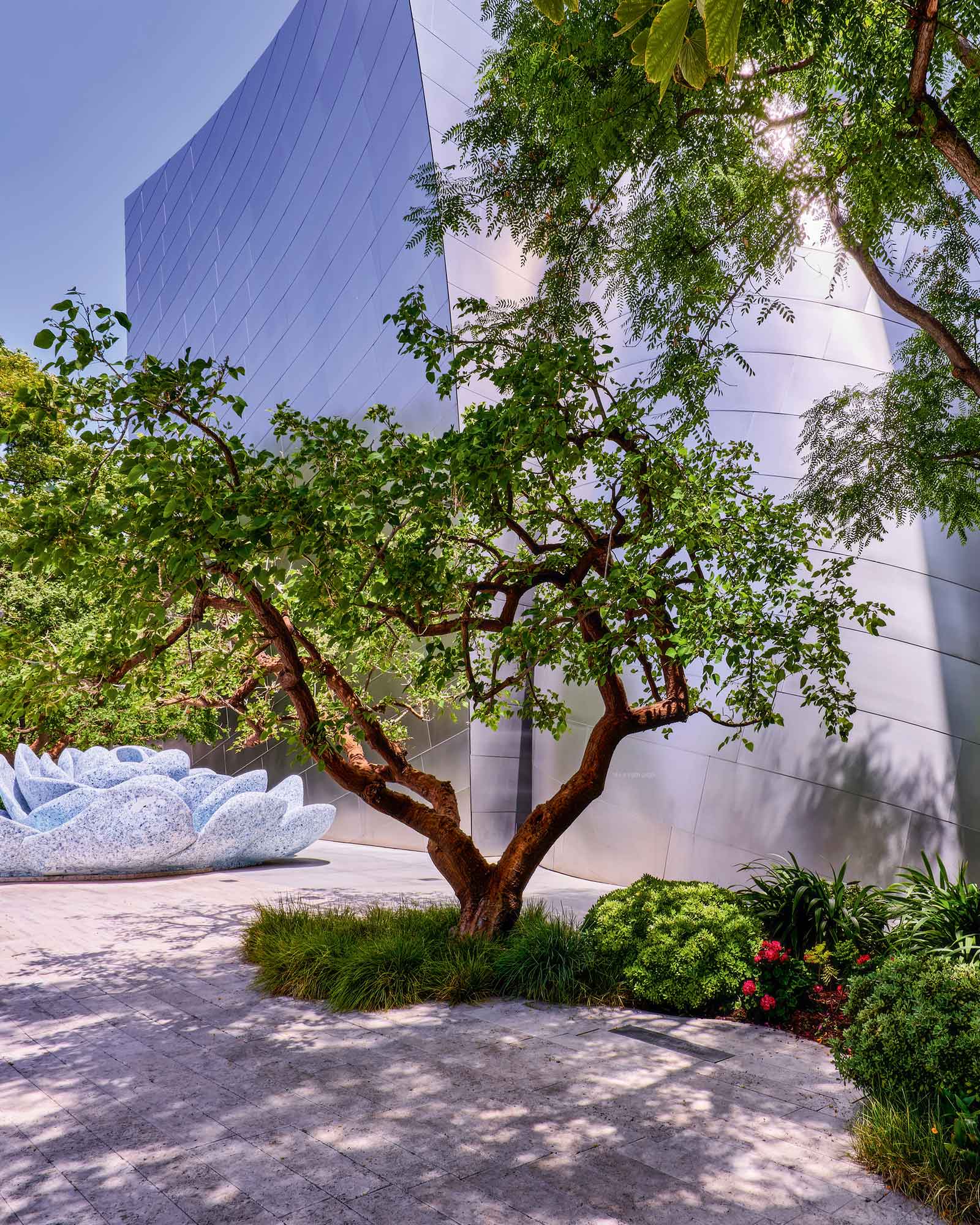
To see Gehry’s squiggly starting point for the Concert Hall, it’s almost impossible to fathom what it turned into. There’s a deconstructivist spirit to the gleaming surfaces that make up the striking exterior of the building, which remains open to interpretation. Do you see a futuristic spaceship with sails, or loose, billowing music sheets, or something else entirely? It’s an invitation to imagination, the building’s clean visual sweep belying the technical rigour required to bring it to life when it first opened in 2003. Even if you’ve never been – and a reported four million visitors flocked there within the first three years of opening – you’ve certainly seen its sleek lines in one of its many TV and film appearances. But it wasn’t all plain sailing…
The project began in earnest in 1987, with a $50m donation from Walt’s widow, Lillian Disney, which she bestowed on the Los Angeles Music Center (Lillian would die 10 years later, before the hall was completed). It was a tribute to Walt’s passion for the arts, and music in particular – classical music was central to so many of his animated works, not least the Silly Symphony shorts and his 1940 opus Fantasia, which synchronised classical pieces with shorts of varied animation styles. As Walt’s work made entertainment accessible for all, so would the Concert Hall.
Finding the architect was the first step, and Gehry was eventually chosen as the longlist was whittled down to one (other contenders had included architecture giants Hans Hollein, Gottfried Böhm and James Stirling). Canadian-American Gehry was one of the biggest names in the business at the time, and worked on the Guggenheim Museum Bilbao over a similar time period (though the Spanish building would be completed first, and its shiny metallic finish would eventually inspire the Concert Hall).
After landing the appointment, Gehry visited the Berliner Philharmonie concert hall, staying in the city for a week and attending every concert. The feeling of intimacy that architect Hans Scharoun had achieved was inspiring to Gehry, who described the German as ‘a master of people-feeling architecture’. The Walt Disney Concert Hall took the best part of two decades to come together, and there was a period of a couple of years from 1994 where construction stalled entirely, thanks to a runaway budget and reported internal feuding, before it got back on track in 1996, with help from numerous benefactors; many are named on the sweeping tiled wall inside, and the curved staircase is named in honour of film composer Henry Mancini.
Gehry had originally planned to have the Concert Hall finished in stone, which he believed would glow at night. But budgetary concerns twinned with the success of Bilbao made the now iconic metal finish inevitable. Gehry leaned on Dassault Systèmes’ CATIA (Computer-Aided Three-Dimensional Interactive Application) to translate the design into practical plans for contractors. Such VFX tech was necessary to bring his idea into reality; every stainless steel panel used is a unique shape. To avoid the need for rivets, 3M’s VHB Tape – a kind of super, double-sided tape also used on aircraft – held the panels in place.
When it opened in 2003 – at a total cost of $274m – it became an instant classic (despite some protests over the spending given the city’s poor and homeless population). A review in the New York Times called the Concert Hall ‘a French curve in a city of T squares’, evocatively describing it as ‘the light of the Hollywood dream’. Yes, some of the panels needed to be sanded down as they were creating too much glare for drivers and overheating some nearby apartments, but it’s no surprise that film stars and movie fans have flocked to the location.
Among its notable screen appearances, the Walt Disney Concert Hall is also the setting for a swanky event ahead of the climax of 2008’s Iron Man. Where else for genius, billionaire, playboy, philanthropist Tony Stark? In the same year, it was also featured in a pivotal sequence in spy comedy Get Smart, starring Steve Carell and Anne Hathaway, who are at the venue to stop a bomb threat against the president (James Caan), who’s attending a concert. ‘It’s the crown jewel of LA,’ Get Smart’s location manager Kokayi Ampah said of using it in the film. ‘It says you’re in LA.’
The project began in earnest in 1987, with a $50m donation from Walt’s widow Lillian Disney, which she bestowed on the Los Angeles Music Center
The Concert Hall also provided near-future vibes for Spike Jonze’s prescient AI-companion romance Her, as Theodore (Joaquin Phoenix) and Samantha (voiced by Scarlett Johansson) people-watch, and Marion Cotillard’s tortured soprano had a residency there in outlandish musical Annette. It received the ultimate decree of pop-culture status with a parody on The Simpsons (featuring a cameo from Gehry himself).
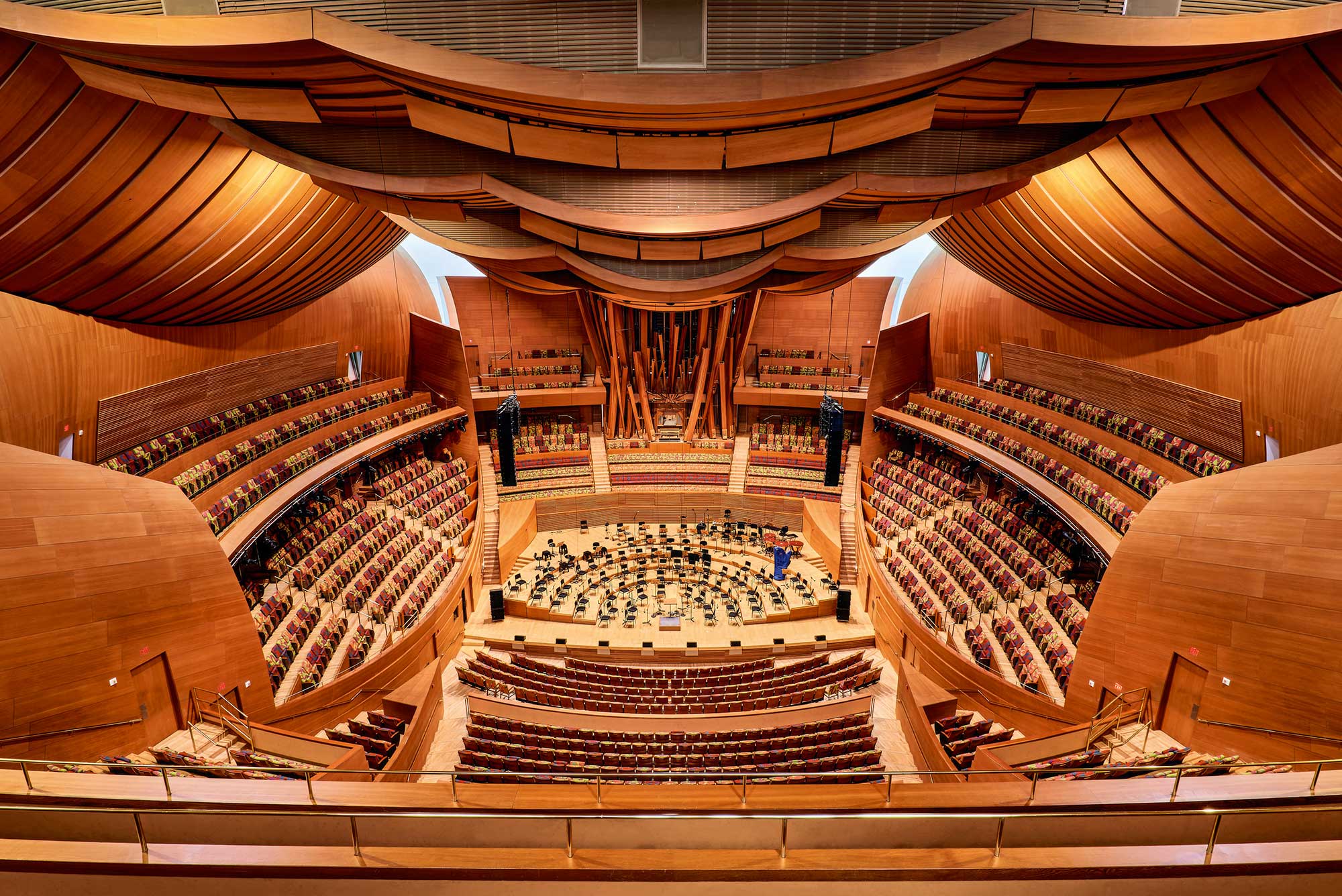
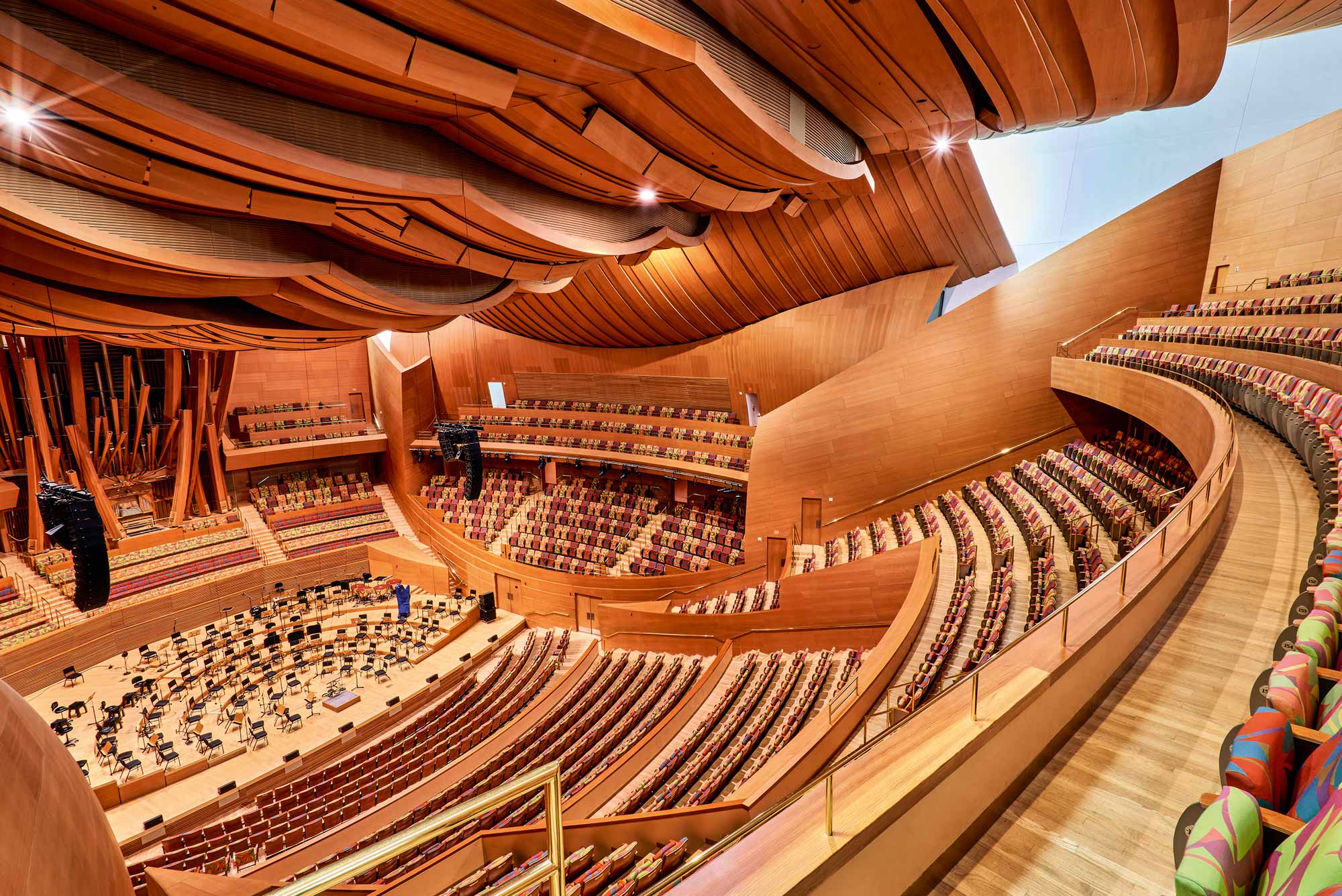
But perhaps its most apt onscreen use was in Joe Wright’s The Soloist, which told the true story of Nathaniel Ayers (Jamie Foxx), a gifted cellist who develops schizophrenia and becomes homeless, before finding a path back via journalist Steve Lopez (Robert Downey Jr.). Because, for all the cinematic showiness of the building’s exterior, it is first and foremost a music venue, and while those sweeping curves continue inside, the wooden surfaces – which glow almost gold – add to a cosy, inviting space.
The acoustics were baked into the design of the building as a priority. Gehry broke away from the conventional ‘shoebox’ layout for a concert hall, to have the seating in the round. While this seating makes it slightly more awkward for visitors to file into, Gehry said that ‘the payoff is incredible’, that the musicians felt more connected to the audience, and vice versa. Testing the sound on a scale model and working with acousticians Yasuhisa Toyota and his predecessor Minoru Nagata, to ensure that there was not a bad seat in the house when it came to sound. With the sound reflection offered by the Douglas fir panelling, there’s no need for audio amplification for any of the 2,265 seats.
A focal point of the hall is the 6,134-pipe organ that Gehry designed in conjunction with organ designer and builder Manuel J. Rosales. The pipes are referred to as French fries for the way they poke out irregularly, in a riposte to the anticipated formality of such an instrument. It’s another fun personal touch in a venue where everything feels generously considered, from the lobby’s ‘trees’ (wood-clad metal beams) to the lily fountain that can be found in the Blue Ribbon Garden. The latter was a tribute to Lillian Disney from Gehry, who instructed Tomas Osinki to build the smooth, wavy structure from thousands of mosaic fragments created from specially acquired Royal Delft Blue porcelain. Gehry had said at the time of completion that he saw the Concert Hall as a ‘kind of flower’ to Lillian, and that expression finds fitting form in this graceful marvel.
Gehry died in December 2025, leaving behind an incredible legacy. Like Walt Disney, Gehry was an innovator who brought art and imagination to the masses. It’s fitting that his most iconic work pays tribute to a fellow trailblazer, and like Walt’s work it will continue to entertain and inspire.
Photographs by MARIO DE LOPEZ
Words by MATT MAYTUM
The Walt Disney Music Hall
111 S Grand Ave, Los Angeles, CA 90012
www.laphil.com