


Words by ARIANNE PHILLIPS
As told to JANE CROWTHER
A fashion designer turned costume designer, Jacqueline West has worked with some of the titans of cinema during her career. She tells Hollywood Authentic how she takes her characters shopping on projects with Malick, Scorsese, Iñárritu and Villeneuve.
Jacqueline West is an acclaimed costume designer whose work has helped define the visual identity of some of Hollywood’s most celebrated films. Known for her meticulous research, artistic craftsmanship and ability to create costumes that deepen character narrative, Jacqueline has built a distinguished career spanning more than three decades and 33 films. She gained widespread recognition for her early work on Quills in 2000, earning her an Academy Award nomination for Best Costume Design. Since then, she has collaborated with many of the industry’s leading directors, creating memorable costumes for six films with Terrence Malick and projects such as Killers of the Flower Moon, The Revenant and the Dune trilogy – all of which have garnered international acclaim for their distinctive blend of epic scale, cultural influences and accuracy, as well as imagination and vision. Whether crafting period garments, contemporary wardrobes or imaginative, futuristic costumes, she combines extensive research with a deep understanding of character psychology. Throughout her career, she has received numerous awards and recognition – including five Oscar nominations – and is widely respected by fellow costume designers. She remains one of the most influential costume designers working in film today, with the highly anticipated Digger and Dune: Part Three releasing later this year.
AP: We have a long friendship and connection, but I am really curious to know a little bit about what I call your origin story – your work as a fashion designer and your lead-up to becoming a costume designer.
JW: Well, my mother lived over an iconic dress shop, Yarmo, in Berkeley, had a wonderful eye for clothes, and had her own clothing store. She was a designer at [renowned San Francisco clothing company] Lilli Ann. So when I was a little girl my dress-up was a mannequin in my bedroom, and all of my mother’s discarded Dior, because they would send my mother to France to copy Dior for Lilli Ann. As a costume designer I’ve used pieces of my mother’s, like on Cate Blanchett, when she’s walking in the snow with the Russian ballet dancer in Benjamin Button. I was going to make it for her. But she tried the original on and said, ‘No. I’m wearing your mother’s coat.’ As a child I never had cut-out paper doll books and stuff. I cut up my mother’s Vogue magazines. I worked in Yarma and then I opened up my own store next door to Chez Panisse, [chef] Alice Waters’ iconic restaurant. I’d get her dressed in my store and Annie Leibovitz, who always photographed her, would come in. Then my store really took off, and I started my own clothing line in 500 stores. One day Philip Kaufman came in. He was doing The Unbearable Lightness of Being, and he came shopping with Jean-Claude Carrière. He was thinking of doing Henry & June and I said, ‘You know, I had coffee with [writer] Anaïs Nin.’ And he said, ‘Have you ever thought of being in the film business?’ I said ‘No’.
AP: How did you come to work on Henry & June with Kaufman?
JW: He asked me to dinner in Paris, where he asked me to come and design. He gave me a driver and a bunch of francs. And I went off on my merry way, and started buying clothes at Marché Malik for Uma Thurman and Maria de Medeiros. The title he gave me was ‘overall artistic consultant to the director’. He had me buying stuff for Anaïs Nin’s house, because he loved how my house looked, and he thought that’s how her house would have looked. I would just go to all the markets and antique stores, and buy anything I thought was her style because I knew her diaries back and forth. How I happened to meet her is, I was in Berkley and I walked to the Northside Café and she was sitting there. I had just read all her diaries, and we had the same exact dress on – an India Imports from Telegraph Avenue; I had the mini, and she had the maxi. She smiled at me and pointed to her dress, and then I took her books out of my book bag. She waved me over to sit with her. I thought my boyfriend was going to die when he walked in, and I was sitting with Anaïs Nin.
AP: At what point did you decide to move from fashion to costume?
JW: I stayed in the fashion business for quite a while, until after Quills. Because I thought, ‘I’ll just work with Phil, and I’ll do both.’ It was hard to give up because that was really in my blood. In fact, when he asked me to do Quills, I said, ‘No, I’m a Thoroughly Modern Millie. I don’t know how to do this.’ And he said, ‘You’re an art history major, and you can do anything.’ My husband, James, was a fashion photographer for French and British Vogue. He said, ‘Listen, you have an eye. All you do is get to know the character, and take them shopping in that period.’ When I did Quills, I came home and wrote ‘I quit’ – on my store – ‘gone to Hollywood’.
AP: It’s a beautiful start.
JW: You’re not so bad yourself, kiddo. I’m a fan of yours. I think we work very similarly.
AP: When beginning a new project, how do you collaborate with a director to establish the visual language of the characters? And what informs your choices on what films you choose to design?
JW: My husband had to give me that advice again on Dune, because I said ‘no’ to Villeneuve because I don’t do sci-fi. Denis said, ‘I want you because I don’t want it to look like a sci-fi movie.’ So, first of all, the script has to grab me, and it has to be a director with a strong vision, and I have to love the vision. As far as my process with the director – Edith Head gave me the best advice. When I first got in the business, Phil gave me her life story as a birthday present, and she said, ‘Read the script seven times. Get to know the characters. And then they’ll dress themselves.’
AP: Let’s talk about being able to balance the historical accuracy and the storytelling like on The Revenant and Killers of the Flower Moon. How do you balance authenticity with your creative interpretation?
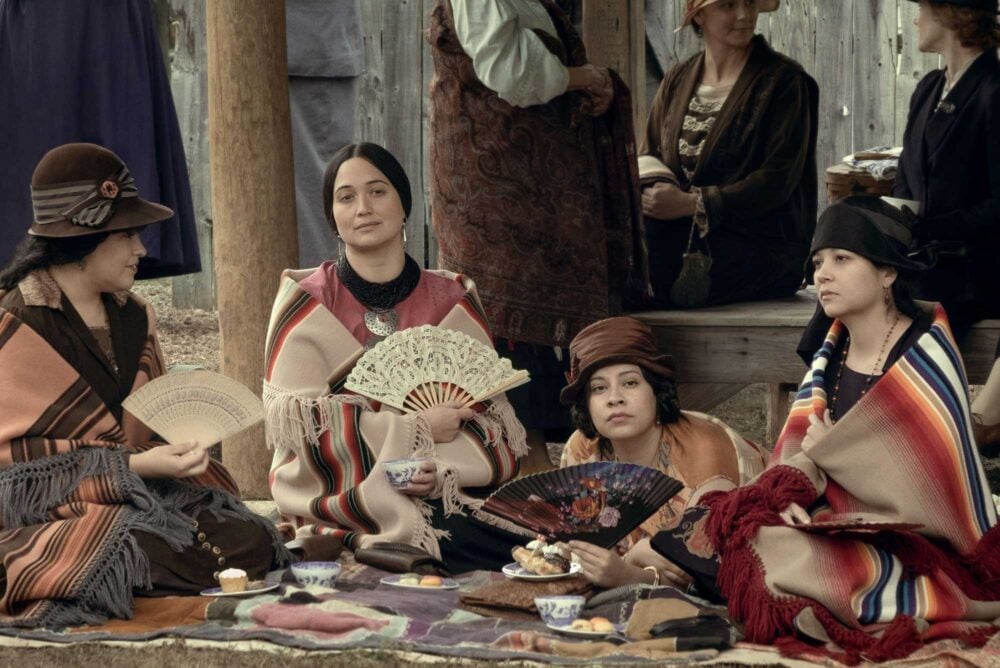
JW: Well, I always lean towards the authentic, rather than the creative side. I love research. I love copying things from paintings. I work with Terrence Malick a lot. He’s very anti-costume. He has to feel everything. He gets a gut reaction to everything. On The New World, there were no paintings or drawings. It was John White’s etchings and little pen drawings. I did all my research from reading all of John Smith’s diaries. When I lecture students, I always say, ‘read voraciously’. I have stacks and stacks of costume books, photography books. On Dune I had these favourite books I’ve had for years called The Orientalist, and I really relied on those for all the Fremen. For Dune: Part Three, I used a lot of samurai references. Everyone asks me what one of my favourite films I’ve done is, and it was Benjamin Button, because it was 100 years of fashion. But I think I’ve gotten every job with every big director I’ve ever worked with because I worked with Terrence Malick. He is the director’s director. When Scorsese called me for Killers of the Flower Moon, he said, ‘You work with Malick. That’s all I need to know.’
AP: I had a similar experience because I designed for Milos Forman, The People Vs Larry Flint, and now I get enquiries because of Tarantino. What have you learned from the directors that you’ve worked with who have such distinctive visual styles?
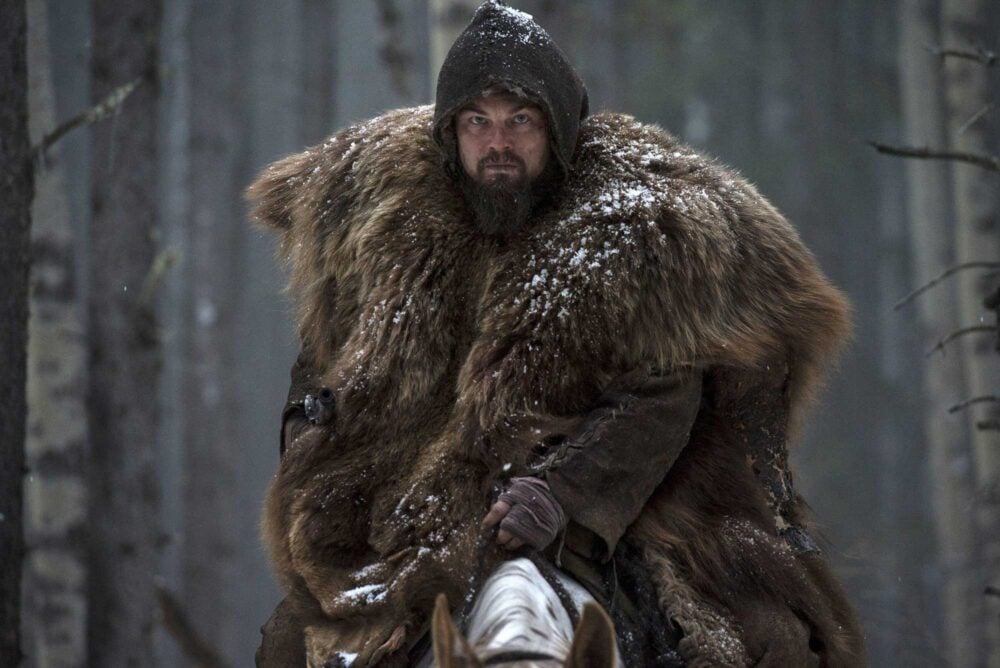
JW: Well, Iñárritu is an artist. He’s the Picasso of all the directors working right now. Working on The Revenant was interesting. That bearskin coat? I had to take out a fur trading license in Canada, and then I had to bid on the skins from the parks department as they only cull two bears a year, and I needed two of them. They cost around 11 grand a piece. I had this buffalo skin at my house so I started playing with it. The only way you could take the skin with you for warmth was to slit a hole in it, and put it over your head. So I had my concept artist do a drawing of that. I sent it to Alejandro and he said, ‘No, Jacqueline, it’s a poncho. I’m Mexican. No ponchos in my movie.’ So we’re camera-testing Leo [DiCaprio], and Leo said, ‘This has to be like this, Alejandro. This is the only way you can wear this.’ So that’s the story of the bearskin.
AP: Is there another costume that made an impression on you.
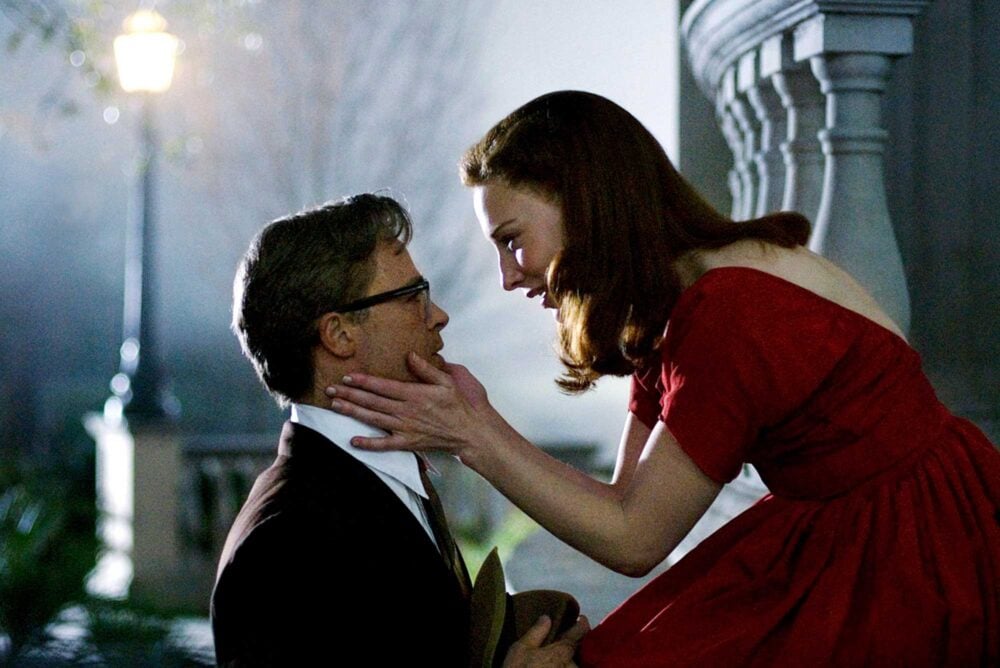
JW: The Marquis de Sade suit [from Quills], all written in blood, was one of my first big challenges ever in my career. I did it with Jane Clive. We tried real cow blood that I got from a butcher, and finally she came up with a concoction of acrylics that looked like blood, because blood turns black when it dries. It had to look like blood. And ageing it. He had to have been in it for 25 years. We’d sit and drink wine, and throw wine at it in the studio! And another iconic costume for me was Cate’s red dress in Benjamin Button. It was inspired by ballerina Tanaquil Le Clercq, who always wore Claire McCardell, and she always wore red. My assistant brings me this red dress. And it was Claire McCardell. I put it on Cate in the fitting, and I show David [Fincher]. And David said, ‘No red in any of my movies.’ But Cate was married to that dress. She wears the red dress into his office, and she said, ‘David, never having worn a red dress, you don’t understand its power. This dress has to be red.’ So David said I could have one red dress in any of his movies.
AP: Can we talk a little bit about what’s to come with Dune: Part Three and Digger?
JW: I was in London with Digger and in Budapest with Dune at the same time. Producer Mary Parent ensured I could do both. For me, Digger was like Citizen Kane, and Dune: Part Three… it really was like a whole new experience. It’s 20 years in the future, so I had to rethink the whole thing – a new still suit, everything had to be different and new. So it was quite an undertaking. I set up an airplane hangar at Origo, and we made it all in-house. Denis started reading these books when he was 12, and he’s so passionate about it. I knew I had to be true to him and Frank Herbert at the same time. So I really did put a lot of thought into it.
AP: What advice would you give to a young person that is aspiring to be a director?
JW: Watch as many foreign films as you can, all of Tarkovsky, all of Truffaut, Fellini… Francis Ford Coppola is an old friend of Alice and mine, and he used to eat at Chez Panisse every other night. It became a film salon. Truffaut would shop in my store, because his daughter went to Berkeley. He had lunch with Kurosawa at Alice’s restaurant – everybody went to that restaurant. I tell people to watch movies, to read as much as they can – and to travel, because it stimulates your imagination. Agatha Christie, whom I’m obsessed with, said that children should scare themselves to be creative. People are relying on computers to do their thinking, and they quit thinking on their own.
Words by ARIANNE PHILLIPS
As told to JANE CROWTHER
Digger is in cinemas now
Dune: Part Three is in cinemas
18 December
Dune: Part Three, Killers of the Flower Moon, The Curious Case of Benjamin Button, The Social Network, The Tree of Life, The Revenant, Argo