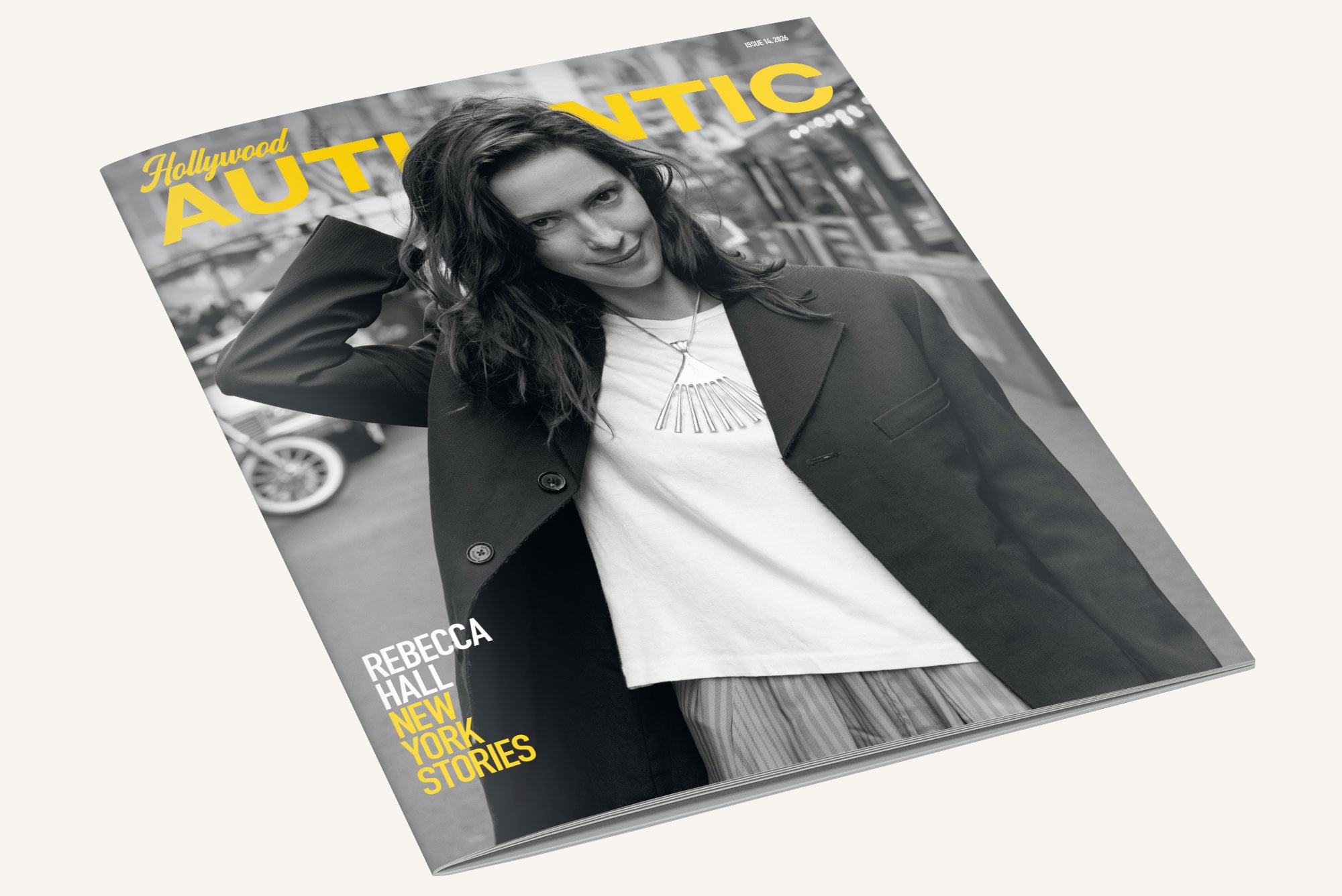
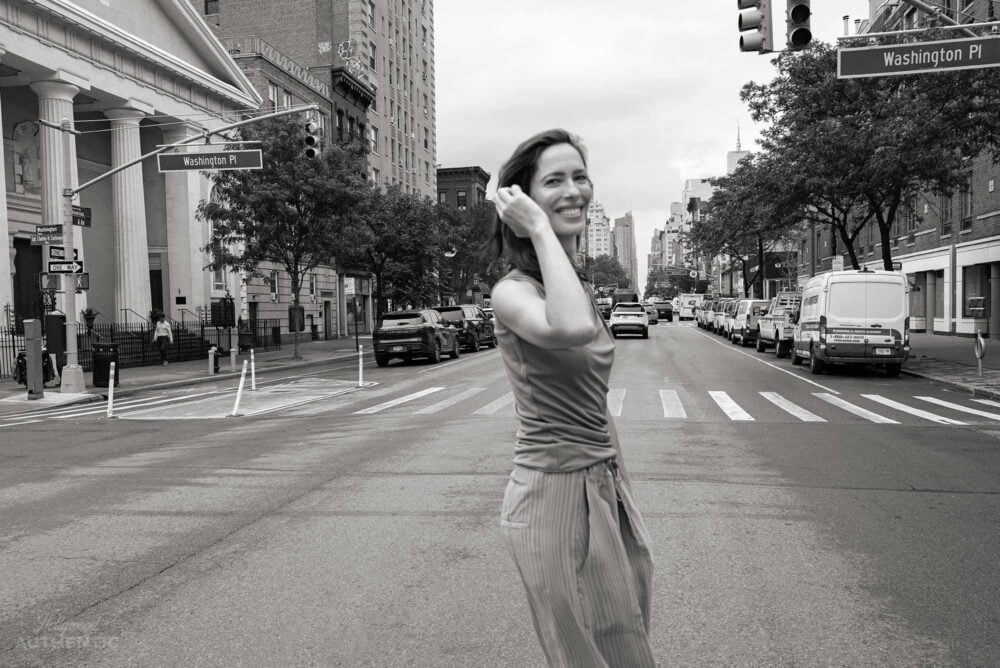
When I was preparing to shoot Rebecca Hall in New York for this issue’s cover story, I asked my friend, and Rebecca’s recent co-star in The End of It, Noomi Rapace, to describe the actor. Her response was immediate. ‘Rebecca is one of the kindest, most classy, gentle, fun actresses I’ve ever worked with,’ she said in a voice note. ‘She’s a brilliant leader on set, I will do anything with her, go anywhere with her. She has such a balance between an ocean of wisdom and something really childlike, naive and playful.’ I found this to be entirely true when I flew to NY to hang out in Washington Square, ride the subway and grab a bite to eat in a Greenwich Village Thai diner with Rebecca in July. As the daughter of a theatre director and an opera singer, she was taught not to take on projects for their commercial appeal and to pursue art for the joy it brings her personally. As we discussed her acting career, her recent art exhibition, her directing and the three scripts she currently has finished on her desk, I felt that she really let me into her real world, life and process. I’d spent time with a multi-disciplined, curious, smart creative who pours herself into everything she does, whether acting, writing, directing or painting. And that was motivational to me.
Rebecca Hall photographed by Greg Williams
Elsewhere in the issue, I made cocktails with Leslie Mann, took in a football game in Como with Damien Lewis, strolled Westminster Bridge with Eve Hewson, hit the Croisette beach with Jay Lycurgo and hung out in Cannes with Diego Calva. And I revisited shooting Matt Damon nearly 30 years ago on-set of The Talented Mr Ripley where The Odyssey actor was contemplating Homeric verse even then, in a moment that now seems like pure kismet. Artistic drive and ambition are inspiring to me and this issue is full of both… I hope it inspires you too. Enjoy the issue!
CANNES DISPATCH Photographs by GREG WILLIAMS Interview byJANE CROWTHER
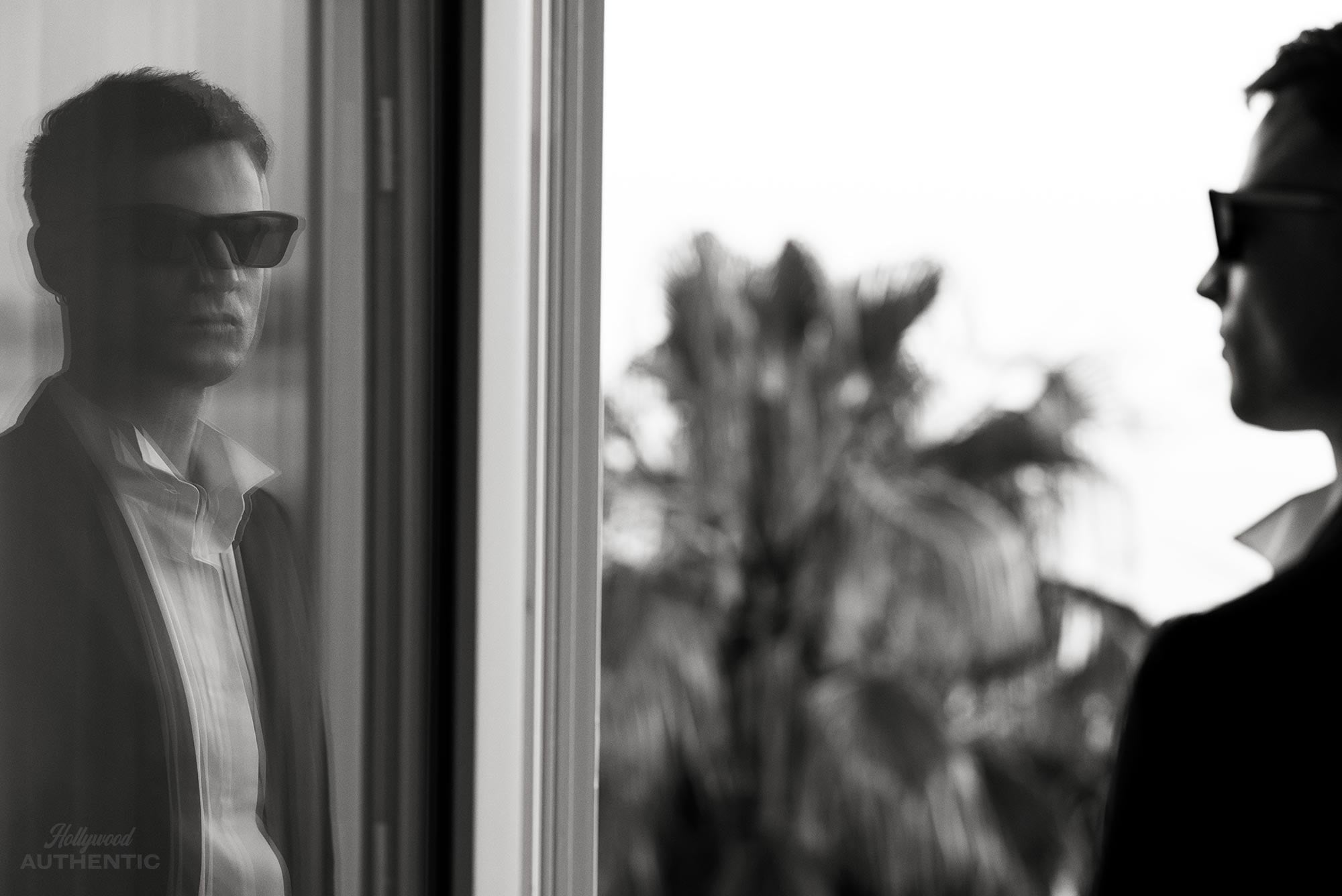
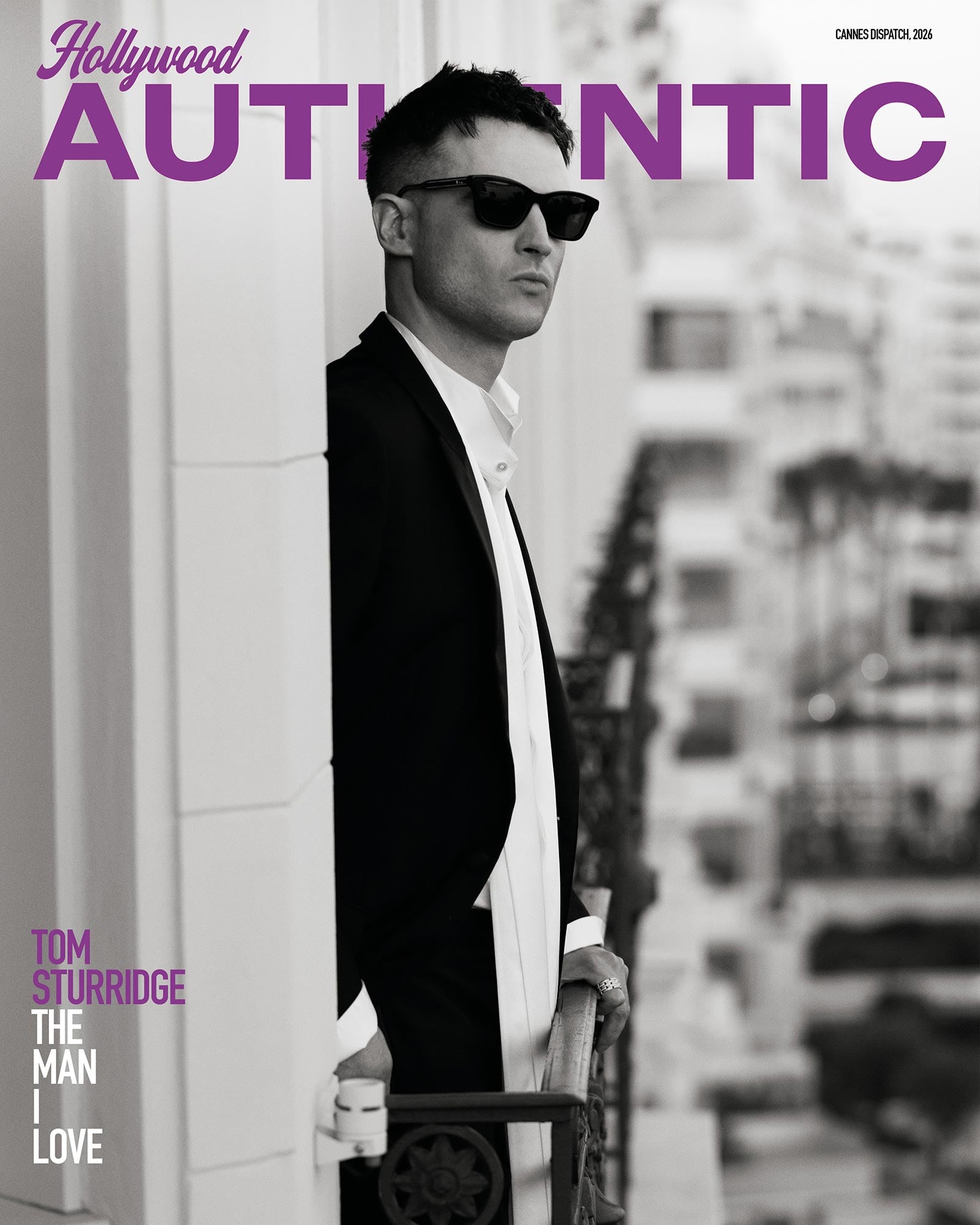
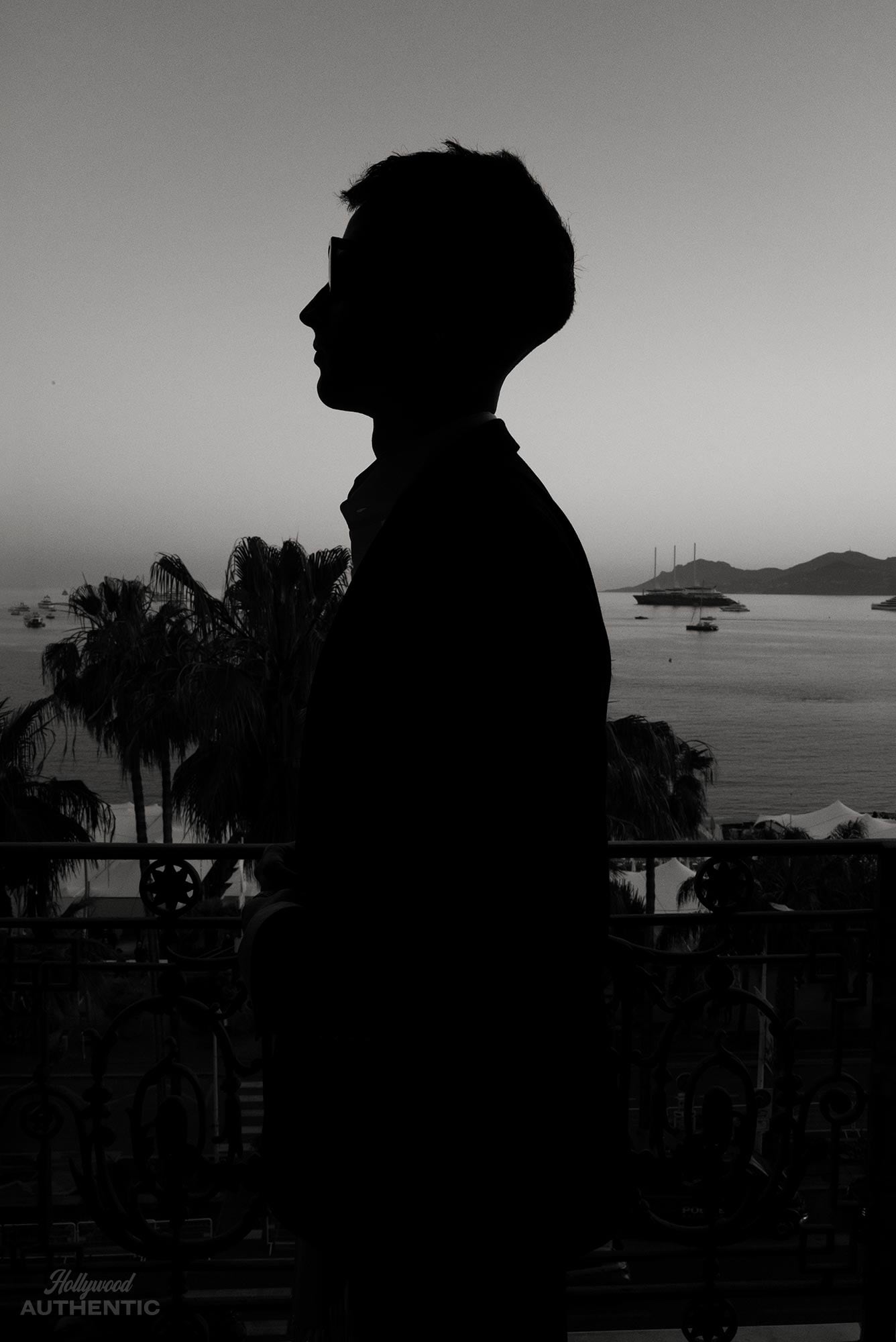
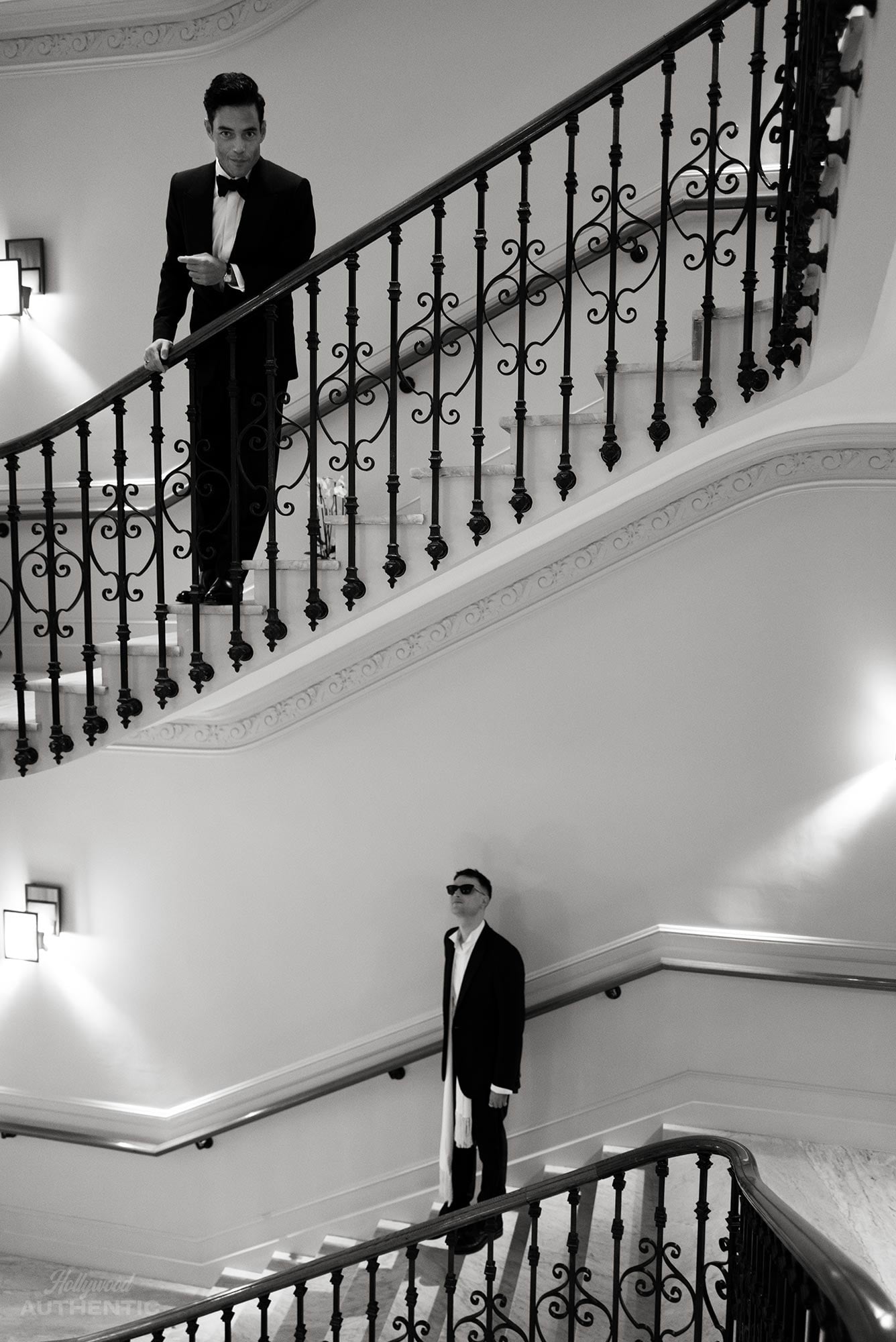
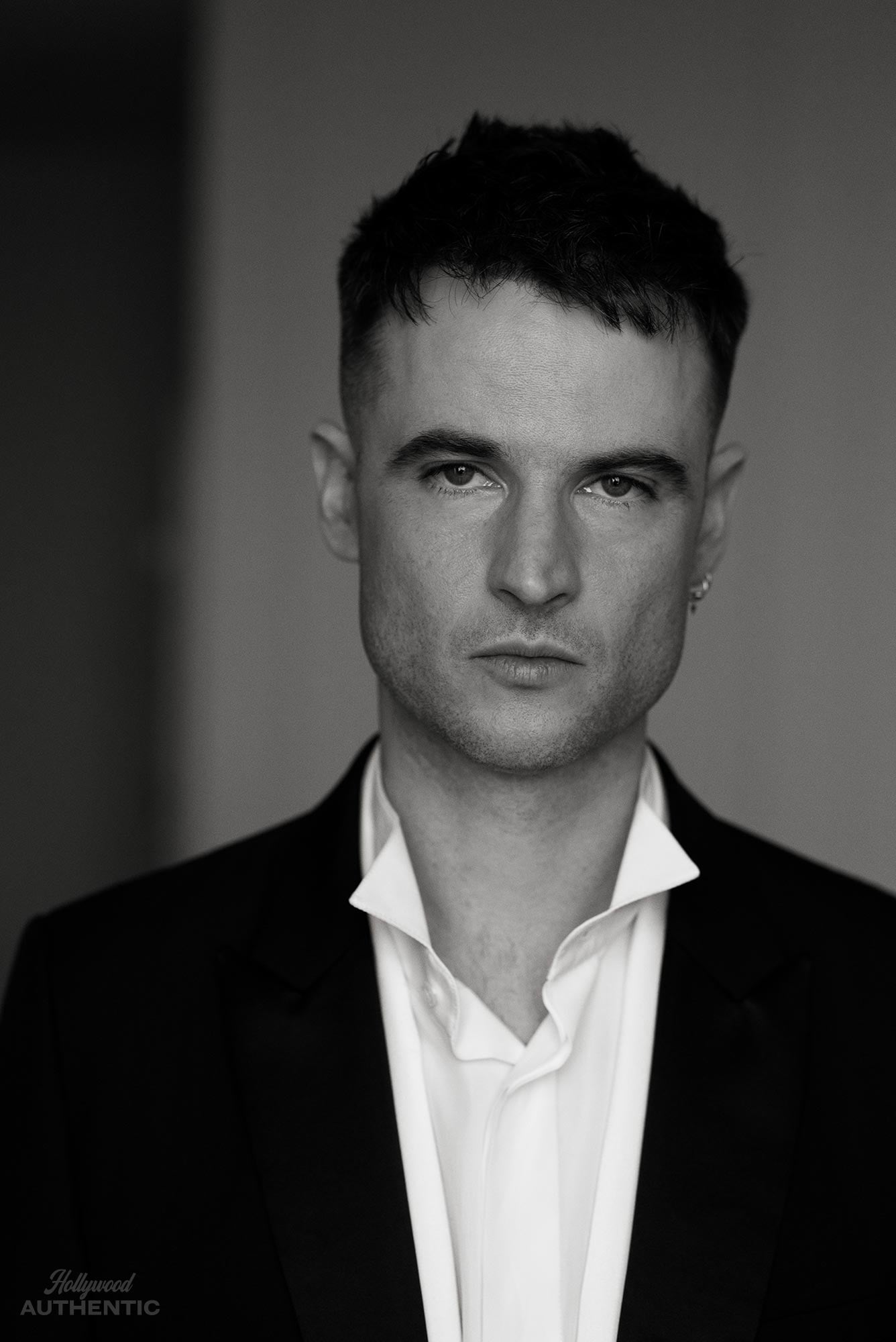
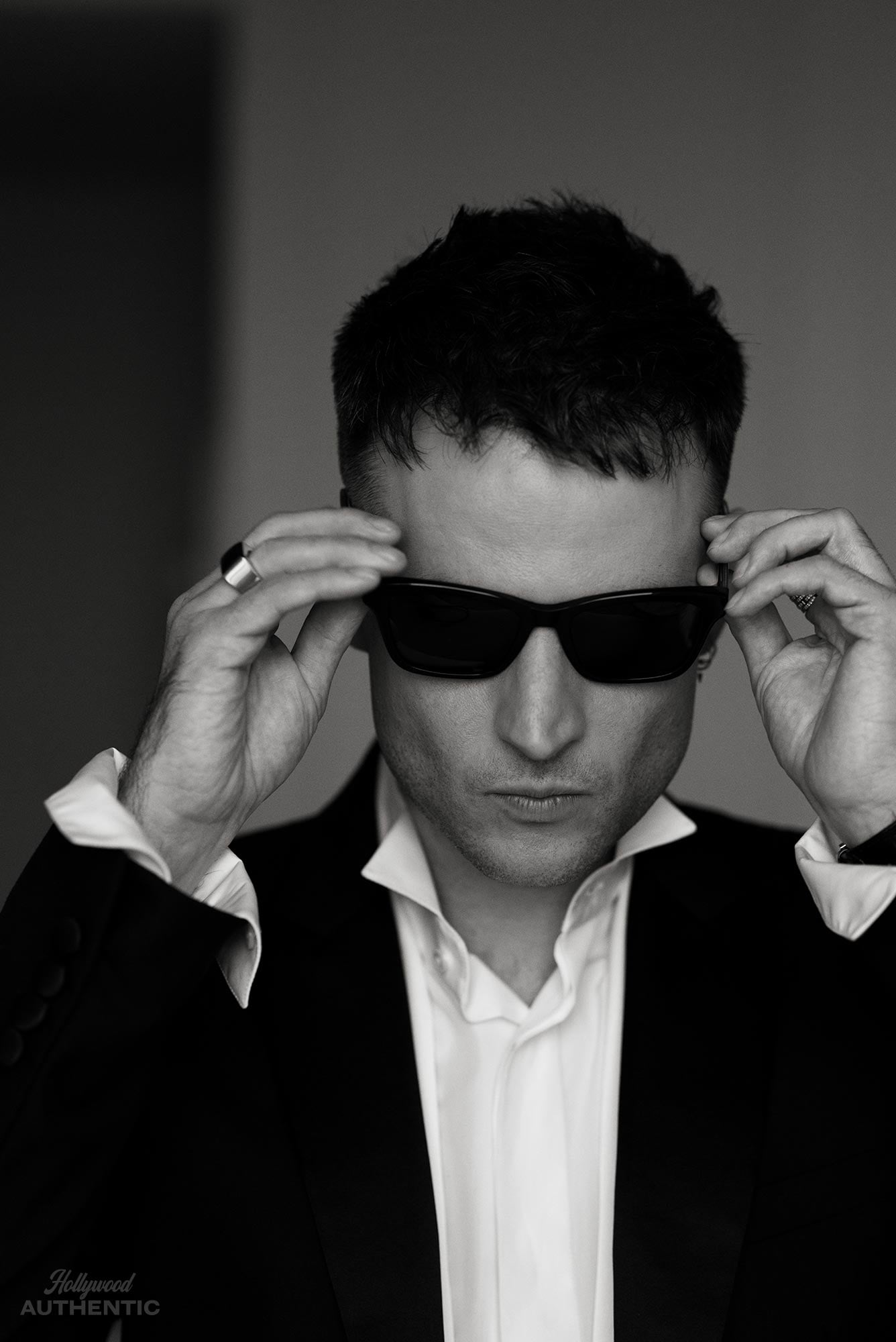
When Greg Williams photographs Tom Sturridge in his Cannes hotel suite just before he walks the red carpet for the premiere of his latest project, Ira Sachs’ The Man I Love, he admits to feeling a little nervous. Not because this is his first time at Cannes but because he would be seeing his film for the first time in the Lumiere Theatre at the Palais. There’s a certain trepidation in that, watching your work with an audience, both discovering it for the first time. ‘The thing that was most special was the room itself – the warmth,’ Sturridge says when Hollywood Authentic catches up with him a few days later. The film received an eight-minute standing ovation and was subject to rapturous reviews. ‘I’ve done that room a couple of times, and it was the most love I’ve ever felt for a film – in my experience. I do prefer, in general, not to watch, but I think when you’re in competition in Cannes, it’s kind of rude not to.’ In Sachs’ period piece, he plays Dennis, the partner of HIV-positive actor Jimmy George (Rami Malek) in Reagan-era New York. As Jimmy voraciously devours life in order to stave off death, Dennis quietly and gently cares for him, ensuring he takes his meds, bathing him, forgiving him. It’s a study of a relationship that lives between the words, Sturridge conveying a long romance through tender glance and touch.
‘My role in it aside, it’s a special piece of work,’ the British actor says bashfully, still discovering how to discuss the film having only just seen it. ‘I think it’s beautiful. What surprised me the most was how it allowed you into that world, that time of New York in 1989, and was so absorbing, tangible.’ He recalls seeing a key scene with Jimmy walking through a club, encountering different characters and essentially a lost world. ‘I became overwhelmingly moved by these extraordinary humans who were the coolest, cleverest, most creative, most brave… And just knowing that we lost so many of them, those humans, just dancing in the club.’
The film is low-key in its period styling, specific in tone. Achieved, Sturridge says, from Sachs’ methodology as the cast began preparing. ‘It began with his personal stories. He shared with all of us his recollections of when he first moved to New York. And then, beyond that, he would very organically send pieces of cinema, literature, documentaries, images or weird clips on YouTube. He would make us watch a lot of films that had no literal connection to our story. It was films by Chantal Akerman, Maurice Pialat and Cassavetes, which were much more about trying to suggest a kind of cinematic grammar that he was aiming for. That was profoundly helpful in accessing the sort of truth that he was looking for, in a surprising way, because it wasn’t through an obvious lens.’
He namechecks books Borrowed Time by Paul Monette and Dancer from the Dance by Andrew Holleran, as well as documentary How to Survive a Plague by David France, all of which were useful in his pre-production prep. But essential to creating the specific vibe of the project was the trust developed between director and cast. ‘An actor’s relationship with a director is always about trust. Ira is someone who doesn’t like to talk much – or really at all – about the text of the script, or the character. When you’re doing lighting setups before you’re shooting a scene – it’s very normal for actors to run the scene. Ira is allergic to hearing his lines spoken before the camera is rolling. He very much wants everything to be discovered in the moment. That requires a profound amount of faith.’ That faith goes both ways. Without traditional rehearsal time, Sachs had to trust his actors to deliver. ‘Absolutely. This was very much an independent film. We did not have months and months to shoot. If he didn’t get what he wanted; if something magical didn’t happen in those eight minutes, then he was going to be in trouble. But weirdly, it releases a lot of freedom. Feeling the faith from him was very liberating. But most specifically, I knew that I would never leave the scene without him getting what he wanted. Despite all of the ephemeral preparation, and not knowing what you were going to do in the moment – he’s very rigorous and precise once the camera is rolling about getting what he wants. So the combination of that rigour and that freedom was intoxicating.’
In order to create a tangible sense of a lived-in relationship with Malek Sturridge connected with the actor beforehand to find an intimacy that translated onscreen. ‘We met a few months before we started shooting, not really talking about the project itself, but just being aware that when you’re portraying people who have loved each other for many years, there is a level of intimacy that you can’t really conjure in the moment. We do have to have an idea of how we’re going to physically communicate with each other. We just spent a lot of time together learning how our bodies work, and move, and finding a kind of physical language.’ The result is an unspoken connection, one that is incredibly evident in a moving scene in which Dennis lovingly bathes Jimmy in a tub. No words are spoken but feelings and stories are told in each gentle caress. ‘I think a performance always sounds stupid when spoken about,’ Sturridge says. ‘But we shot that scene towards the end of the shoot. Whatever subliminal work we’d done up to that point, was allowed to be articulated. Ira put the camera in the room, closed the door, and left us for a long, long, long time. There’s certainly a version of that scene that’s about three hours long.’
Like The Man I Love, Sturridge is drawn to projects by their directors and his next two gigs are dream jobs. He has a small role in Mia Hansen-Løve’s If Love Should Die (shooting soon) and worked with Dustin Hoffman on The Revisionist. ‘I think [Hansen-Løve] is one of the greatest filmmakers of any generation, let alone her own. I was fortunate enough to meet her a couple of years ago, and I just basically said, ‘I will make the coffee for you’.’ Working with Hoffman was an education he says as a fan of his career, particularly The Graduate and Midnight Cowboy. ‘He has gifted the world some of the most extraordinary cinematic performances ever. When you have the chance to be in a chamber piece and play the violin with the greatest violinist, it’s too bizarre an opportunity to pass up. He’s someone who just has absolute freedom in the way he performs. He’ll do the scene as written, and then he’ll do the scene absolutely as not written, and then he’ll do the scene in German, and then he’ll do the scene as a lion. He has endless imagination. He’s constantly testing you and pushing you, and trying to drag you into a reality, rather than sitting in the page. For someone of his maturity it’s extraordinarily alive – far beyond anyone I have ever worked with. He’s just constantly filled with ideas and effervescent life.’ So is Sturridge’s goal to be as curious as Hoffman while still working in his eighties? ‘Yeah, absolutely. I still want to care the way he does. He could easily just be putting his feet up now, but he doesn’t want to. Not in a dissimilar way to the story of our film – he needs to create to live.’
Photographs by GREG WILLIAMS Interview by JANE CROWTHER Styling by ROSE FORDE Grooming by ALEXIS DAY The Man I Love premiered at the 79th Cannes Film Festival