

Words by JANE CROWTHER


Having pretended to be a murderer in Richard Linklaker’s breezy romp, Hit Man, Glen Powell takes to offing people for real in this loose remake of the Alec Guinness starrer Kind Hearts and Coronets – with mixed results. Telling his tale from the clink, Becket (Powell) relays all the ways in which he crawled his way closer to a family inheritance, denied to him by his mom being unceremoniously disowned by her unyielding dad (Ed Harris). 

Glen Powell, Ed Harris, Margaret Qualley, Rafferty Law, Topher Grace
Ilze Kitshoff/StudioCanal

The Redfellows are an American East Coast dynasty of huge wealth and influence, Becket a long-lost impoverished relative consigned to New Jersey who suddenly pitches up at the family pile as ‘accidents’ start to happen. Straight out the gate, audiences are asked to accept that this is a universe where no one asks questions about the motivation of a mysterious family member who appears at funerals, inveigles his way into his cousin’s stock market firm and is slowly creeping up the family ladder to a multi-million dollar windfall. A hefty suspension of disbelief is required, despite the real-world tone of proceedings.
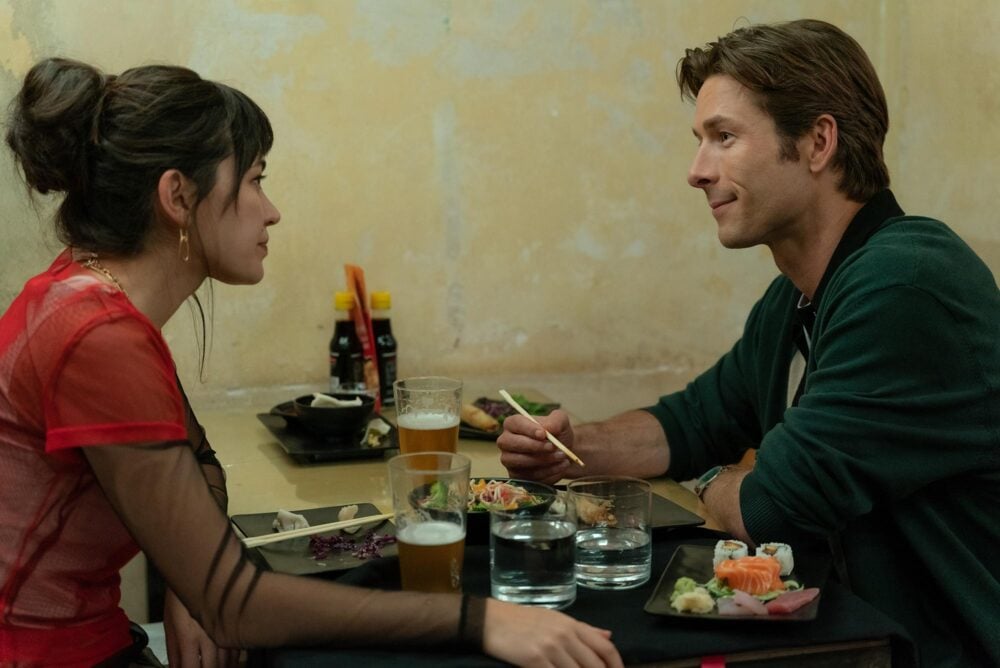
Glen Powell, Ed Harris, Margaret Qualley, Rafferty Law, Topher Grace
Ilze Kitshoff/StudioCanal

Get past the first killing – of Rafferty Law’s party boy financier – and spending time with Becket is an amusing distraction as he pines for a rich-bitch childhood friend (Margaret Qualley in conspicuous Chanel and channelling ’40s femme fatales), smartens up, has a minor crisis of conscience and thinks up wild ways to permanently relegate his relatives, most of which wouldn’t past muster with CSI. There’s the manner of dispatch of a pretentious, entitled wannabe artist, of a spa-loving matriarch, of a TV evangelist… all in service to getting to the big fish, Harris’ unhinged Whitelaw Redfellow. Snuffing out people in his family tree is framed as justified and comical simply by virtue of them being rich, so no real time is spent on their characterisation or Becket’s morality. It’s a step-change from the complicated money troubles and desperation that breeds illegality in writer/director John Patton Ford’s excellent precursor Emily the Criminal.

Glen Powell, Ed Harris, Margaret Qualley, Rafferty Law, Topher Grace
Ilze Kitshoff/StudioCanal

Of course there’s a reckoning of sorts, but one so signposted that audiences might expect a double bluff, and once the credits roll How to Make a Killing will either prompt questions of logic which will collapse it like a house of cards, or never be thought of again. But in the moment, Powell floats the action along with considerable charm, providing a 100-minute diversion from reality that is entertaining enough.

Glen Powell, Ed Harris, Margaret Qualley, Rafferty Law, Topher Grace
Ilze Kitshoff/StudioCanal

Words by JANE CROWTHER
Pictures courtesy of StudioCanal
How to Make a Killing is in cinemas now

May 25, 2024

demi moore, dennis quaid, the substance, coralie fargeat, cannes
hollywood authentic, cannes dispatch, cannes film festival, greg williams, hollywood authentic
demi moore, the substance, coralie fargeat, cannes, hollywood authentic cover

CANNES DISPATCH 13 …
Words by JANE CROWTHER
Photographs by GREG WILLIAMS


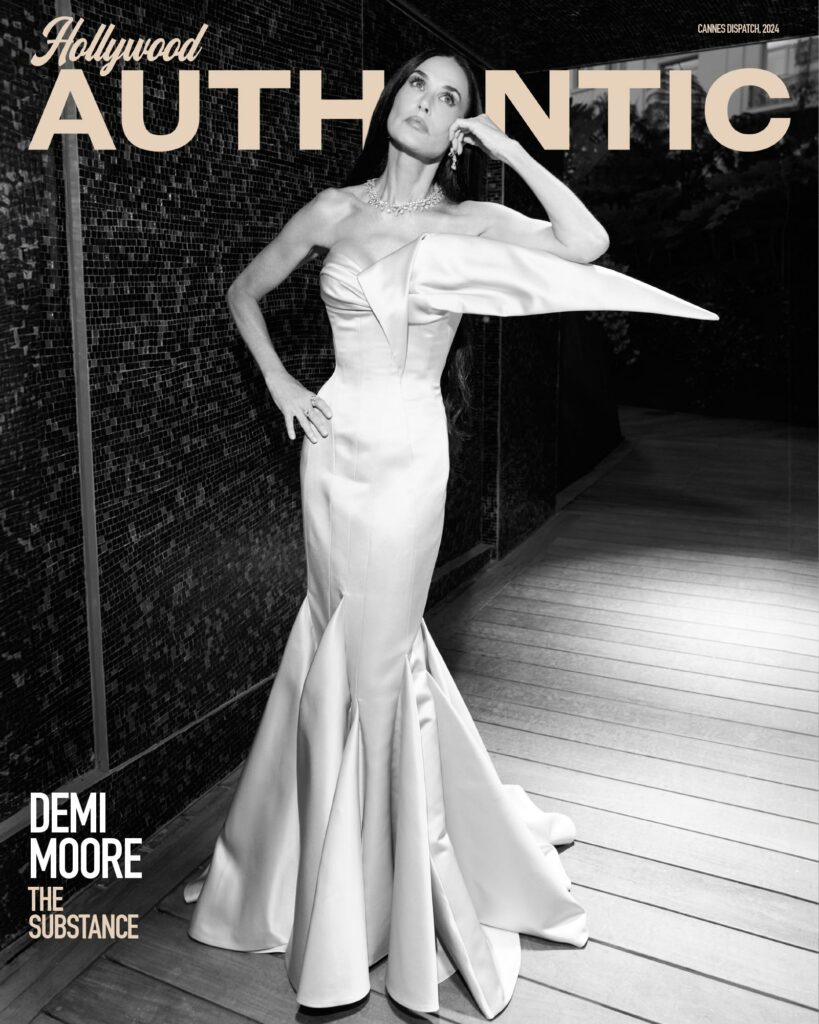
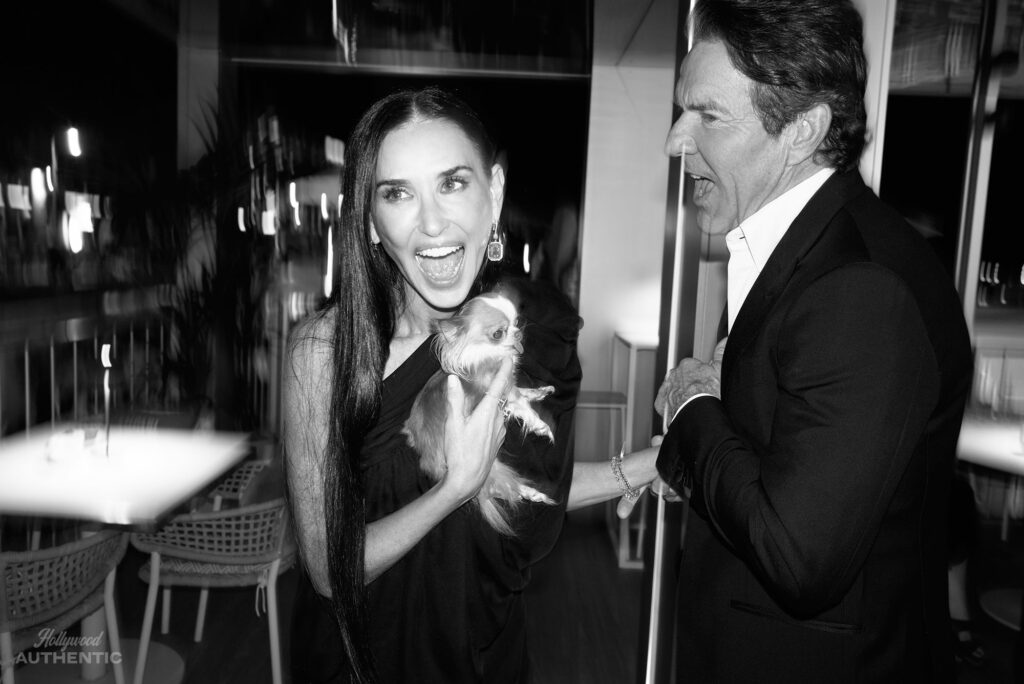
The last time Demi Moore graced the Cannes famous red steps she was a guest at the opening night film of 1997’s festival, The Fifth Element. This year she’s back for her first premiere in her own right, a blistering turn in Coralie Fargeat’s feminist body-horror The Substance. And with her tiny 1.5lb Chihuahua (and Insta star), Pilaf.

She admitted to ‘nervous butterflies excitement’ before walking the carpet dressed in showstopping Schiaparelli haute couture as Greg Williams shot her in her hotel on Cannes’ famous Croisette. The film requires Moore to be vulnerable both physically and emotionally as it charts a movie star who is sacked for being too old and seeking redemption in the form of a shady procedure called The Substance that promises a ‘younger, more beautiful, more perfect you’. That version of herself is ‘born’ from her own body (a truly horrific sequence) as Margaret Qualley, and the two alter-egos duel for supremacy in a misogynist world that values youth and beauty over all else. The role requires a lack of vanity from Moore via full frontal nudity and unflattering lighting, as her character grapples with mortality and external validation. ‘It’s about the male perspective of the idealised women that we have bought into,’ she says.

demi moore, dennis quaid, the substance, coralie fargeat, cannes
demi moore, the substance, coralie fargeat, cannes

‘I saw it as a challenge in the best way,’ Moore reflects on taking the project. ‘I look for material that pushes me out of my comfort zone – if something scares me a little bit then I know there’s an opportunity… that on the other side I would come out it a better person.’ The nudity needed was something that wasn’t shied away from in initial discussions. ‘It was spelled out, the level of vulnerability and rawness that was required to tell this story. It was a very vulnerable experience and it required going into it with a lot of sensitivity and finding that common ground of mutual trust.’

In Qualley, Moore says, she found a ‘great partner who I felt very safe with’. ‘We obviously were quite close in certain moments, naked! It allowed us a lot of levity in those moments at how absurd those situations were.’

The film received a standing ovation at its premiere and rave reviews from the press who praised the profundity and prescience of its subject matter – alongside gleeful squirts of blood, icky injections and some thrillingly gross body horror to challenge Cronenberg. ‘There has been a wake-up to a demographic that is deserving of being served,’ Moore says of the film’s Feminist slant. ‘You’re starting to see a lot more stories that are reflecting that audience and it’s nice!’ That’s not to say the movie is male-bashing. ‘We’re not anti-men – we’re just anti-jerks.’

The performance heralds a return to cinema for Moore after an absence and based on audience response in Cannes, marks the start of more to come. As co-star Dennis Quaid commented during the Cannes press conference of experiencing the premiere; ‘I was so glad to be here to see the beginning of an incredible third act for Demi.’


Demi Moore wears Schiaparelli. Necklace and earrings by Chopard
The Substance premiered at the 77th Cannes Film Festival and will be released by MUBI later this year. To see our review out of Cannes click here

Words by JANE CROWTHER


After making an impression with her feminist debut Revenge, writer-director Coralie Fargeat delivers on her promise with a provocative, gory film that sews together All About Eve and David Cronenberg body horror with instant-cult results. It also marks an explosive return to cinema for Demi Moore in a no-holds-barred role that reflects her own vocation and is a female roar against #MeToo, ageism, self-hate and dream factory objectification.

Moore plays Elisabeth Sparkle, an actress whose best years are behind her, her star on the pavement cracked, her career reduced to fitness TV shows. A still beautiful and vital woman with experience and skills, Elisabeth is considered old news by her hideous network boss – a braying, sexist egotist in flashy suits who insists ‘all pretty girls should smile’ and ogles every woman in his vicinity with unvarnished lecherousness and possession (Dennis Quaid). He’s called Harvey, of course. 

Feeling threatened by her industry and buying into its standards of beauty, Elisabeth despairs at her reflection in the mirror, prodding a body that is strong, real and lived in with disgust. Brought low by her perceived lack of value, she’s the perfect candidate for a new off-books treatment called The Substance – a complicated system of injections, liquid nutrition and spinal taps that allows the user to regenerate a new self – one younger, fitter, more beautiful than they are. Eager for the promise of youth Elisabeth injects, giving horrific ‘birth’ (to say more would spoil the treats of this bloody scream of a movie) to ‘Sue’ (Margaret Qualley) a gorgeous creature who Elisabeth can live through as she becomes an instant star and sex symbol. There are naturally rules of the treatment and if they are bent all hell will break loose, and when it does… buckle up.

Viciously funny while also being profound, The Substance taps into the fears and rages of women in and out of the public eye. ‘After 50 it all ends’ is a repeated mantra in a film that explores the perceived physical limitations on female usefulness, the complicity of women living in a society that dictates their attractiveness and the dark side of cosmetic surgery and procedures. Every time a shudder-inducing injection is made we’re reminded of botox, fillers, Ozempic, the normalised pursuit of beauty. Fargeat questions what the monstrous outcome of this might be as Elisabeth suffers for her regime, culminating in a finale that is a magnificent horror.

Qualley is wonderful as the rapacious Sue, a wide-eyed ingénue who will literally step on the sisterhood to get ahead, but the film is Moore’s – elegant, vulnerable, bonkers in a role that requires her to strip naked both physically and emotionally. Must-see cinema with bite that will make viewers question how critically they look at others as well as in the mirror.


Coralie Fargeat’s The Substance starring Demi Moore, Margaret Qualley and Dennis Quaid is in cinemas now