




Words by JANE CROWTHER
David Fincher’s 2010 study of Mark Zuckerberg (Jesse Eisenberg) and his tech-bro MO, The Social Network, explored the genesis of Facebook and Zuckerberg’s dubious but impressive drive. Now writer-director Aaron Sorkin returns to the Silicon Valley well to unpack the repercussions of allowing the digital frontier to evolve unchecked and unpunished when big tech business pushes its product at the expense of users’ mental health, and allows ‘fake news’ to become the new norm. Based on the Wall Street Journal’s 2001 expose of Facebook’s internal workings, Sorkin depicts the real-world result of radicalisation, the endeavours and importance of a free print press to investigate, and the shark-eyed response of a billionaire to data that reveals a moral quandary. As a follow-up to The Social Network it’s necessarily less fun and suffers from the absence of Fincher’s particular style. But as another film that asks an audience how complicit they are in the erosion of democracy, fact-checked and properly-sourced ‘truth’ and free speech (FB censors comments on everything, including free speech posts), it’s a sobering watch.
Beginning with a prologue, Sorkin plops us squarely in a 2019 world where far-right ideology is pedestrian, all ‘facts’ are platformed and society is polarised as a pair of cops pull up to help a broken-down motorist at the side of the road. She is an indignant, drunk, racist ‘Karen’ (Portia Doubleday) who live-streams her bigotry and MAGA politics. And she’s also the nucleus for Facebook data scientist Frances Haugen (Mikey Madison, in her first post-Oscar role) to begin to question the company she works for when content like this is not only allowed, but promoted by intentional algorithms. Haugen may be dismissed at work for raising concerns but she’s smart as a whip and talks like Rosalind Russell. She’s soon connecting to WSJ investigative reporter Jeff Horwitz (Jeremy Allen White) to facilitate a covert whistleblower takedown. Haugen is a movie ‘nerd’ who spouts the facts, Horwitz a technophobe and audience surrogate who parses it down into layman’s understandable terms.
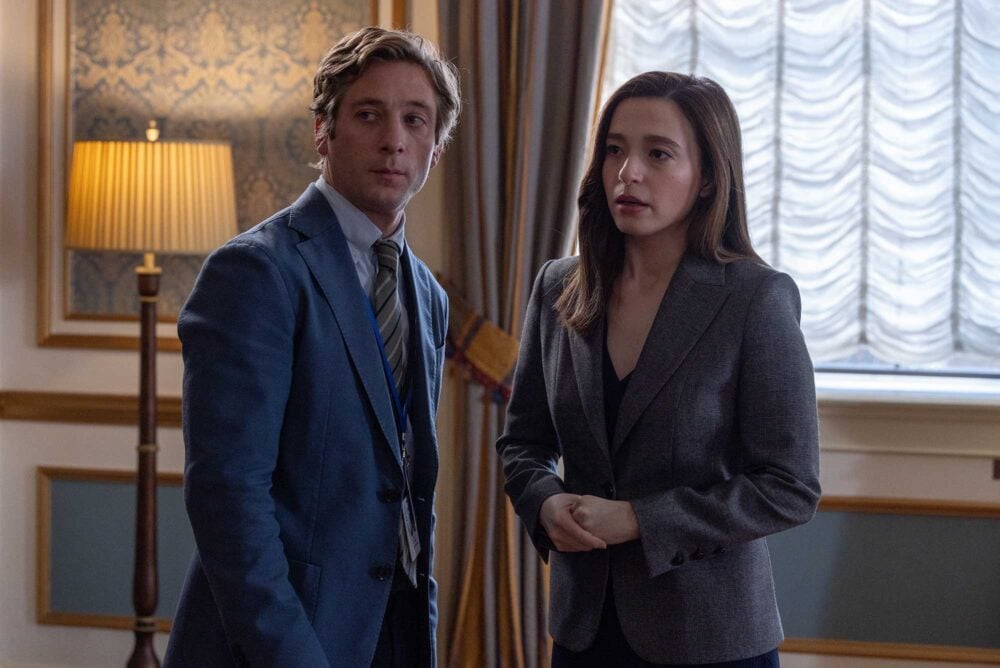
This is the meat of the film, with Sorkin (like Danny Boyle’s Ink) championing the disappearing need and skill of journalism and the importance of the print press in a Wild West culture. Horwitz is needled by a snarky bureau chief (a scene-stealing Betty Gilpin), writes long-hand in legal pads and shows his work in the way he approaches his source in ensuring he moves within the law. He and Haugen have a flirty, adversarial relationship (though did she really wear slinky evening wear to his hotel room as a cover for their meetings so that she could be perceived to be on a date should she see a work colleague?) and there’s much to enjoy in the banter and frisson created by White and Madison. As they pore over laptops and meet in rainy redwoods, the timeline toggles between the investigation and the resulting media fallout for Zuckerberg and Haugen’s 2021 Senate committee testimony.
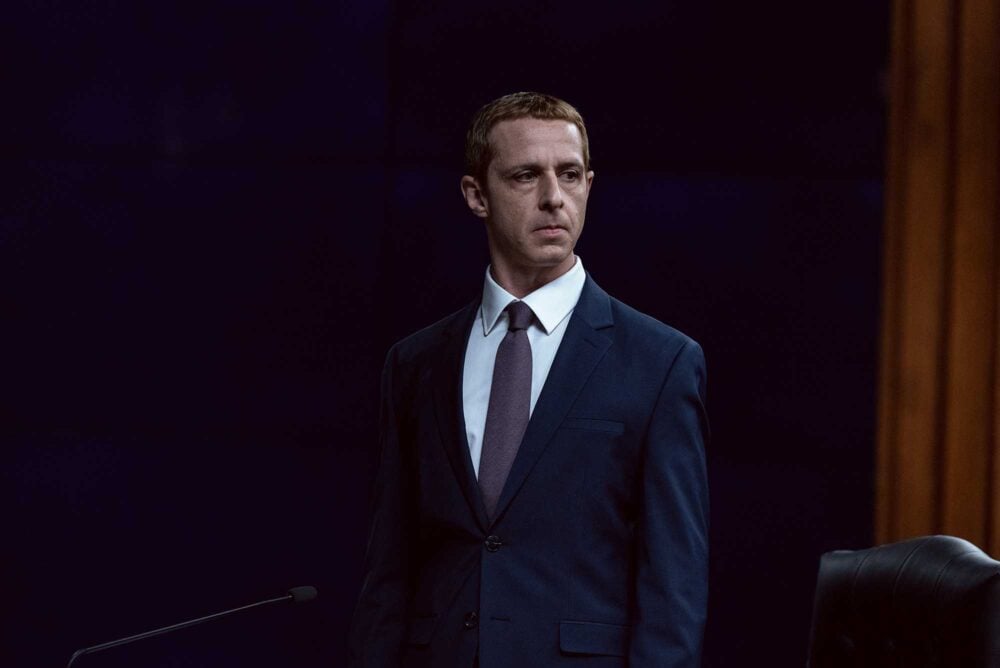
The side dish then, is Zuckerberg, now played by Jeremy Strong as a stiff psychopath with robotic deportment, zero charisma and a pathological devotion to ‘free speech absolutism’. Teased towards an outward appearance of humanity by his crisis management expert (Wumni Osaku) in the wake of exposé, he’s little more than a caricature and ‘Big Bad’. As with Facebook itself, there is little nuance, or interest in getting to the root of who Zuckerberg has truly become after his initial college dorm brilliance/ruthlessness. That will likely make the whole endeavour easier to dismiss by those Sorkin seeks to challenge. As a narrative that champions those who risk everything to do the right thing, it’s a curiously old-fashioned but engaging entertainment.
Words by JANE CROWTHER
Images courtesy of SONY PICTURES ENTERTAINMENT INC.
The Social Reckoning is in cinemas now